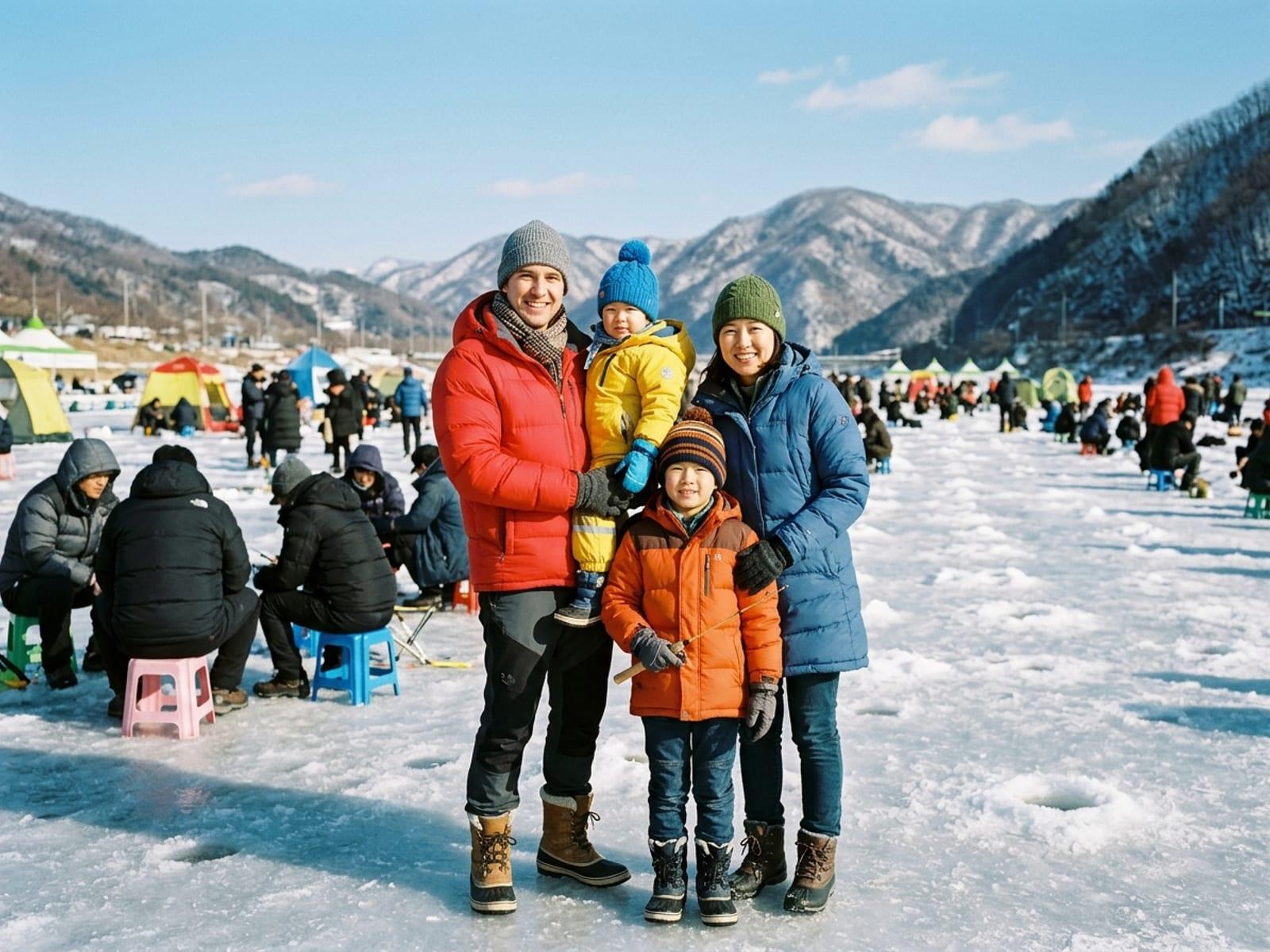
The Hwacheon Sancheoneo Ice Festival runs for about three weeks, mostly in January, on the frozen Hwacheoncheon stream in Hwacheon County, Gangwon Province, in northeastern Korea (in 2026, January 10 to February 1). Ice fishing for sancheoneo, a river-dwelling cherry salmon, through holes in the ice is the main event, with sledding and ice sculptures alongside. If your children are old enough to hold a fishing rod, it's well worth the trip, but half the day is a contest with the cold: warm clothing and arriving at opening time on a weekday matter most.
Thousands of small holes are drilled across the thick ice, and families sit beside them with short rods, waiting for a bite. It's one of the most visited winter festivals in Korea.
A small mountain town that fills up for three winter weeks
Hwacheon County sits in the north of Gangwon Province, about 25 km south of the inter-Korean border and about 90 km northeast of Seoul. It's a mountain town of a little over 20,000 people. The festival started in 2003, and in 2010 the Ministry of Culture, Sports and Tourism named it the best festival in the country. In 2025 it drew more than 1.86 million visitors, a new record, including 122,000 from abroad. With more foreign visitors coming, the site now has fishing areas and rest areas set aside just for them, which takes some of the stress out of a first visit.
The sancheoneo itself is the landlocked form of the masu salmon, which spends its whole life in rivers instead of going out to sea. It lives only in cold, clean water. Most of the fish released into the river are farmed. According to Stars and Stripes, the magazine for the US military community in Korea, about 90 percent are raised at 16 fish farms around the country, and some travel more than 200 km alive to get there.
The 2026 festival ran for 23 days, from January 10 to February 1. The 2027 dates had not been announced at the time of writing. The county is also reviewing its prices. Reports describe a plan to raise the adult experience fee from 15,000 won to around 25,000 won, while increasing the amount returned as vouchers for local farm produce or regional gift certificates from 5,000 won to 15,000 won (still under discussion as of October 2026). Check fees and dates on the official website before you go.
Ice fishing, or catching trout by hand
The heart of the festival is ice fishing through holes cut in the thick ice. The rods are short and the rigs are simple, so a primary-school child can manage alone with a little help from an adult. Whether anything bites is down to luck, though, and you can go 30 minutes or more without a nibble. Be ready to switch to the sleds the moment the kids lose interest, and everyone stays in a better mood.
The other big draw is bare-hand fishing: you step into a pen of icy water and grab the fish with your hands. The organizers bill it as something you "can only experience in Hwacheon," and participants are lent waterproof clothing. It's the loudest moment of the festival, with cheers reaching all the way to the spectator seats. Still, this means putting your hands and feet into midwinter water. Decide whether your child takes part based on age and how they're feeling that day, and check the conditions for joining at the site.
You can take your catch to the grilling area to have it salt-grilled, or have it prepared as sashimi. Staff grill the fish and hand it over at a booth with tables; one 2026 tour operator's guide said a kimchi pancake came with it. Eating the fish you pulled out of the ice an hour earlier is the whole point of the day. This is an event built around live fish, so if a child is scared to touch them, don't push. Watching is plenty.
Sleds and ice sculptures between fishing sessions
There's plenty for children beyond fishing. In 2026 the festival had sledding on a 40-meter slope and a 60-meter stretch of frozen river, an "ice bobsleigh" where families slide down a spiral tube together, plus curling and ice soccer.
At the indoor venue, about 30 artisans from Harbin, China, carved the ice sculptures on display. Eolgomi Castle, a collection of snow sculptures, included a replica of the post office at Finland's Santa Claus Village (we cover the original in our Santa Claus Village article). On weekend nights there was also a festival on Seondeung Street, hung with lanterns shaped like sancheoneo. Fish in the morning, then warm up at the indoor exhibits once the cold starts to bite. Doing things in that order keeps children from getting cranky.
Dress for an hour sitting on the ice
Ice fishing means sitting still on a small stool, so you get far colder than you would walking around a city. Wear a down jacket, a hat, a neck warmer and waterproof boots that won't let snow or water in. The cold of the ice comes straight up through your feet, so layer thick socks and bring disposable heat packs, including ones made for shoes. When everyone is chilled through, a warm hotteok or bungeoppang, Korea's winter street-stall snacks, is very welcome.
You'll take your gloves off every time you tie a line or unhook a fish, so a thin pair under a thick pair works well. Even if you skip the bare-hand fishing, pack a full change of clothes in case someone gets wet. For photos, down jackets in red, yellow or bright blue stand out against all that white snow and ice. If you're curious how a family lined up on the frozen river might look, you can try it before the trip with pokesta's AI photos ($1 per photo, and your first one is free).
With kids, go first thing on a weekday morning
On weekends, lines form early at the fishing registration desks and the parking lots fill up fast. If your schedule allows, pick a weekday and aim to arrive when the grounds open, which makes it easier to get a fishing spot. In 2026 the grounds were open 9 a.m. to 6 p.m. on weekdays and 8:30 a.m. to 6 p.m. on weekends, with night fishing sessions too (hours change from year to year).
With a baby or preschooler, it's safer not to plan long stretches on the ice. Strollers are hard to push over snow and ice, so a baby carrier is the better choice. When you arrive, find the toilets and the heated rest areas first. That way a sudden chill or a change of clothes won't send you into a panic.
From Seoul by bus or tour
International visitors usually arrive at Incheon International Airport (ICN). From Seoul, intercity buses to Hwacheon leave from Dong Seoul Bus Terminal, and once you reach Hwacheon's bus terminal, follow the local festival directions to the grounds. During the festival there are also many day-trip tour buses from Seoul, some bundling admission and fishing gear rental. With no transfers to manage, they suit families carrying a lot. Return buses get busy in the late afternoon, so settle on which one you'll take early.
Entry requirements for Korea depend on your nationality, so check your own government's official information and the K-ETA (Korea Electronic Travel Authorization) guidance before you leave. If you're visiting Korea over the autumn holidays instead, see our article on Chuseok.
If you can't decide, ask yourself whether your child could sit on the ice holding a rod for 30 minutes. If the answer is yes, a January in Hwacheon will become a family story you tell for years.
References