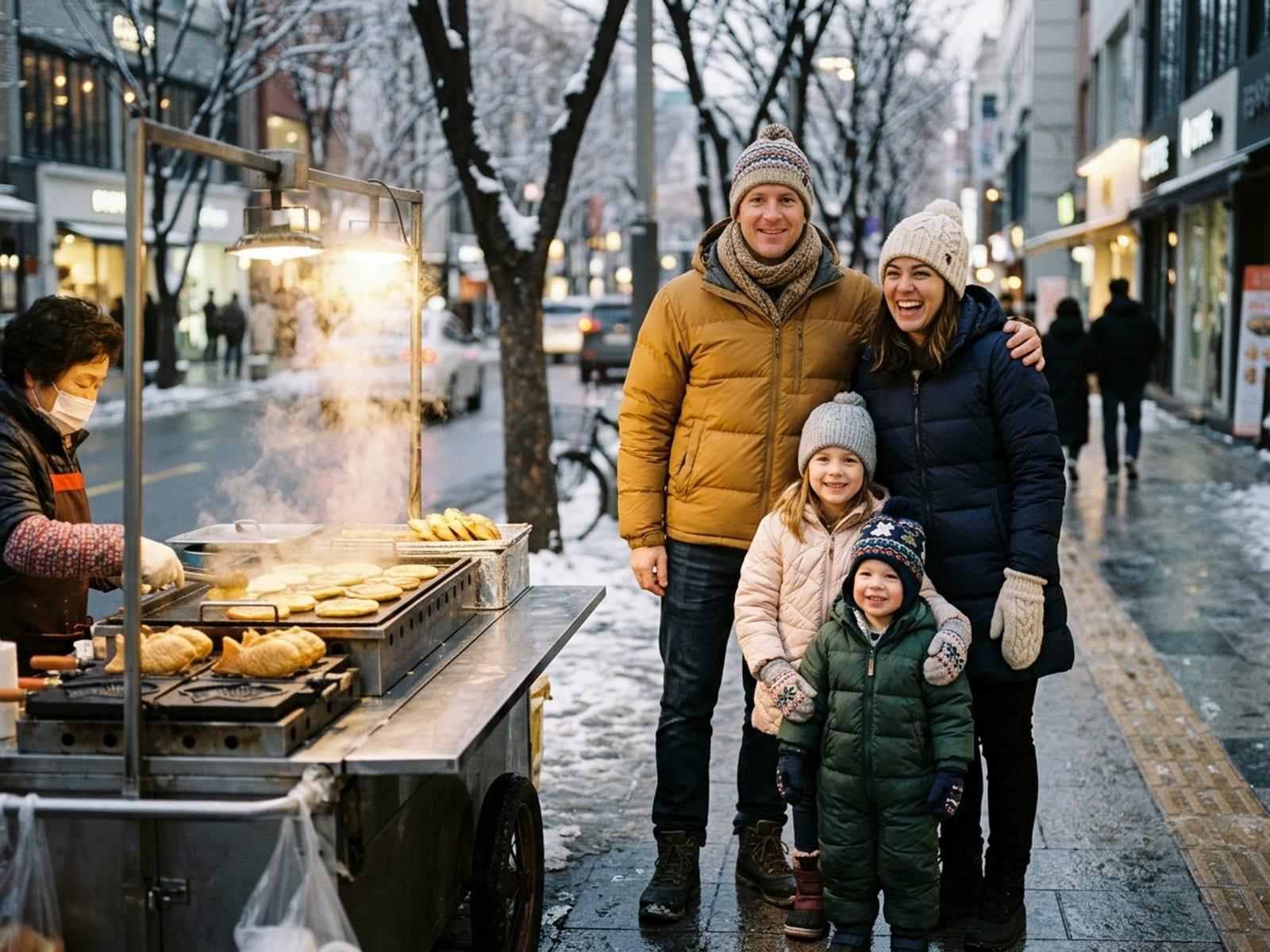
Hotteok (sweet filled pancakes), bungeoppang (fish-shaped pastries) and gyeranppang (egg bread) are Korea's winter street snacks, sold from carts on street corners from around November to February. You'll find them in busy shopping streets and around markets in Seoul and Busan, and all three fit in one hand. With children, watch out for the scalding syrup inside hotteok and for nut and egg allergies.
Once the air turns cold enough to see your breath, hotteok sizzle as they're pressed flat on the griddle, bungeoppang come out of their molds one after another, and gyeranppang arrive topped with a whole egg. You can eat them on the move, and they double as hand warmers on a cold day.
Hotteok: brown sugar syrup oozing from the middle
Hotteok are made from a dough of wheat flour with milk, sugar and yeast, left to rise for a few hours, then wrapped around a sweet filling and fried. The classic filling is brown sugar mixed with honey, chopped peanuts or walnuts, and cinnamon. A ball of dough goes onto an oiled griddle, gets pressed firmly flat with a metal tool that has a handle, and is browned on both sides. By the time it's done, the sugar inside has melted into a runny syrup.
The snack came from China. The "ho" in its name refers to a word used for foreign, northern peoples, and the story goes that Qing merchants who came to Korea in the late 19th century, in the wake of the Imo Incident of 1882, opened shops and began selling it. There are many more kinds now, from green tea dough and corn-filled versions to savory hotteok stuffed with japchae (stir-fried glass noodles).
There is also gonggal hotteok, puffed up and hollow inside, which some carts sell as "bubble hotteok." If you'd like to make them at home, several Korean food companies sell hotteok mixes in supermarkets. Bought at the end of a trip, a box makes for a fun afternoon of cooking with the kids back home.
Koreans sometimes describe a noisy, chaotic scene as being "like a hotteok shop on fire," which tells you how much a part of everyday street life the snack is.
Bungeoppang: fish-shaped pastry filled with red bean
Bungeoppang means "carp bread" (bungeo is the crucian carp). Batter is baked in fish-shaped molds around a filling of sweetened red bean paste. It descends from the Japanese taiyaki and is thought to have arrived in Korea around the 1930s, during the Japanese colonial period. In Korea, the fish changed from a sea bream to a crucian carp.
Its popularity dipped for a time, but a retro boom in the 1990s brought it back into the spotlight. Besides red bean, carts now offer custard cream, sweet potato, chocolate and other fillings. They're small, just right for a child's hand. The English Wikipedia describes the standard size as costing about 1,000 won for two, though prices vary by stall and year. Lately bungeoppang has become so popular that fans have built online maps of where to find the carts.
Gyeranppang: a whole egg on top
Gyeranppang means "egg bread." A fluffy, slightly sweet batter is poured into an oblong mold, a whole egg is cracked on top, and it's baked. You get sweetness and the savory saltiness of egg in one bite, which makes it almost a light meal. It's said to have been sold for the first time in 1984 outside the back gate of Inha University in Incheon, making it a newer arrival than bungeoppang or hotteok. The baking plates have dozens of long hollows in a row, and watching the vendor pour batter and crack egg after egg is enough to keep children glued to the cart. With a whole egg inside, it can stand in for a small breakfast rather than a treat.
Seed hotteok in Nampo-dong, Busan
If you visit Busan, try ssiat hotteok (씨앗호떡), seed hotteok. The wheat dough is paired with sugar-coated sunflower seeds, pumpkin seeds, peanuts and the like, so you get the toasty crunch and the sweetness at the same time. It's known as a specialty of the Kkangtong ("tin can") Night Market in Bupyeong-dong, next door to Nampo-dong.
This is Busan's old downtown, where BIFF Square, developed alongside the Busan International Film Festival that began in 1996, runs into Gukje Market, which grew out of stalls set up by Koreans who came back from Japan, China and elsewhere after liberation in 1945. It's within walking distance of Jagalchi Market too, so a hotteok makes a well-placed snack after lunch at Jagalchi Market.
With kids, watch out for hot syrup
The thing to be most careful about is the syrup inside a hotteok. The outside may feel pleasantly warm while the melted sugar inside is very hot. When you hand a freshly fried one to a child, wait a moment after you get it, and have an adult take a bite first to check the temperature inside. The syrup drips onto hands and clothes easily, so wet wipes come in handy.
Portion size matters too. Hotteok contain plenty of sugar, and one can reach up to about 230 calories. If it's before a meal, splitting one hotteok between an adult and a small child and giving each child a single bungeoppang is about right. It's easy to snack your way through a street and then have no room for dinner.
Allergies need attention as well. The filling of hotteok often contains peanuts or walnuts, and seed hotteok adds a variety of other seeds and nuts. Bungeoppang and gyeranppang contain wheat and egg, and some batters also contain milk. Street carts almost never list ingredients, so if anyone has an allergy, don't take chances; packaged products with an ingredient label are the safer choice.
To order, point and say "igeo hana juseyo" ("One of these, please"). For two, say "du gae"; for three, "se gae." While you wait, watch with the kids as the dough gets pressed and the molds get flipped.
You can eat standing at the cart, but on busy sidewalks, move to the edge with your children before you eat. To see what your family sharing a steaming snack on a cold day might look like in a photo, you can try pokesta's AI-generated photos ($1 per photo, and your first one is free).
Carts multiply from late autumn into winter
Street snack carts become a common sight from around November, as temperatures drop, through about February. You're most likely to find them while walking busy shopping streets and the areas around markets. In Seoul, a snack crawl pairs well with the food stalls of Gwangjang Market, known for mung bean bindaetteok and mini gimbap. Carts don't appear on fixed days, and they come and go with the weather and season, so the best approach is to buy one whenever you happen to spot it.
The main gateways are Incheon International Airport (ICN) for Seoul and Gimhae International Airport (PUS) for Busan. Korean winters are cold, and below-freezing days are common in Seoul, so don't forget hats and gloves for the children. A winter trip to Korea can also take in the Hwacheon Sancheoneo Ice Festival, where people fish through the ice on a frozen river. Entry requirements for South Korea depend on your nationality, so check your own government's official information before you travel.
References