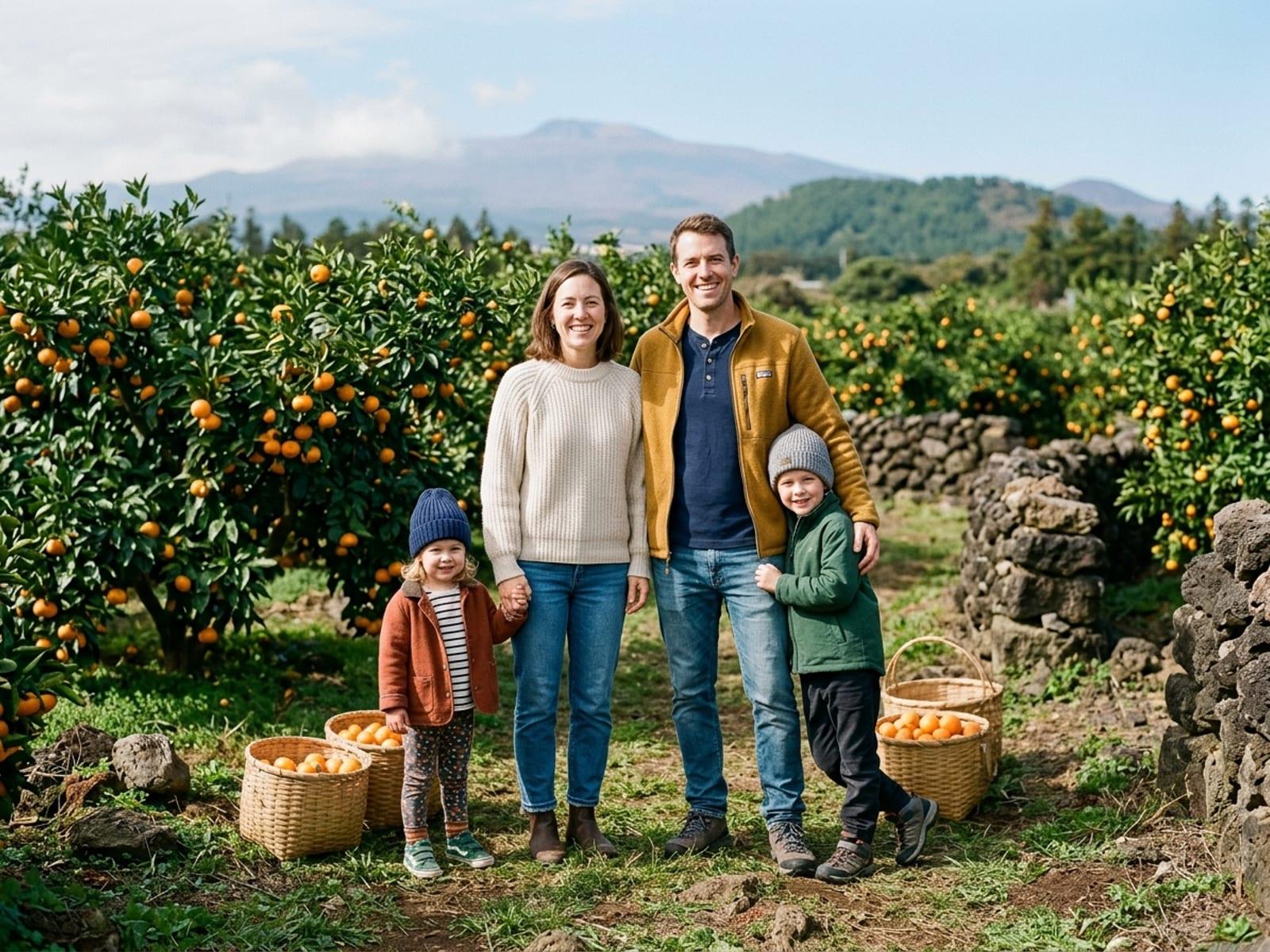
Tangerine picking season on Jeju Island runs from early October to around January, with most farms opening from mid-October. The best time to go is mid-November through December, when the early open-field tangerines ripen and whole orchards turn deep orange. Come in October and you'll pick extra-early fruit with a green tinge; in winter the trees carry Red Hyang (December to February), hallabong (best January to March) and Cheonhyehyang (January to March) instead. Prices vary by farm; for open-field tangerines, about 7,000 to 11,000 won with 1 to 2 kg to take away is typical. You'll be using scissors, so with small children, let them hold the fruit while an adult does the cutting.
Jeju's tangerines, called gamgyul, grow in orchards ringed by walls of black lava stone. They were once sent as tribute to the kings of Joseon, and they're still the island's best-known product.
The island fruit that went to the king
Jeju's ties to citrus are old. In the Three Kingdoms period, the island kingdom of Tamna is said to have sent citrus to Baekje and other states. The Annals of King Taejong of the Joseon dynasty record that from 1412 into the following year, several hundred citrus trees were shipped from Jeju and planted in coastal towns of Jeolla Province such as Suncheon.
In the Joseon era, Jeju citrus was tribute for the king. The "Gamgyul Bongjin" scene in the Tamna Sullyeokdo, a set of documentary paintings made in 1702, shows 40,000 pieces of citrus of eight varieties being sent as tribute. That tribute weighed heavily on the islanders, though. Officials counted the trees, entered them in registers and even kept watch over how much fruit they bore, and records say some people uprooted or cut down their trees as a result.
Much of the citrus grown on Jeju today comes from varieties brought in from Japan, often by Koreans living there, from the colonial period onward. Hallabong is one of them: the dekopon, developed in Japan, reached Korea in 1990 and came to be named after Jeju's Hallasan mountain. Since the late 2010s, farmers have also begun growing new varieties bred in Korea, such as Harye-gyul, Gaeulhyang, Minihyang and Winter Prince. Several native citrus varieties survive on the island too, including yuja and kumquats, so Jeju's citrus lineup is far more varied than you might expect.
Greenish fruit in October, deep orange in winter
Picking season runs from early October to around January, and most farms open from mid-October on. What's on the trees, and how it looks, depends on when you go.
In October you pick extra-early open-field tangerines, their skins still tinged with green. The orchards turn solid orange from mid-November, when early open-field tangerines come into season, lasting through the end of December. In winter, larger and more fragrant varieties follow: Red Hyang (December to February), hallabong (December to May, best from January to March) and Cheonhyehyang (January to March). For photos of orchards glowing orange, aim for mid-November to December.
Prices vary by farm. For open-field tangerines, a typical guide is about 7,000 to 11,000 won including 1 to 2 kg to take home (as of September 2026; prices can change even within a season). Some farms let you eat as much as you like in the orchard, while others only set how much you can take away, so ask when you book. You may see "Tyvek" tangerines advertised. That isn't a variety but a growing method: a white sheet is laid under the trees to reflect sunlight onto the fruit.
Picking at the Seogwipo Citrus Museum
In Sinhyo-dong, Seogwipo, on the south side of the island, the Seogwipo Citrus Museum covers the history and industry of Jeju citrus. It opened in 2005 and, after renovation, reopened with new exhibits. It has a hall of citrus from around the world and a subtropical botanical garden, and one exhibit lets you hear first-generation citrus farmers tell their own stories. In autumn 2025 it also ran Saturday sessions where visitors made and tasted a chilled pasta using citrus, linking orchard, exhibition and food in one place.
The museum grounds have three citrus orchards, and in 2025 tangerine picking ran from November 3 to December 30. It cost 5,000 won per person: staff guided you as you picked and tasted, and you took home about 1 kg of fruit you'd picked yourself. Sessions ran from 9:30 to 11:30 a.m. and 1 to 4:30 p.m., and the activity was canceled on rainy days for safety. Check the museum's information for 2026 dates and prices.
From November 19 to 23, 2026, the Jeju Citrus Expo takes place around the Agricultural Ecology Park of the Seogwipo Agricultural Technology Center in Namwon-eup, Seogwipo. Tangerine picking runs every day of the expo, paid on site: 5,000 won, free for preschool children. Admission is 2,000 won at the gate (1,000 won if you book by November 18) and free for children under 13 and adults 65 and over, and the gates are open from 10 a.m. to 5 p.m. In a year when the museum hasn't announced its picking dates yet, those five days still give you a place to pick.
Adults hold the scissors
When picking tangerines, you don't pull them off by hand; you cut them with scissors. Cut a little above the stem, then trim what's left of the stem short. A long stem left on the fruit will scratch the other tangerines in the basket. Take care not to cut off whole branches, too.
With small children, it's safest for the adult to keep the scissors: the child holds the fruit while the adult cuts. For the tastiest fruit, look for a thin, green stem, a bumpy surface around the stem, and a size a little smaller than medium. Spots on the skin have nothing to do with flavor. Place cut fruit gently in the basket instead of tossing it in; a scratched skin spoils faster before you get it home. For fruit on high branches, lift your child only as high as they can reach, and don't let them climb stepladders or the trees.
The ground in the orchards is uneven, so wear sneakers. From November the wind on Jeju can be cold, so bring a light jacket. To see how a photo of your family in front of black stone walls and orange fruit might look, you can try pokesta's AI photos ($1 per photo, and the first one is free).
When to go and how to get there
Picking runs from October to around January, and counting the winter varieties, citrus season lasts into early spring. Jeju International Airport (CJU) handles both domestic and international flights. Picking farms are scattered across the island. To reach Seogwipo, where the citrus museum is, you cross the island south from Jeju City, where the airport is. Many farms are far from town, so a rental car or taxi makes getting around easier. With a car, you can pair a farm with Seongsan Ilchulbong, the World Heritage volcanic cone at the island's eastern tip, on the same day.
Taking fresh fruit across borders is subject to quarantine rules and is restricted in many countries. Pick only as much as you can eat while you're still on the island. Entry requirements for Korea depend on your nationality, so check your own government's official information.
For more of Korea's regional specialties, see our articles on Boseong's green tea fields and Busan's Jagalchi Market.
What children remember most from tangerine picking is the taste of the one they chose and cut themselves. Rather than filling the basket, take your time in front of the tree asking, "Which one looks the tastiest?"
References