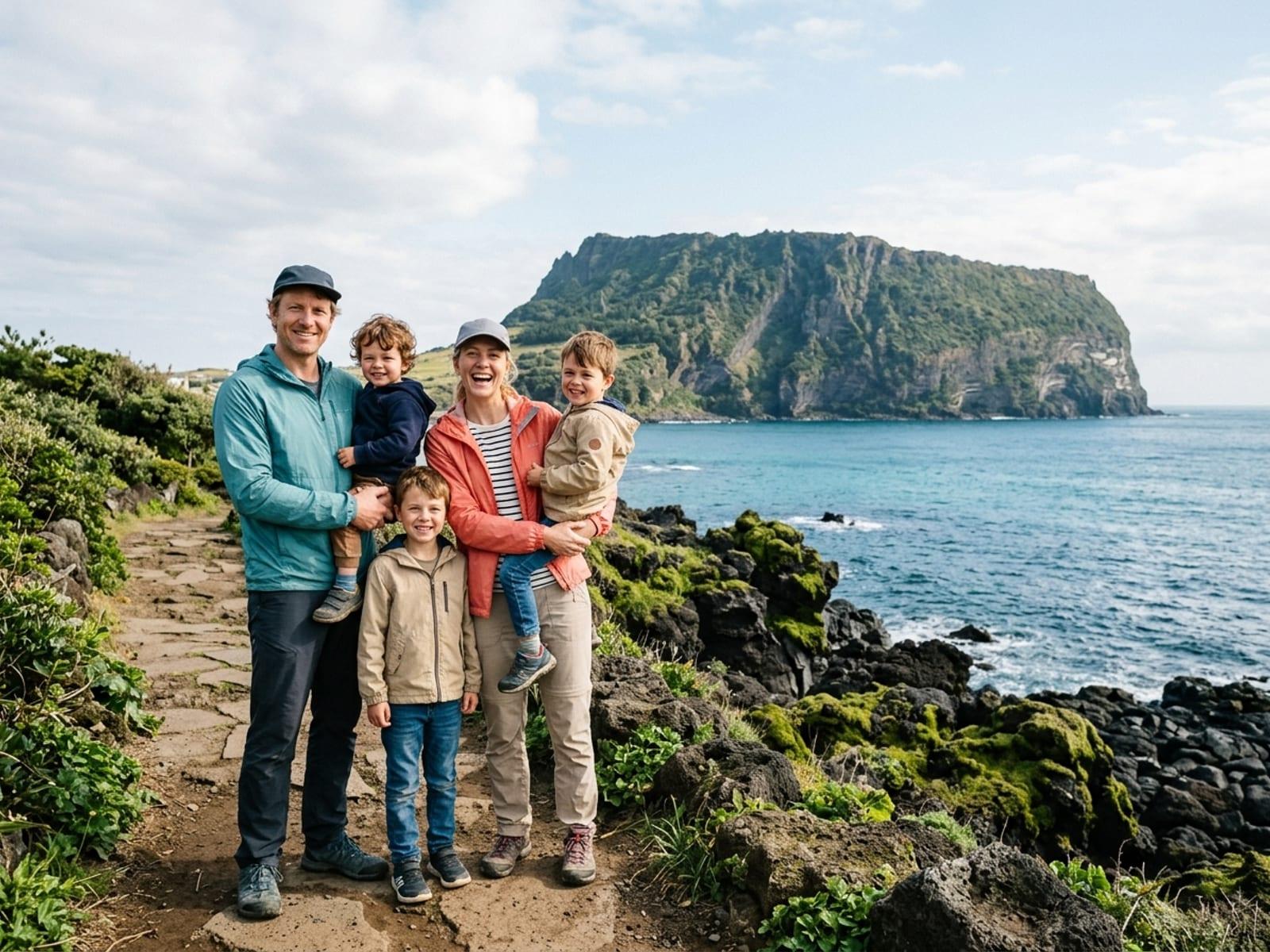
Seongsan Ilchulbong is a 182-meter volcanic cone that juts out of the sea at the eastern tip of Jeju Island, inscribed in 2007 as part of a UNESCO World Natural Heritage site. About 30 minutes of stairs takes you to the top, and at the foot of the hill you may be able to watch haenyeo, Jeju's women divers, give a diving demonstration. With children, go in spring or autumn, watch the sunrise from flat Gwangchigi Beach, and climb once it's light.
From below, the top looks flat. Reach the summit and a huge, grass-covered crater opens up in front of you.
A 182-meter hill left by an undersea eruption
Seongsan Ilchulbong stands 182 meters tall. It was formed by an eruption on the floor of a shallow sea, and it belongs to the type known as a tuff cone, built up from layers of volcanic ash. The cone is about 600 meters across. Rising abruptly out of the water, it looks nothing like a volcano formed by lava flowing out and spreading into gentle slopes.
The UNESCO site "Jeju Volcanic Island and Lava Tubes" is made up of three areas: Hallasan, at 1,950 meters the highest mountain in South Korea; the Geomunoreum Lava Tube System, which UNESCO rates as the finest lava tube system in the world; and Seongsan Ilchulbong. Jeju is a volcanic island in the sea about 130 kilometers south of the Korean Peninsula, and the whole island feels like a museum of volcanic landforms. The part of Hallasan above 800 meters has been a nature reserve since 1966, and more than 1,500 plant species have been recorded there.
As the name Ilchulbong, "sunrise peak," suggests, this is a famous spot for watching the sunrise. Every year around the New Year, the Seongsan Sunrise Festival is held over several days. From the summit on a clear day, you can see across to Hallasan and to Udo, an island just to the north.
About 30 minutes of stairs to the top
A stepped trail leads all the way to the summit, and the climb takes about 30 minutes. The path is well built, but it's almost entirely steps, which makes it a longer haul than you'd expect for small children. If a child gets tired, don't push; take breaks and enjoy the view as you go.
The hill sticks out into the sea, and the summit and seaward slopes can get very windy, so give children's hats a chin strap or put them away for the climb. There's little shade on the trail; in summer, go early and bring more to drink than you think you'll need. Strollers can't go up, so bring a baby carrier for anyone too small to walk the distance.
Opening hours change with the season; the site opens about an hour before sunrise and stays open into the evening. The English Wikipedia gives closing time as 8 p.m. from November to February and 9 p.m. from March to October, but ticket sales cutoffs, closed days and fees can change, so check the latest information with Jeju's tourism information service (Visit Jeju) or on site. If you're climbing early to catch the sunrise, bring a light for the dark path.
Watching the haenyeo at work
At the foot of Seongsan Ilchulbong, at a fishing ground called Umutgae, local haenyeo give demonstrations of diving into the sea. A travel information site describes a single show a day at 2 p.m., running from an introduction to the haenyeo through diving, gathering seafood and a photo session to the sale and tasting of the catch, and says it can be watched with a Seongsan Ilchulbong admission ticket (information updated April 2025). Shows may be canceled or changed depending on the weather and sea conditions, so check before you go.
Jeju's haenyeo are women who dive without oxygen tanks, holding their breath to gather abalone, turban shells, octopus, sea urchins, seaweed and more. A single dive can reach depths of 20 meters, holding the breath for one to three minutes. When they surface they release a whistling breath known as sumbisori. In 2016, Jeju's haenyeo culture was added to UNESCO's list of Intangible Cultural Heritage. In the past, girls are said to have begun training in the sea at around age 11 and taken about seven years to become fully fledged haenyeo. Fewer young women take up the work now, though: in 1970, 14 percent of haenyeo were over 50, while in 2014, 98 percent were. Today most haenyeo are over 60, and some are over 80. Tell your children how long the women diving in front of them have been working with the sea.
Watch the sunrise from Gwangchigi Beach
On the west side of Seongsan Ilchulbong, a stretch of sand runs toward the town of Seongsan-eup. This is Gwangchigi Beach, which is also the end point of Route 1 of the Jeju Olle Trail, the walking route that circles the island. Its distinctive scenery of black lava rocks covered in green moss makes it a well-known spot for watching the sun rise to the right of Seongsan Ilchulbong.
If you'd like to see Seongsan Ilchulbong and Udo in one view, you can climb Jimibong, a small hill nearby; from its top, Udo floating in the sea and Seongsan Ilchulbong fit into the same panorama. Around Hallasan there are said to be as many as 360 small parasitic volcanoes, and on Jeju these little volcanic hills are called oreum. They're dotted all over the island, and poring over the map with your children to choose "which oreum next?" is one of the pleasures of an island trip.
Climbing in the dark before dawn with small children is hard work, so one good plan is to watch the sunrise from the flat ground of this beach and climb Seongsan Ilchulbong once it's light. The rocks get slippery when wet, so hold your children's hands. To see what your family lined up in front of the volcanic cone might look like, you can try pokesta's AI-generated photos ($1 per photo, and your first one is free).
When to go and how to get there
Seongsan Ilchulbong can be visited year-round. Summer calls for protection from heat and sun, winter from the cold sea wind, so with children, spring and autumn are the easiest seasons for the climb. The gateway is Jeju International Airport (CJU) on the north side of the island; from there, travel to the eastern tip by rental car, taxi or bus. Staying on the east side of the island makes an early-morning trip to the beach easier.
In winter, Jeju also offers tangerine picking in fields ringed by stone walls. For World Heritage on the mainland, Gyeongju's Silla royal tombs and observatory in the southeast are just as easy to explore on foot with children. Entry requirements for South Korea depend on your nationality, so check your own government's official information before you travel.
References