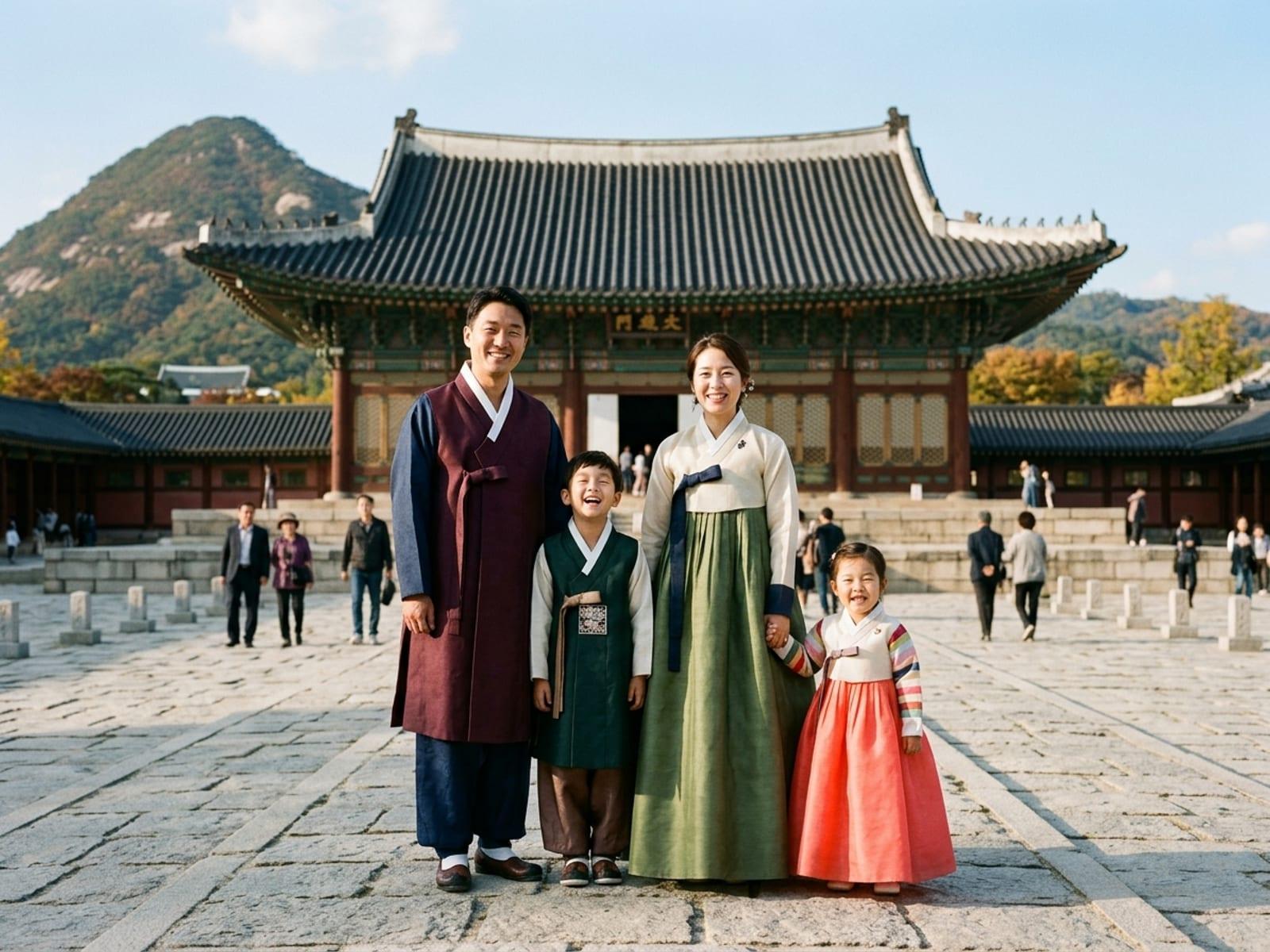
Chuseok is Korea's autumn harvest holiday: the 15th day of the eighth lunar month and the days either side are public holidays, falling on September 24–26 in 2026 and September 14–16 in 2027. For a family trip, the classic plan is to wear hanbok to Seoul's royal palaces, which in some years open free over the break, but many traditional markets and family-run restaurants close and travel out of the city is jammed with people heading home. Plan meals around busy districts and stay in Seoul, and the holiday is easy to enjoy.
Chuseok is one of Korea's two great traditional holidays, alongside Seollal, the Lunar New Year. Families gather in their hometowns to give thanks for the year's harvest and honor their ancestors.
2027: Tuesday, September 14 to Thursday the 16th, with no substitute day
Chuseok is held on the 15th day of the eighth lunar month, the night of the full moon. The Gregorian date therefore shifts every year, landing between mid-September and early October. The public holiday covers three days: Chuseok itself plus the day before and the day after.
Since 2014, Korea has had a substitute holiday rule. If any of those three days falls on a Sunday or on another public holiday such as National Foundation Day, the first day after the break that is neither a Sunday nor a holiday becomes a day off. Saturdays don't count, which is why 2026, when the 26th was a Saturday, still had only the three days from the 24th to the 26th.
In 2027, Chuseok Day is Wednesday, September 15, and the holiday runs from Tuesday the 14th to Thursday the 16th. The 2027 calendar data published by the Korea Astronomy and Space Science Institute (KASI) gives the same dates, and since none of them is a Sunday or another holiday, there is no substitute day. Monday the 13th and Friday the 17th are ordinary working days.
If palaces are on your list, watch how the closing days shift. According to the Royal Palaces and Tombs Center, Gyeongbokgung and Jongmyo Shrine close on Tuesdays, while Changdeokgung, Changgyeonggung and Deoksugung close on Mondays. When a closing day falls on a public holiday, the site stays open and closes instead on the next day that isn't a holiday. By that rule, in 2027 Gyeongbokgung and Jongmyo should be open on Tuesday the 14th and closed on Friday the 17th, while Changdeokgung, Changgyeonggung and Deoksugung close as usual on Monday the 13th. Check the center's notices shortly before you go.
From clearing the graves to circle dances under the full moon
Preparations start before the holiday. Families take sharpened sickles to their ancestors' graves and cut back the grass that grew over the summer, a task called beolcho. The Encyclopedia of Korean Culture explains that if the overgrown grass dried out and caught a wildfire, the grave itself could burn, so it was cleared in advance. A grave still overgrown at Chuseok was taken as one with no descendants to tend it, and people would laugh at it.
Chuseok morning opens with charye, a memorial rite held at the head household of the extended family. At Seollal the offering is tteokguk, rice cake soup; at Chuseok it is customarily rice cooked from the new harvest, liquor brewed from new rice, and songpyeon made with fresh grain. After the rite the family shares the food that was offered, a custom called eumbok, and then visits the graves to pay their respects, known as seongmyo.
As for what belongs on the table, the ritual committee of Sungkyunkwan, Korea's main Confucian body, issued a standard in September 2022. It lists songpyeon, seasoned vegetables (namul), a grilled dish (jeok), kimchi, fruit and liquor as the basics, and says fried dishes such as jeon pancakes don't need to be offered at all. Layout rules like "red fruit east, white fruit west," it added, have no basis in the old ritual texts.
Songpyeon are rice-flour dumplings a little smaller than a golf ball, filled with sesame, beans, red beans or chestnuts, shaped into half-moons and steamed on a bed of pine needles. Many families make them together on the eve of Chuseok, and an old saying holds that whoever shapes them beautifully will find a good spouse. The half-moon shape is often explained as a wish for growth: a full moon can only wane, while a half moon still has its fullness ahead.
At night, as the moon rises, women join hands in a ring and circle while they sing: this is ganggangsullae. It comes from the southwestern coast of South Jeolla Province. The song starts slowly and gradually speeds up, with games such as gosari-kkeokgi, "picking fern shoots," worked in along the way. One story credits the naval commander Yi Sun-sin with inventing it, but the Encyclopedia of Korean Culture sees it as a much older circle dance that was later put to use as a wartime ruse. In 2009 it was inscribed on UNESCO's Representative List of the Intangible Cultural Heritage of Humanity.
For visitors, the palaces and traditional events are the draw
Holiday rituals mostly take place within the family, and visitors are very unlikely to join a charye. Travelers can still get a taste of Chuseok in two ways.
The first is free entry to the royal palaces. In 2026, during the Chuseok break from September 24 to 27, the four palaces of Gyeongbokgung, Changdeokgung, Deoksugung and Changgyeonggung, along with Jongmyo Shrine and the Royal Tombs of the Joseon Dynasty, were open free of charge. Jongmyo, normally visited on timed, reserved tours, could be seen without a reservation (the Secret Garden at Changdeokgung was not part of the free opening). The Korea Heritage Service announces each year whether free entry will be offered and for which dates.
At Gyeongbokgung, the royal guard changing ceremony took place at 10 a.m. and 2 p.m., the gate guard ritual at 11 a.m. and 1 p.m., and a patrol of the palace grounds at 3 p.m. No booking was needed for any of them, and they're easy for children to follow.
The second is events at traditional culture venues. In 2026, Namsangol Hanok Village held a Chuseok festival with programs explaining the meaning and etiquette of charye and sessions where you could try on hanbok. The Seoul Culture Lounge inside Seoul Tourism Plaza offered songpyeon making and traditional dance workshops around Chuseok. Outside Seoul, the National Intangible Heritage Center in Jeonju held a free Chuseok folk games day on September 19, before the break, with rice-cake pounding, nongak folk music, miniature gat (traditional hat) making and old games like tuho, arrow-throwing into a pot. Seoul city and the Korea Tourism Organization list these events online each year, so check before you leave.
Rent hanbok near the palaces and shorten the kids' skirts
Many Korean families dress their children in hanbok to visit relatives at Chuseok, so it's very much a festive outfit. Rental shops cluster around Gyeongbokgung, and some carry children's sizes. Even outside the holiday, anyone wearing hanbok gets free entry to Gyeongbokgung, Changdeokgung, Deoksugung and Changgyeonggung: show ID at the ticket booth (a passport, for visitors) and you'll be given a free ticket. Which outfits qualify is covered in our guide to family hanbok for Seollal. During a free Chuseok opening everyone gets in anyway, but palace photos in hanbok are a keepsake of the season.
Rentals book up quickly over the holiday, so reserve as soon as your dates are set. The palaces have lots of gravel paths and stone steps, and children in long chima skirts tend to step on the hem. Ask the shop to shorten the length for kids, or bring sneakers so they can walk comfortably before and after the photos.
Before the trip, you can picture your family strolling a palace in hanbok with pokesta's AI photos, at $1 per photo.
Closures and packed trains over the holiday
First, expect closures. Around Chuseok Day in particular, many traditional markets and family-run restaurants close. Restaurants in busy districts such as Myeongdong, large shopping centers and convenience stores usually stay open, so plan your meals around your hotel and the main shopping areas. It helps to go over how Korean restaurants work, from call buttons to paying at the counter, with the family beforehand. And if you're counting on the National Museum of Korea in Yongsan for a rainy day, note that it closes on Chuseok Day itself.
Second, expect crowded transport. On the first and last days of the break, highways jam with cars heading to and from hometowns, and KTX high-speed train and long-distance bus tickets sell out early. Seoul itself, meanwhile, gets quieter and easier to walk, with less crowded subways, so stay in the city and save trips out to the provinces for outside the holiday. Old regional capitals such as Gyeongju, with its Silla royal tombs, are far calmer if you shift your visit a few days before or after the break.
Because the free palace openings and Chuseok events are packed into a few days of the break, even a short two- or three-night stay can fit them in comfortably.
Getting in from Incheon, and checking K-ETA before you fly
The main gateway is Incheon International Airport (ICN). The AREX airport railroad reaches Seoul Station in about an hour on the all-stop train, or in 40 to 50-odd minutes on the express. Gimpo Airport (GMP), closer to the city, also handles some international flights.
Whether you need a visa or a K-ETA (Korea Electronic Travel Authorization) depends on your nationality. Korea has temporarily exempted certain countries and regions from K-ETA and has extended the exemption several times, but at the time of writing it isn't known which will still be exempt by Chuseok 2027. Entry procedures such as electronic arrival cards are also still changing. Check your own government's travel advice and the official K-ETA website, and look again about a month before you leave.
Airports and trains are packed on either side of the holiday, so once your dates are set, book flights, accommodation and hanbok rental together, early.
References
- Traditional Korean Holiday of Bountiful Harvest, Chuseok (VISITKOREA, Korea Tourism Organization)
- 2026 Chuseok Holiday Travel Guide (VISITKOREA, Korea Tourism Organization)
- 2027 calendar data (Korea Astronomy and Space Science Institute, in Korean)
- Substitute holidays (Korean Wikipedia)
- Opening hours (Royal Palaces and Tombs Center, in Korean)
- Chuseok (Encyclopedia of Korean Culture, in Korean)
- Sungkyunkwan's standard charye table (Financial News, in Korean, 2022)
- Songpyeon (Wikipedia)
- Ganggangsullae (UNESCO Intangible Cultural Heritage)
- Palaces and royal tombs free over Chuseok (Financial News, in Korean)
- Four palaces, Jongmyo and Joseon royal tombs open wide for Chuseok (Herald Business, in Korean)
- Chuseok programs to enjoy in Seoul (Korea.net, in Japanese)
- Chuseok holiday in Seoul (Seoul Metropolitan Government, in Japanese)
- Gyeongbokgung Palace (Konest, in Japanese)
- AREX (Wikipedia)
- K-ETA Korea Electronic Travel Authorization (Ministry of Justice, official)
- Seoul Chuseok 2026: What's Open, What's Closed (Seoul Window)