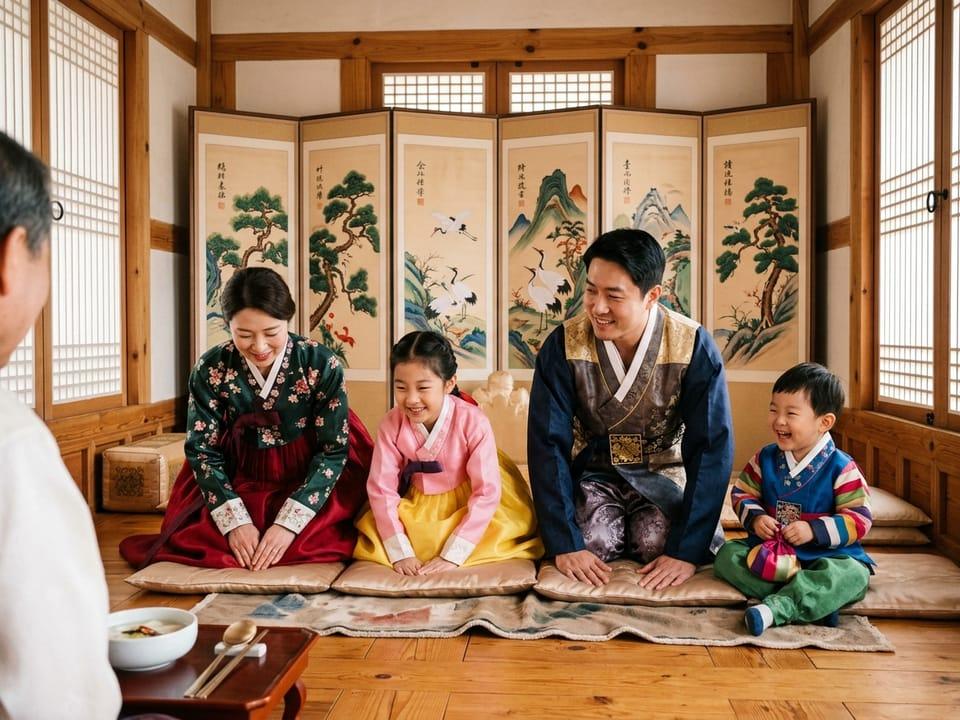
On Seollal morning, a child in hanbok bows deeply to their grandparents for sebae, the New Year's bow. It's one of the moments families most want to keep. The hanbok itself tends to be the sticking point: kids outgrow it within a season, it's bitterly cold around Seollal, and dressing everyone at once often ends in a clash of colors. Decide between renting and buying by how many times it will be worn while it still fits, let the children carry the color, and fight the cold under the hanbok rather than over it. Then rehearse the sebae once the night before, since men and women fold their hands differently.
Seollal 2027 is Sunday, February 7, with a four-day break
Seollal is the first day of the lunar year, and in Korea the day before, the day itself and the day after are all public holidays. In 2027 it lands on Sunday, February 7, so the holiday runs from Saturday the 6th to Monday the 8th. Because one of those days is a Sunday, Tuesday the 9th becomes a substitute holiday, giving a four-day break from February 6 to 9. The 2027 calendar data published by the Korea Astronomy and Space Science Institute lists the 9th as a "substitute holiday (Seollal)."
Chinese New Year falls a day earlier that year, on February 6. A lunar month begins on the day of the new moon, and each country counts that day in its own standard time. The February 2027 new moon arrives at about 15:56 Universal Time on the 6th. That's around 12:56 a.m. on February 7 in Korea but around 11:56 p.m. on February 6 in China, so the two New Years land on different dates.
Seollal morning traditionally begins with charye, the ancestral rite, after which younger family members perform sebae to their elders. Children who bow receive deokdam, words of blessing, and New Year's money called sebaetdon. Eating tteokguk, rice cake soup, is said to add a year to your age, and some families play yunnori afterward.
Seolbim: something new, and for kids, stripes and magpie coats
The new clothes worn for the New Year are called seolbim. Young and old alike would have bright, colorful clothes ready before New Year's Eve, change into them on Seollal morning and keep wearing them until roughly Daeboreum, the first full moon of the lunar year, two weeks later. Sebae, too, is traditionally done in hanbok.
For children, the eye-catcher is the saekdong jeogori, a jacket with sleeves made of rainbow stripes. The Encyclopedia of Korean Culture notes that girls in particular wear saekdong jackets at Seollal. Boys more often wore the kkachi durumagi, or "magpie overcoat," a children's coat in five colors standing for the four directions and the center: blue for east, white for west, red for south, black for north and yellow for the center. It was once worn as seolbim. The name links the coat to the magpie, a bird believed to bring good news, and to children's eagerness for the holiday; the day before Seollal has long been called Kkachi Seollal, "magpie Seollal."
Today you're more likely to see a kkachi durumagi at a doljanchi, a child's first birthday party. If the hanbok from your child's dol still fits, it can do a second turn as seolbim. Our guide to renting dol hanbok goes through what those outfits include.
Rent or buy: count the wears before it's outgrown
A child's hanbok is often too small after a single season, so the real question is how many times it will be worn before then.
For Seollal photos and a palace outing alone, renting does the job. Some rental shops around the palaces carry children's sizes, but they get busy over the holiday and hours can change, so confirm sizes for everyone and opening days early.
Buying starts to make sense if you want to follow the seolbim custom and have your child wear it several times through Daeboreum, or if it will also come out for Chuseok or a relative's wedding. A traditional chima skirt wraps around the chest and ties, so it can absorb a fair amount of growth. For adults, saenghwal hanbok, modern everyday hanbok, is an option you'll actually wear again.
Let the kids carry the color, and layer underneath
When everyone wears a different bright color, the photo loses its focus. Put the children in saekdong stripes, red or pink, and the adults in calmer navy, jade, plum or ivory, and the kids will stand out. Dressing the whole family in pastels is another low-risk option with a soft look. Against a white wall at home, pastels photograph beautifully, but in a white landscape like a palace in the snow, stronger colors hold up better.
Seoul is bitterly cold around Seollal. Hanbok is cut loose, so thermal underwear under the jeogori and baji doesn't show at all, and leggings or tights disappear under a chima. Outdoors, add a durumagi, the long overcoat, or a padded vest called a baeja. Traditional cloth hanbok shoes slip on icy paths, so walk in boots or sneakers and change once you reach the spot where you'll take pictures. A boy's bokgeon hood or a girl's jobawi cap keeps heads warm too.
Sebae starts with the hands; shoot it low and from the side
Sebae is a deep bow performed down on the floor, and the sequence and movements differ for men and women. The difference starts with gongsu, the way the hands are folded before bowing: men put the left hand on top, women the right. A 2016 etiquette piece in the Daegu daily Maeil Shinmun adds that announcing the bow to an elder ("Grandpa, please accept my bow") is actually poor form. The child simply bows, listens to the elder's deokdam, and then answers with something like "I'll do my best." Run through the hand position and that quiet bow-then-reply sequence once the night before, and your child won't be flustered on the day.
Head-on, all you get is the top of a head, so whoever holds the camera should crouch at the side and frame from low down to get the child's whole body along with the grandparents' faces as they receive the bow. Video works better than stills for the whole sequence. Keep recording through the blessings and the handing over of sebaetdon, and you'll have the grandparents' voices from that year. Clear the floor; a few floor cushions and a folding screen are all you need for a New Year backdrop. For the tteokguk table, take one shot from directly overhead.
Palaces: wear a full set, and Gyeongbokgung stays open over the break
Wearing hanbok gets you free entry to the four palaces (Gyeongbokgung, Changdeokgung, Deoksugung and Changgyeonggung), Jongmyo Shrine and the Joseon royal tombs, and that includes foreign visitors. Under the guidelines of the Royal Palaces and Tombs Center, both traditional and modern hanbok count, as long as you wear a jeogori with a wrap-style collar plus a chima or baji. A durumagi thrown over regular clothes doesn't count, and neither do a jeogori with jeans, a T-shirt-style top, or a one-piece hanbok dress without a jeogori. For what the palaces are like when they open free to everyone over a major holiday, see our Chuseok guide.
Gyeongbokgung normally closes on Tuesdays, but the center's visitor information says that when the regular closing day falls on a public or substitute holiday, the palace stays open and closes instead on the next day that isn't a holiday. Going by that rule, Gyeongbokgung will be open on Tuesday, February 9, 2027, and closed on Wednesday the 10th. January and February hours are 9 a.m. to 5 p.m., with last entry at 4 p.m. Whether there will be a free opening over the break is announced separately, so check the center's notices shortly before you go.
One photo a year, in the same spot, with everyone in it
If you bought the hanbok, take one photo in the same spot every Seollal until it no longer fits. As the sleeves creep up the arms from one year to the next, the photos turn into a growth record that belongs to your family alone.
If family members live overseas, or the grandparents are too far away to visit this year, pokesta can create a family photo with everyone in hanbok in a sebae room or at a snowy palace, using AI and each person's own phone snapshots. Your first image is free, and after that it's $1 per photo. You can make a Seollal family photo or browse everyone's Seollal posts for color ideas.
References