
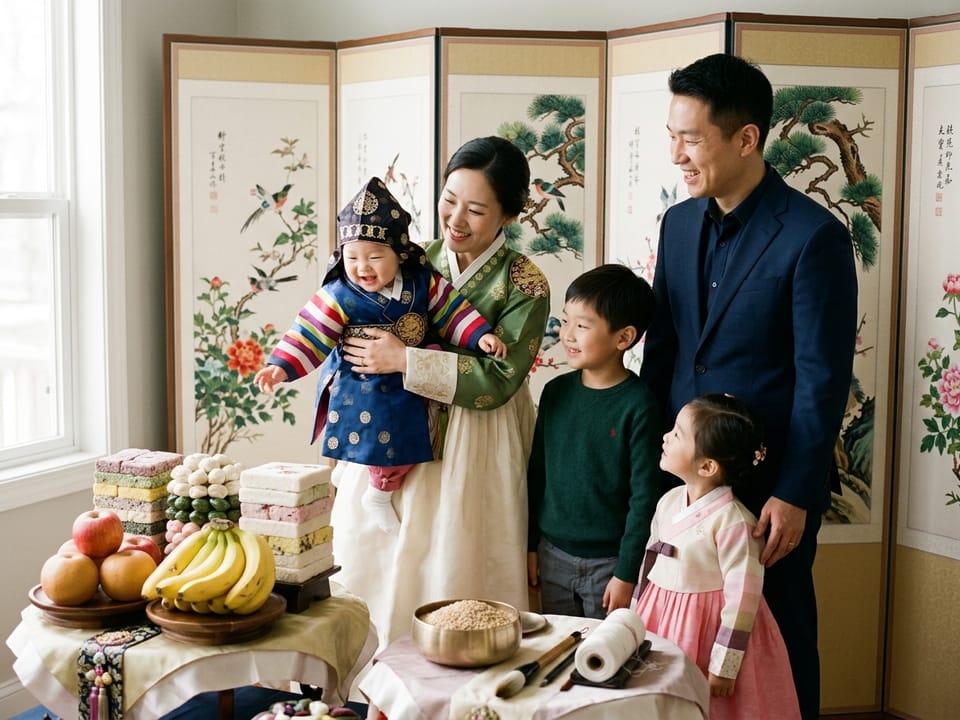
For a doljanchi, the party for a Korean baby's first birthday, renting hanbok is usually the sensible choice: the baby wears the outfit for an hour or two and outgrows it within months, and the adults' hanbok may not come out again for years. Rent the baby's set from a shop that handles dol hanbok, decide early whether the parents will wear hanbok too and, if so, which kind, and leave enough time between delivery and the party to try everything on and swap sizes. For the photos, let the baby be the brightest thing in the frame and dress everyone else to support that.
A doljanchi today may be held in a banquet hall or hotel with a photographer, a stylist and an MC hired for the day, and hanbok is one more thing families rent for it.
The baby's set has more pieces than the listing photo shows
A full dol outfit is layered. The Academy of Korean Studies' Encyclopedia of Korean Culture describes a boy dressed in a jeogori jacket and baji trousers with a vest, a short magoja jacket and a durumagi overcoat, and a navy kwaeja over the top, with a bokgeon hood on his head. A girl wears a saekdong jeogori with rainbow-striped sleeves and a long deep-red chima skirt, sometimes with a dangui over it, and a jobawi cap or a gulle on her head. Both wear embroidered taraebeoseon socks and a dol-tti, a long sash wrapped around the chest, with a small dol-jumeoni pouch at the waist; for a girl it is fastened to the skirt band.
That is why "full set" means different things at different shops. When you compare listings, check whether the hat, socks, sash and pouch are in the price or charged separately, how many layers the boy's outfit has, and whether the girl's set includes the overgarment. An extra layer looks grand in a portrait and is one more thing to wrestle onto a one-year-old, so a slightly simpler set can be the better rental.
The gulle is worth a look if you have a daughter. The encyclopedia describes it as a cap worn by girls in well-off households in the late Joseon period, from around the first birthday until about four or five, both for show and for warmth. Versions with many strands covering the head were mostly worn in the north, while the three-strand style that leaves more hair showing was the Seoul fashion and more decorative.
Measure your child and ignore the age label
Size labels on children's hanbok vary from shop to shop, and a label based on age tells you little about a particular one-year-old. Measure your child's height and chest and compare them with the shop's own chart. If your child is between sizes, go up: a wrap-style chima and loose jeogori sleeves hide extra room far better than a tight collar hides too little.
Think about what the baby will be doing. A child who is pulling up to stand or taking first steps needs trousers or a skirt that clear the feet, and cloth taraebeoseon can slide on a polished banquet floor, so plan any walking shots barefoot or in grippy socks. A banquet hall can be warm and the layers are thick; a thin cotton bodysuit underneath is plenty.
For an older sibling, look for a set with an adjustable waist and a jacket that fastens easily, so they can get in and out of it without help after the photos. Letting them choose one detail, such as the color of a sash, can make the outfit feel like theirs rather than a costume they were put in.
Parents don't have to wear hanbok at all. If they do, the choice is between traditional hanbok and modern everyday hanbok. If the mother is still breastfeeding, a two-piece jeogori and chima is easier to manage than a one-piece dress, and the wrap-around chima accommodates a body that is still changing after birth.