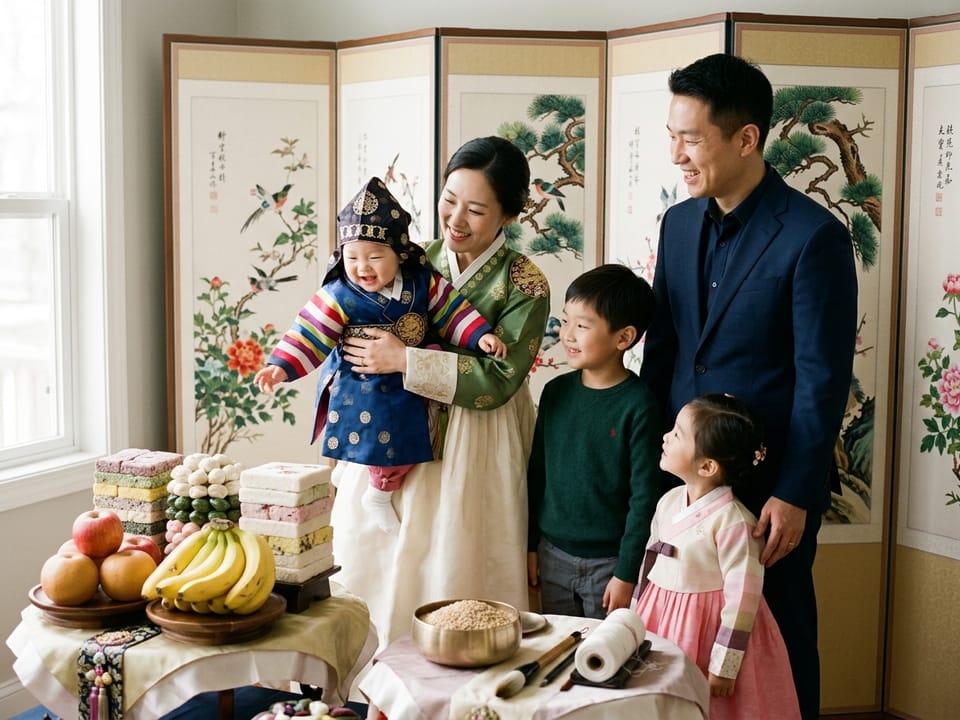
A small doljanchi, the Korean first-birthday party held for just the family, goes best when it's built around three moments: the baby at the dol table, the doljabi grab, and one photo of everyone together. Fit the meal around those, not the other way round. A private room at a restaurant takes the cooking and clearing off your hands; home gives you the baby's nap schedule and no clock. Either way, settle before the day who holds the camera and where they stand when the baby reaches for the tray.
Family-only is how many Korean families celebrate now
Large doljanchi at hotels and banquet halls haven't gone away, but smaller ones have become common. In April 2026 Maeil Shinmun, a daily paper based in Daegu, reported that family-centred small events took hold after the pandemic years, with parents inviting family and close friends rather than colleagues and distant relatives. Its description of a typical preparation is a useful map for a small one too: book a restaurant, find a dol table company to decorate the space, rent hanbok or other outfits, arrange someone to photograph the day. Some families in the same report skipped the party altogether for a family trip or a donation in the child's name. Between those two sits the family meal, 돌잔치 대신 가족식사 in Korean, "a family meal instead of a doljanchi", with the dol table and doljabi kept in.
None of this is far from the older form. The Encyclopedia of Korean Culture describes a dol morning that began at home: a table set for Samsin, the spirits believed to grant children, to pray for the child's fortune, a family breakfast of seaweed soup and rice, then the celebration with relatives gathered round the child, and rice cakes sent next door to the neighbours. A family-sized dol is close to how the day used to look.
Restaurant room or home: what each one gives you
A private room (bang, often just called a "room") at a Korean restaurant gives you food, service and cleanup, and a door that closes. What it takes away is time and control. Ask how long the room is yours, whether you can bring in a dol table set and decorations, and whether you can bring your own photographer. That last question matters: in a February 2026 warning on doljanchi services, the Korea Consumer Agency described a venue that told a family no snap photographer other than the one it had recommended could be used, then refused to refund the deposit when they tried to cancel. The agency's general advice is to read the cancellation terms before paying, because most complaints it received came from families unable to get deposits back. If a room's only light comes from the ceiling, ask for one with a window, and set the dol table against the plainest wall.
Home costs less and moves at the baby's pace. Naps happen in the baby's own bed, and nobody is waiting for the room. The work shifts to you: food, setting up and clearing away, and finding one uncluttered wall near a window. Dol table sets can be rented and delivered, which is covered in our piece on renting a self dol table. Put the table low enough that the baby, sitting or standing at it, is level with the food, and keep the folding screen or backdrop behind the baby, the way the encyclopedia describes the child sitting with a screen at their back, facing the table.
A running order that fits a one-year-old's mood
Plan the photos for the start, while the baby is rested and fed. Dress the baby last, just before the first guests arrive, and take the hat shots first; a boy's bokgeon or a girl's jobawi rarely stays on long. Then the dol table portrait with the parents, then each set of grandparents with the baby. Hold the doljabi next, before the meal, while the baby is still curious rather than tired. Eat. Bring out the cake, take the group photo, and let everyone go home before the baby needs to.
The dol table itself carries meaning. According to the encyclopedia, noodles, baekseolgi (white steamed rice cake) and susu-patteok (sorghum balls in red bean) stand for long life, good health and warding off misfortune. Even a small table with those three looks complete in a photo.
Pick one person to shoot, and give them the whole job
At a family dol it's easy for everyone to take pictures and nobody to take the pictures. Choose one person whose only job is photos: an aunt, an uncle, a cousin who's handy with a phone. It shouldn't be a parent, who will be holding the baby, or the grandparent hosting. A second person can film the doljabi. Give the photographer a short list: the baby alone at the table, the parents with the baby, each set of grandparents, the doljabi, the chosen item in the baby's hand, and everyone together. For that last photo, put a phone on a tripod and use the self-timer so the photographer is in it too.
If nobody in the family wants the job, a short professional booking covering just the first hour may be enough for a gathering this size. Our piece on what drives the cost of a dol snap explains how to keep that booking small. And if a grandparent overseas can't make the trip, pokesta can create an AI family photo in hanbok around the dol table from each person's own phone snapshots ($1 per photo, the first one free).
Where to stand for the doljabi
In the traditional doljabi described by the encyclopedia, objects such as rice, money, books, a brush, ink, a bow, thread, jujubes, noodles and rice cake were set out in no particular order, and the first and second things the child picked up were read for their future. Thread and noodles meant long life, rice and money meant wealth, books and brushes meant learning. The entry adds that parents sometimes put the object they hoped for closer, and that children often picked something else.
Lay the items on a tray or mat on the floor, or on a low table, a little apart so the photo shows which one was chosen. The photographer should crouch behind the items, at the baby's eye level, facing the baby. That way the reaching hand and the baby's face are in the same frame, and the family sitting behind the baby appears in the background, reacting. The person filming stands to one side and starts recording before the baby is set down. Nobody should call out to the baby or point at their favourite item; let the grandparent hosting read out each item's meaning once the grab is done.
Keep real coins and anything small within an adult's reach and out of the baby's mouth. The American Academy of Pediatrics' parenting site lists coins and small balls among the household items to keep away from young children, and warns that balloons pose a choking risk to children up to eight. Use large play money or an envelope instead of loose coins, and hang balloons high.
The grab lasts a second, so decide the camera first
A small doljanchi has few moving parts, which is why it's easy to under-plan the one that matters. Decide who shoots and where they'll crouch before you decide the menu. The food will be remembered for an evening; the photo of the baby's hand closing around the thread will be on the wall for years. Everyone's posts from the day can be found under the dol tag.
References