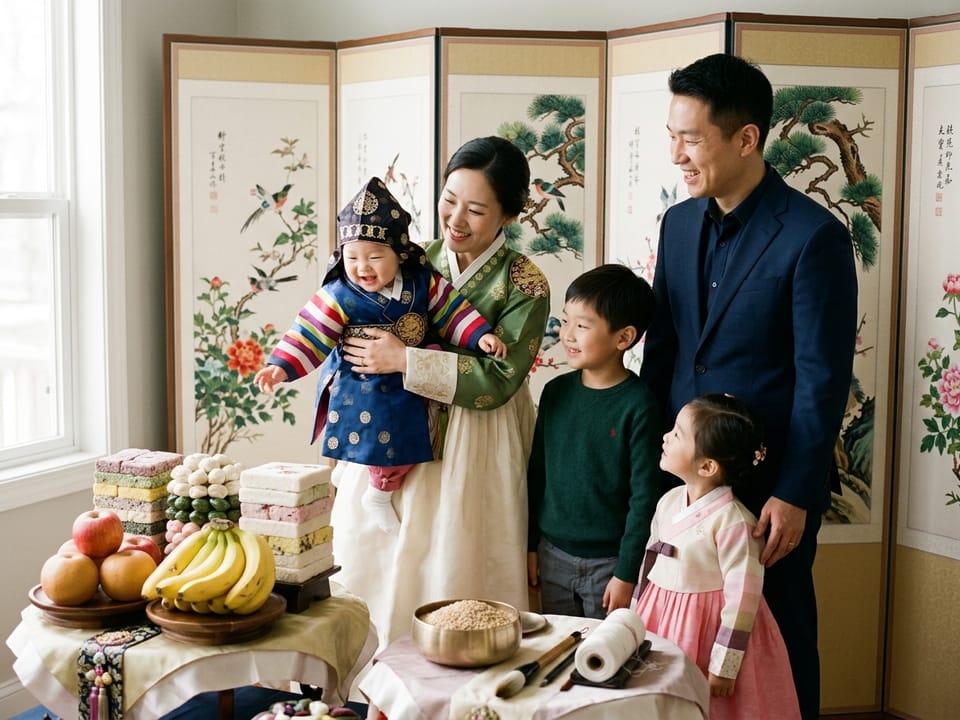
A doljanchi mobile invitation (돌잔치 모바일 초대장) is a small web page for a Korean first-birthday party, sent as a link by text or KakaoTalk, and its photo has to work on a tall phone screen with your wording laid over or around it. Shoot it vertically, with plain space above or below the baby, a weekend or two before the day you plan to send. Then keep the page to what guests need in order to arrive, and write the message around the link so nobody takes it for a scam.
The invitation is a tall screen, so shoot tall
Many templates open on a full-screen cover: one photo, a title, a date. Hold the phone upright and you're already working in the right shape. The decision to make before you press the shutter is where the text will sit. If the template puts the baby's name and the date at the top, place the baby in the lower half of the frame with empty wall above; if the words run along the bottom, flip it. A pale wall, or a plain sheet pinned up behind the sofa, gives the lettering somewhere to land without fighting a busy pattern.
Leave more room around the baby than feels natural. The same cover can be cropped differently on different phones, and the preview that appears in a chat window may show only part of the image, so a head that touches the top edge is the first thing to go. Shoot every setup twice, once with the space above and once with it below, and choose after you've tried both in the template.
Get down to the baby's eye level, keep the window to one side, and switch off the ceiling lights so the colour stays even. One-year-olds don't hold still, and burst mode plus a second adult making noises just behind the phone will do more than any setting. If your child already has studio portraits from earlier in the year, look at them on a phone screen before planning a new shoot. A horizontal portrait shrinks to a strip once it's dropped into a vertical cover; if you're booking a studio anyway, ask for one upright frame with space for text.
Choose the send date first, then the shoot day
Work backwards from the party. Fix the date and the venue, then decide when the invitation goes out. Relatives who have to travel or take time off need more notice than a cousin across town, and a family lunch in a private room can go out later than a banquet for a hundred guests. Put the photo shoot one or two weekends before that send date. You get a spare weekend if the baby is unwell or teething, and a few evenings to pick the frame, try it in the template and settle the wording.
Plan the outfit with the shoot rather than with the party. A rented dol hanbok can cover the invitation photo and the day itself, or just the day; renting hanbok for the whole family goes through sizes and pickup timing. You can also keep the costume as a surprise and use something simple for the invitation. A plain white top against a pale wall reads cleanly at phone size.
A pair of photos is another option. A picture from the 100th day (백일, baegil) beside a recent one shows guests how much the baby has changed in the months since, and the older photo is already taken. If you haven't yet decided where the portraits for the day will come from, our guide to dol photos at a studio, a doljanchi or at home sets out the choices.
Write the message so it can't be mistaken for a scam
Invitation links have a reputation problem in Korea. In August 2013 the then Ministry of Science, ICT and Future Planning, the Financial Services Commission, the Financial Supervisory Service and the National Police Agency issued a joint smishing alert that named fake doljanchi invitations, along with mobile wedding invitations, among texts that lured people into tapping a link that could install a malicious app. The problem hasn't gone away. A 2025 explainer from KB Kookmin Bank, citing the Ministry of Science and ICT and the Korea Internet & Security Agency, says smishing that impersonates acquaintances with wedding and funeral notices went from about 60,000 cases in 2023 to more than six times that a year later, and it tells recipients to check with the sender by phone or KakaoTalk before tapping anything.
So make your invitation easy to trust. Send it from your own number or your own KakaoTalk account, to people who already have you saved. Put your names, the child's name and the date in the message itself, above the link, so it makes sense even to someone who never opens the page. For grandparents and older relatives, ring first and say a link is coming, or send the details as plain text with the link as an extra. Avoid link shorteners if the invitation service gives you its own address.
The message can be short. Something like 저희 ○○이가 첫 생일을 맞았습니다. 함께 축하해 주시면 감사하겠습니다 ("Our ○○ is turning one, and we'd be glad if you could celebrate with us"), followed by the date, time and venue, is plenty. The page carries the rest.
Put on the page only what guests need to find you
A link is easy to forward, and once it has been forwarded you no longer decide who sees it. Treat the invitation as a semi-public page. Guests need the date and start time, the venue's name and address, parking, and a way to reply. They don't need your home address, the hospital where the baby was born, or a second gallery of bath-time photos.
Korea's Personal Information Protection Commission has built education for parents about the risks of "sharenting" into its plan for protecting children's personal information, and a lawyer quoted by the news agency Newsis in 2022 pointed out that photos posted online can be enough to work out where a family lives. Look at the background of your cover photo for an apartment complex name, a street sign or a daycare bag with a name tag. If the service lets you set an expiry date or take the page down, do it the week after the party.
Some templates include a section for a bank account so guests can send a gift. Whether to fill it in is a family decision, and leaving it out is always an option.
When a call, a printed card or a photographer does it better
Not everyone wants a link. For older relatives who rarely open them, or a relationship where a card in the hand says more, a printed card or a phone call does the job better. A very small gathering may not need an invitation at all, and a small family doljanchi covers who to ask and how to run that kind of day. If the invitation photo is also going to be the portrait you frame, a studio session with proper lighting earns its price.
When part of the family lives far away and can't be in the cover photo, pokesta can create a family photo in hanbok from each person's own phone snapshots, at $1 per photo with the first one free.
Send the link to yourself first
Before it goes to anyone else, open the invitation on two different phones, ideally one older and smaller. Check that the baby's face isn't cut off on the cover or in the chat preview, that the map pin opens the venue and not your home, and that the date, the time and the day of the week all agree. Then send it, starting with the people you would have phoned anyway.
References