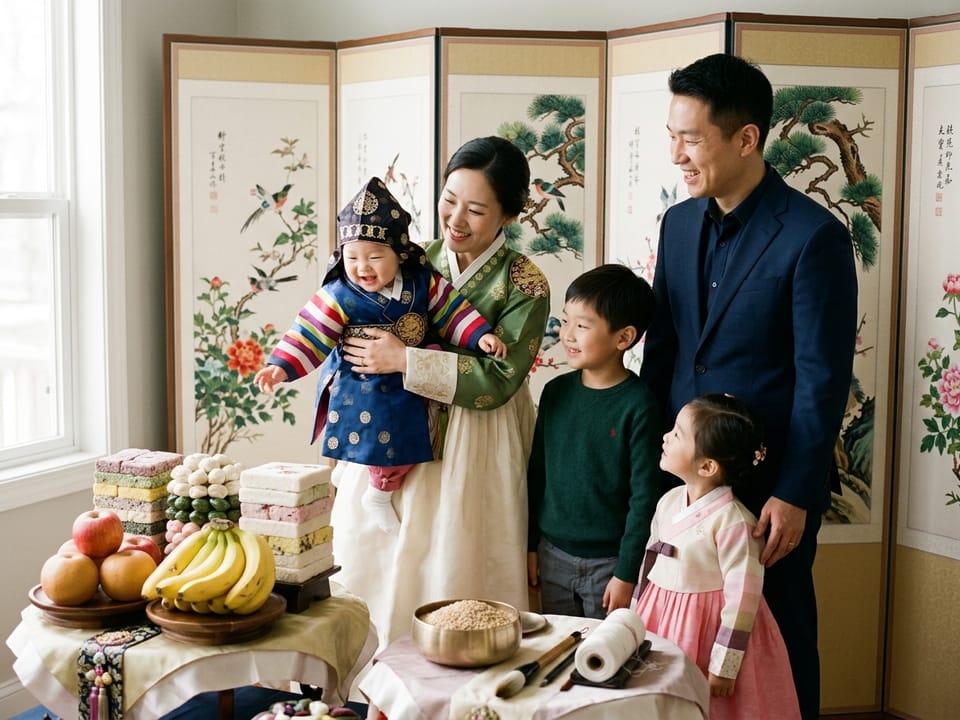
In Korea a child's first birthday is called dol, and it's marked with a decorated dol table. These days the way families celebrate covers a wide range, from a big doljanchi party at a hotel or banquet hall to a family-only meal plus a studio portrait session. Those choices lead to three quite different kinds of dol photos, taken in a studio, by a snap photographer at the doljanchi, or by the family around a dol table at home.
The dol table and doljabi each carry meaning
The first birthday has long been special in Korea because, in the past, infant mortality was high and many babies didn't live to see it. Dol celebrates a year safely passed and wishes the child health and happiness from here on.
The dol table holds baekseolgi, white steamed rice cake standing for purity; susu-patteok, sorghum rice balls coated in red beans, meant to ward off misfortune; noodles and skeins of thread for long life; and jujubes and fruit for a flourishing family line. According to the Academy of Korean Studies' Encyclopedia of Korean Culture, the table traditionally held rice, noodles, jujubes, thread, a brush, ink, books, a bow, money and a ruler, with a bow and arrows added for boys as a symbol of martial fortune and courage, and colored paper, a ruler and thread for girls in the hope they'd sew well.
Doljabi is the moment the child reaches for one of these, which is said to hint at their future. Thread means long life, money or rice means wealth, books or a brush mean learning. Some families now add modern items such as a stethoscope (doctor), a gavel (judge) or a computer mouse.
The traditional outfit for a boy is a jeogori jacket with rainbow-striped saekdong sleeves and baji trousers, layered with a vest and long outer robe and topped with a bokgeon hood. A girl wears a saekdong jeogori with a deep red chima skirt and a decorated jobawi cap.
Option 1: A studio dol photo session
A studio's biggest strength is that lighting, costumes and backdrops are all handled for you. Some can do portraits in dol hanbok in front of a traditional folding screen and then in a dress or a little tuxedo, all in one session. Since the party day itself is hectic, it's also easy to get the portraits done at the studio beforehand.
Things to check before you book:
- Can you see sample photos of babies around one year old, not just newborns?
- How many outfits are included, and is a family photo part of the package?
- How many retouched files do you get, and do you receive the originals?
- How long is the session, and can you pick a time around feeds and naps?
- Is it stroller-accessible, and is there parking?
Prices vary widely between studios. Lining up quotes side by side, with what's included and what costs extra, makes the decision much easier.
Option 2: A doljanchi with a snap photographer
If you're holding a doljanchi at a hotel or banquet hall, you can book a photographer, a stylist and an MC along with the venue.
Give the photographer a written list of must-have shots in advance: the whole family at the dol table, each set of grandparents with the baby, the doljabi moment, close-ups of the hanbok details, and a group photo with the guests. Doljabi in particular is over in a second, so agree on a spot where the photographer can shoot the baby head-on without the MC in the way. Starting the party after the baby's nap keeps the guest of honor happy for longer.
Option 3: A dol table at home, photographed yourselves
Some families deliberately skip the big party in favor of a small, frugal celebration. The Korea Herald has reported on families who simply take photos at a studio and then go out to eat, instead of hosting a party.
For a dol table at home, set a low table in front of a light-colored wall, positioned so window light comes in from the side. Bring the table down to the child's eye level so the child and the food fit in one frame. A few rice cakes and some fruit on your own dishes are plenty, and hanbok can be rented, so there's no need to buy everything. For the family photo, put the phone on a tripod and use the self-timer.
Big party, framed portrait or a quiet day at home
If you're torn, work through it in this order. If you want a lot of people in the photos, hold a doljanchi. When a portrait to frame matters most, go to a studio. For a very shy child, or a small family, do it at home. Combining a studio portrait session with a family-only meal on the day works well too.
Hats first, clean hands, small items out of reach
Babies yank off a bokgeon or jobawi almost immediately, so take the hat shots first. Hanbok sleeves are long; go easy on snacks until the shoot is done so hands stay clean. If your baby is pulling up to stand, use a low chair or a parent's hand just out of frame for support.
With real coins or other small items on the doljabi tray, keep an adult right there so nothing goes in a mouth. The American Academy of Pediatrics' parenting site advises keeping coins and small balls out of young children's reach, and notes that broken or deflated balloons are a choking risk for children up to about age eight. Hang decorative balloons well above a toddler's reach.
When the grandparents live far away
If grandparents overseas or in another city can't make it, pokesta can use AI to create a family photo with everyone in dol hanbok around the dol table, from each person's own phone snapshots. Your first image after signing up is free, and after that it's $1 per photo.
Keep the item with the photos
Put whatever your child grabbed at doljabi in a box with the photos from that day; it becomes a story the family tells for years. Whichever route you take, deciding first what you most want to keep makes the day itself go far more smoothly.
References