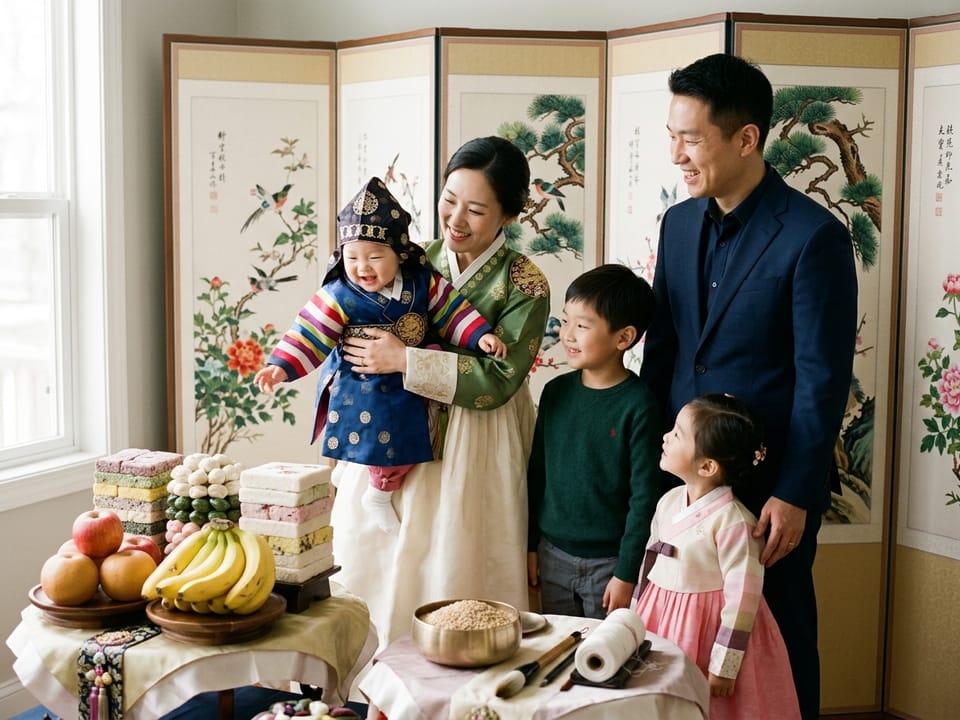
A one-year-old who cries the moment a stranger leans in is right on schedule. The CDC lists being "shy, clingy, or fearful around strangers" among the milestones most babies reach by 9 months, and the American Academy of Pediatrics places stranger anxiety at 7 to 12 months. The first birthday also falls inside the AAP's peak window for separation anxiety, 10 to 18 months. So a dol photoshoot for a shy baby needs warm-up time built into the booking, a shot order that starts on a parent's lap, and a clear answer, before you pay, on what the studio does if the session falls apart.
Shyness at one is a stage, and a studio sets it off
Natgarim (낯가림), as Korean parents call it, arrives right around the age when families book the dol portrait, the first-birthday photos in hanbok in front of a folding screen. Koreans have cherished this birthday since infant mortality was high; at the doljanchi party the baby grabs one object from the round dolsang table, a brush, money or thread, to foretell the future in the doljabi. A studio presses every button: an unfamiliar room, bright lights, a stranger with a camera, and a costume the baby didn't ask for. The AAP notes that at this age even relatives and regular babysitters can make a baby hide or cry, especially if they approach hastily. A smiling photographer striding over is no different.
A second fear joins in around the first birthday. Cleveland Clinic separates stranger anxiety, feeling scared around people the child doesn't know, from separation anxiety, which typically begins at 6 to 12 months and fades by about age 3. The AAP says separation anxiety peaks between 10 and 18 months and gets stronger when a baby is tired, hungry or sick. Tears aimed at the photographer call for a slower approach; tears when you step away call for a different spot for you.
The AAP's advice for this age, written for the first weeks of child care, is to ease in gradually, spend extra time together before parting, and let the baby hold a favorite toy. Crying means the baby needs the room and the people to feel familiar first, not that the day has failed.
The outfit can tip things over by itself. One on-location photographer's listing on Kmong suggests trying the hanbok, hat and shoes on at home first, because hanbok and scratchy fabrics can set a baby off. A boy's bokgeon hood or a girl's jobawi cap is often the last straw.
Book a slot with slack, after a nap
Studios run to the clock. Pureundal Photo Studio's dol price page lists single cuts of 30 minutes per outfit and states that shooting never runs past the booked time. Bebelog Studio in Hwaseong sells a basic package of about an hour with three of its six concepts, and a premium package of about two hours with all six. For a shy baby, fewer concepts in a longer slot beat a full menu squeezed into one hour, and the slot should come after a nap and a feed, which takes tiredness and hunger off the table. Check, too, whether a fever lets you postpone.
Ask whether you can arrive 15 minutes early so the baby can crawl around the set before the lights go on. Cleveland Clinic suggests letting a child warm to a new caregiver by spending time together as a group first; here, that means the photographer chatting with you for a few minutes while the baby watches from your arms. Bring the toy or blanket the baby sleeps with, and a snack that won't stain; Bebelog, for one, lets families bring baby snacks inside.
Start on a lap and save the hat for last
Order the shots from easiest to hardest for the baby. Begin with the family photo, baby on a parent's lap, so nobody has to let go. Next comes the baby alone with that parent crouched just out of frame. Then the parent moves to stand directly behind the photographer at the baby's eye level, so the baby looks toward the lens to find a familiar face. If the crying starts the moment you leave the lap, that's separation anxiety: stay where the baby can see you and keep talking. The hat goes on at the very end, for one or two frames.
Keep the room quiet. One parent talks, everyone else stays silent and out of the baby's line of sight. Ask the photographer to work from a few steps back at first instead of leaning in, and don't hand the baby to staff to be posed.
When the crying starts, stop. Pick the baby up, step out of the room, offer milk or water, and come back once the breathing settles. Ten minutes off usually costs less than twenty minutes of photographing a red face. Pureundal's page is candid about this: with a shy child, it says, parents have to do a lot of the soothing to get good expressions.
Read the reshoot rules before you pay
Most price lists assume the session happens whatever the baby's mood. Pureundal's dol page says that, because the subjects are small children, the shoot goes ahead even if the child doesn't smile, and marks cancellation, postponement and reshoots as not available. Bebelog allows one date change up to three days before the shoot, none on the day, and no refund for cancelling from two days before. The Kmong listing says reshoots and refunds aren't offered because weather and the baby's condition change how photos look, and that extra time caused by the baby's condition is charged.
So ask three things in writing before booking. If the baby can't go on, can the unfinished concepts move to another day? Is a date change allowed when the baby is ill, and at what cost? Is a longer slot available? The prices and rules here were checked in October 2026 and vary by studio, season and plan, so confirm them on each studio's own site.
Studio, on-location photographer or your own phone
|
Studio |
On-location photographer |
Your own phone |
| Example price (Oct 2026) |
Pureundal dol package A, 209,000 won for 4 concepts; Bebelog basic, 190,000 won on weekdays |
Kmong listing, 190,000 won for 60 minutes |
Hanbok rental and props |
| For a shy baby |
New room, lights, stranger |
Familiar place, still a stranger |
Nobody new |
| Changing the date |
Studio's rules |
Listing's rules |
Any day |
| Result |
Lighting, backdrop, retouching |
Natural light, real surroundings |
Depends on you |
A studio earns its fee for the formal portrait: the folding screen, the full dol hanbok, controlled light and a retouched print for the wall. Our dol photo guide covers what a session usually includes, and renting the dol hanbok a week early gives you time to practice wearing it at home. A photographer who comes to you suits a baby who relaxes only in familiar surroundings, and your own phone wins when strangers are simply too much this month.
A portrait made from photos you already have
If the session ends in tears, or you'd rather wait, there's a gentler option. pokesta can turn the phone photos you already have into a dol family portrait in hanbok with AI, at $1 per photo with the first photo free. It's an image made from your pictures, not a record of the day, so treat it as one for the frame or the invitation. Try it with a recent photo of your baby before you book anything: make a dol family photo.
References