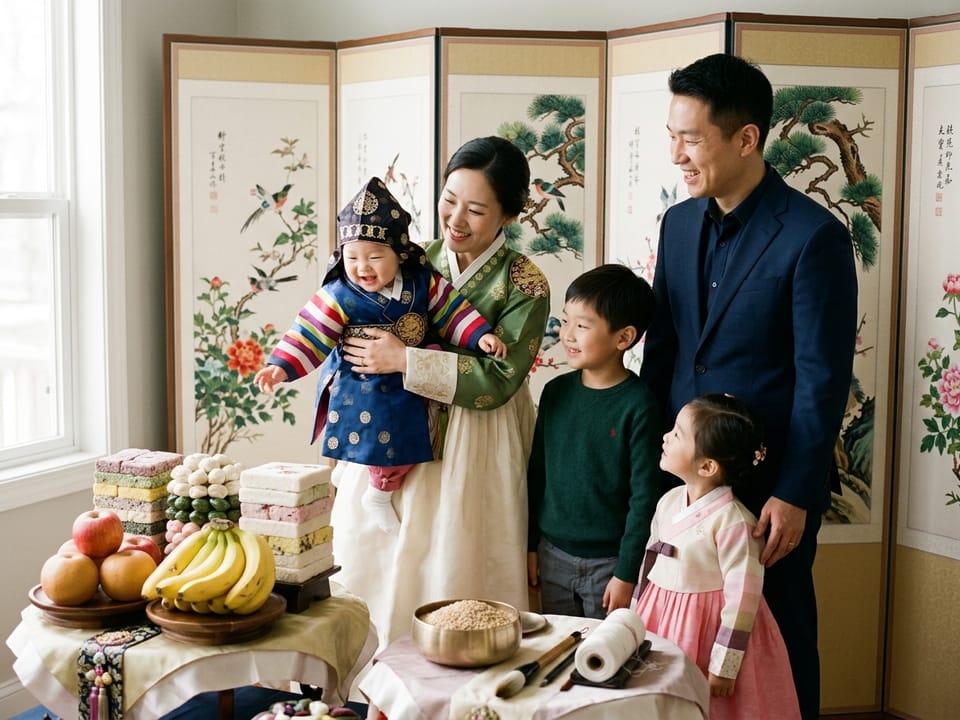
A self photo studio in Korea (셀프 스튜디오, often listed as a rental studio, 렌탈 스튜디오) rents you a styled room by the hour, with backdrops, furniture and often a table setup and outfits, while you press the shutter yourselves. For baby photos at baegil (백일, the 100th day) or dol (돌, the first birthday), it sits between a full studio package and the living room. It works when you book the slot around the baby's feeds, find out what the rate really includes, and treat the props as scenery rather than somewhere to put a baby.
You're renting a room, not hiring a photographer
The rate buys space and time. Listings for these rooms on a Korean parenting directory follow a similar price shape: an hourly rate for a base group (three or four people in the listings checked for this article), a higher rate at weekends and on public holidays, a charge for each extra person, and add-ons for a 백일상 or 돌상 (the decorated 100th-day or first-birthday table), for traditional hanbok, or for a retouched file. What comes free varies. One studio in Gyeonggi Province listed a tripod, a phone holder and a Bluetooth remote at no charge and rented out flash heads and softboxes separately. Another, in North Gyeongsang, included a rail of everyday outfits but charged extra for 백일 and 돌 hanbok, and dressed its tables with fake rice cakes. Prices vary by region, day and plan, so add up the total for your group and your hours instead of comparing headline hourly rates.
What you don't get is someone whose whole job is to watch the baby, the light and the clock at the same time. That's the trade. If one parent is happy running a phone on a tripod and the other is happy being the entertainer, a self studio gives you a clean, styled set without paying for a photographer's time.
Ask these questions before you pay
Read the listing first, then message the studio about anything it doesn't answer.
- Who counts toward the base number of people, and does the baby count?
- Is the 백일상 or 돌상 setup included, which pieces are real, and can you bring your own rice cakes?
- What hanbok sizes are on the rail, and is there anything small enough for a three-month-old?
- Is there a nursing room or at least a private corner, and a changing table?
- Can you get a stroller in, is there a lift, and where do you park?
- If the baby is ill on the day, can you move the booking, and until when?
Facilities are the part listings handle least consistently. Of the two studios above, one had a nursing room with a changing table and a nursing chair; the other said it had neither, and offered a padded topper in its dressing room for changing clothes. If the answer is no, pack a changing mat and plan to feed in the car or a quiet corner. Screenshot the cancellation terms when you pay, because each business sets its own.
Book the slot around a feed, then split it in three
Time inside the room is the scarce thing, and the baby decides how it's spent. Start the booking shortly after a usual feed and before a nap, and if you can, take two hours rather than one. Plan for at least one feed and one change inside the booking, so neither of them comes as a crisis.
Split the time roughly into thirds. In the first, set up while the baby stays in the stroller or a parent's arms: arrange the table, test the light with a parent's face where the baby will be, fix the tripod and the remote, and lay the outfits out in the order you'll use them. In the second, take the baby's portraits, starting with the one you'll print, usually the table shot in hanbok, while the baby is fresh. Leave the third for family photos and anything playful, keeping the last ten minutes for changing the baby, packing and checking under the furniture for socks and dummies.
Work in short rounds. When the baby fusses, stop, feed, and come back to the same setup. That's the reason for setting everything up first.
A 100-day-old lies down; a one-year-old needs a spotter
At a hundred days a baby is a little over three months old. The CDC's milestone checklist for four months lists holding the head steady without support while being held, and pushing up onto the forearms during tummy time; sitting up alone is still months away. So the 100-day table photo is taken with the baby lying on a firm mat on the floor in front of the table, or held on a parent's lap behind it, not propped in a tiny chair or set on the table top. Studio furniture is built to look good in a picture, not to hold an infant.
Raised surfaces are the main hazard in a rented room. The American Academy of Pediatrics' parenting site says never to leave a child unattended on a changing table, even for a moment and even when strapped in, and the same thinking applies to a prop bench, a sofa or a styled bed. One adult keeps a hand on the baby whenever they're off the floor.
By the first birthday, the CDC's checklist has children pulling up to stand and walking while holding on to furniture, which turns every prop into a handhold. Keep a spotter just out of frame. Small things are the other risk. The AAP lists coins, small balls, toys with small parts and button batteries among things to keep away from young children, and warns that balloons are a choking risk up to age eight. Check the table for fake fruit, beads and loose decorations, hang balloons high, and stay right beside the doljabi tray, the objects a child picks from at dol.
Hanbok is layered, so between outfits feel the back of the baby's neck for sweat and take a layer off if they're hot. If the baby falls asleep in a carrier or the stroller, the AAP's advice is to move them onto a firm, flat surface on their back as soon as you can, with any hat removed.
When a photographer is still the better booking
A self studio isn't the cheaper version of everything. If neither parent wants to run a camera while soothing a baby, if grandparents are coming and you want everyone in the frame under good light, or if you want one formal portrait to hang for years, a studio session with a photographer is money well spent. The same goes for twins, and for a baby who only settles in one particular pair of arms. Our guide to dol photos at a studio, a doljanchi or at home compares those routes. A self studio also can't bring relatives who live abroad into the room; pokesta can create a family photo in hanbok from each person's own phone snapshots, at $1 per photo with the first one free.
Decide your three frames before you arrive
Write down three pictures before you go: the table shot, one close-up of hands or feet, and one family frame. Get those, then play. Back up the phone before you leave the building. If the hour runs out before the family picture, a window and a plain wall at home will cover it, and baegil photos at home picks up from there, with the table itself in a self baegil table.
References