
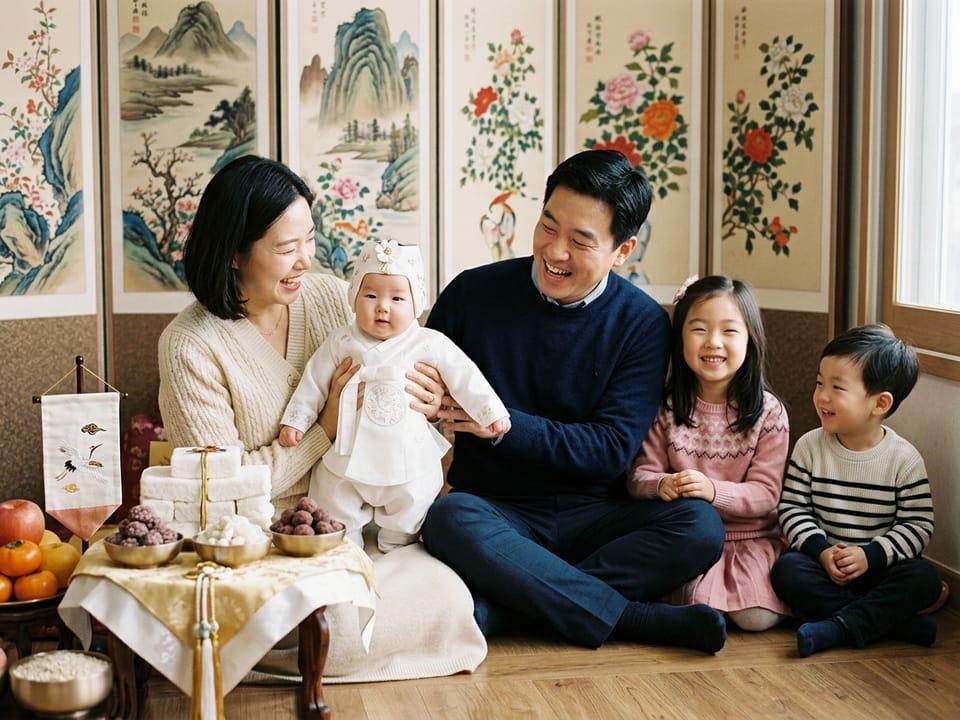
A self baegil table (셀프 백일상) is the table for a Korean baby's 100th day that the family puts together itself, instead of hiring a stylist or booking a studio set. The part that carries the meaning is small and cheap: white baekseolgi rice cake, sorghum balls rolled in red bean, a skein of white thread and a bowl of rice. Buy those fresh, rent or borrow the decorations around them, and build the whole thing to fit the camera's frame rather than the room.
Every item on the table is a wish for the baby
Baegil (백일) simply means "a hundred days." The Academy of Korean Studies' Encyclopedia of Korean Culture traces the custom to a time when medicine was limited and many babies didn't survive those first months, so reaching the hundredth day was worth a feast. Traditionally the day opened with a samsinsang (삼신상), a small morning table of seaweed soup and white rice at which the mother or grandmother prayed for the child's health and long life.
The baegil table laid out for guests holds several kinds of rice cake, fruit and other dishes, with skeins of white thread and rice as wishes for a long life and blessings. Two rice cakes do most of the symbolic work. Baekseolgi (백설기) is steamed rice flour with no coating at all, and the encyclopedia describes it as a food regarded as spotlessly clean and sacred, which is why it became the standard cake for a child's 21st day, 100th day and first birthday.
The second is a sorghum dumpling boiled and rolled in red bean, known as susu-gyeongdan (수수경단), susu-patteok (수수팥떡) or susu-pat-danja (수수팥단자). For a baby's 100th day or first birthday, the encyclopedia says, families made it because red was believed to chase away evil spirits. In the older custom it was made again on every birthday up to the tenth.
The cakes were never meant to stay on the table. After the celebration they went round the neighbors, and a household that received baegil rice cakes sent the bowl back with money or white thread in it. In some regions families handed cakes to passersby too, believing that the more people ate them, the longer and luckier the baby's life would be. One old rule still makes sense: if the baby was ill, there was no feast. A baby with a cold is a good reason to move the table, and the photos, to the following week.
Buy the food, borrow the scenery
That split is where the saving comes from. A rice-cake shop can make baekseolgi and susu-gyeongdan in small quantities, the fruit can come from your kitchen, and white thread and a bowl of uncooked rice cost next to nothing. Real cakes also give you something to share afterwards.
The backdrop is where a rental earns its keep: a folding screen or fabric backdrop, a tablecloth, cake stands, "100" letters or the baby's name. Paid 셀프 백일상 대여 sets in Korea differ widely in what they include, and prices vary by region, season and plan, so compare listings piece by piece rather than by the headline price. Ask whether the table comes with the set, whether the cakes and fruit are models, whether delivery covers both directions, how many days you keep it, and what a late return or a chipped piece costs. Photograph everything as it comes out of the box.
Some public services lend sets free. Seongnam's childcare support center (성남시육아종합지원센터) in Gyeonggi-do runs a free baegil and dol table lending program, with a modern set and a traditional set to choose from. For the baegil table the baby has to be between 90 and 120 days old, and the family has to live or work in Seongnam; foster families in the city can apply too, and so can grandparents living there, for a grandchild's table. Booking is online and first come, first served, from midnight on the second Wednesday of the month before you want the set until 23:59 that Thursday, and you collect and return it in person.
The center lends only the decorative props and a 2,200 × 1,550 mm tablecloth. The table, the food, the outfits and a baby seat are up to the family. Glue and double-sided tape are banned, and anything lost or broken must be replaced with the same item. Other cities and districts run their own schemes, some through a toy library; our piece on dol table rental gathers more examples. Rules change, so read the current notice first.