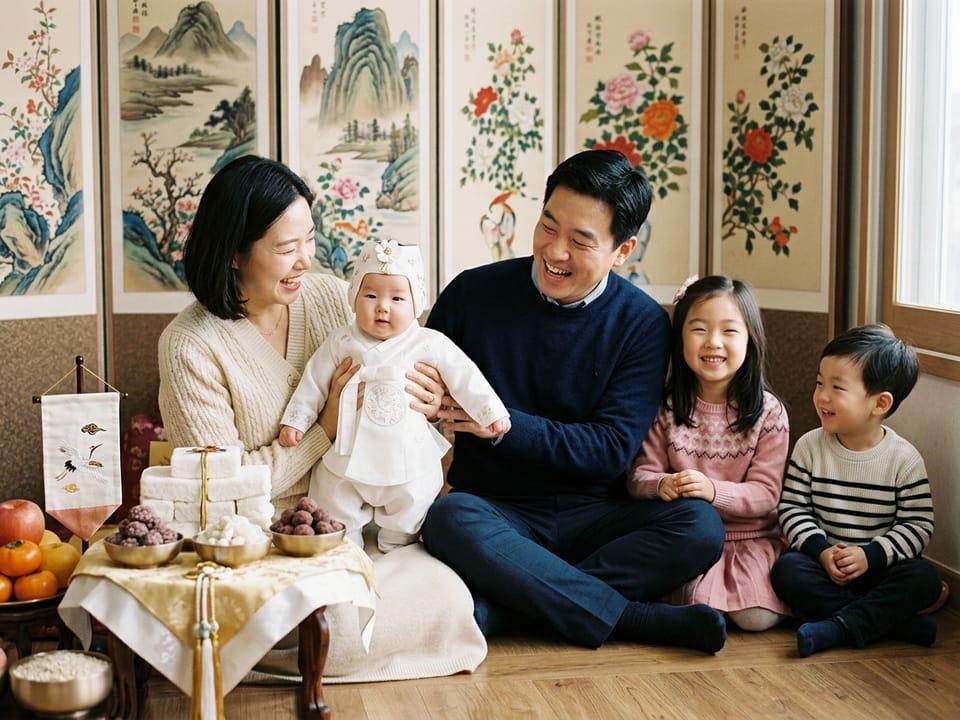
Baegil Photos at Home: Shooting a 100-Day-Old Safely
pokesta Editorial Team · Updated October 12, 2026
Baegil photos at home (백일 셀프촬영) work best with the baby lying on their back on the floor or held by a seated adult, not propped up in a seat at the table. At 100 days many babies are still working on steady head control, so plan the shoot around poses that don't depend on it. Put them in a baby hanbok for a few frames, shoot by a window after a feed, and keep each round to a few minutes.
Plan as if the head still needs your hand
Baegil (백일), the hundredth day, falls a little past three months, an age at which babies differ a lot. The CDC's milestone checklists say that by two months a baby holds their head up while lying on their tummy, and that by four months they hold it steady without support while being held and push up onto their elbows or forearms during tummy time. A baby at 100 days falls in the gap between the two checklists. Some are already steady; others still wobble when tired, and every baby gets tired during a photo shoot.
That is why the classic picture of a baby sitting upright behind the 100-day table is the one to skip. Sitting puts the baby's full weight on head and trunk control they may not have yet, and a slump forward or sideways happens fast. You can get the same feeling of "the baby at their table" with the baby in a parent's arms beside it, which is how our guide to setting up a self baegil table lays the room out.
Four poses that don't need sitting up
The simplest is the baby on their back on a firm mat or folded blanket spread on the floor, photographed from directly above. Not on a sofa, a bed or the table itself: a baby this age can wriggle and push surprisingly far. Shooting from straight above puts the phone over the baby's face, so keep both hands on it or a strap around your wrist.
The second is a tummy shot while the baby is awake, happy to push up, and has an adult right beside them. The American Academy of Pediatrics recommends supervised tummy time while awake every day anyway, so this one costs nothing in safety. Stop when the head starts to droop.
The third is the lap pose. A parent sits on the floor with knees raised, and the baby lies back along the thighs facing the camera, head toward the knees, with the parent's hands along both sides. The fourth is the baby held upright against a parent's chest with a hand behind the head, shot over the shoulder or in profile face to face. These two put a parent in the picture too, which home shoots often forget.
Some families reach for a baby floor seat such as the Bumbo to get a sitting pose, and its history is worth knowing. In 2012 the US Consumer Product Safety Commission announced a repair recall, adding a restraint belt, because babies can maneuver out of or fall from the seat. It said that after an earlier 2007 recall there had been at least 50 incidents of babies falling from a seat used on a raised surface, 19 of them involving skull fractures, plus 34 reports of babies falling or wriggling out of seats used on the floor or at an unknown height. Its instruction was blunt: even with the belt, the seat should never be used on any raised surface. If you use any infant seat, keep it on the floor, keep a hand within reach, and keep it for a baby who already holds their head steady.
Baegil clothes: color for the first time
There is a reason for the bright baby hanbok. The Academy of Korean Studies' Encyclopedia of Korean Culture notes that before baegil babies were mostly dressed in white, and that on the day the white clothes came off and the baby wore colored clothes for the first time. A rainbow-striped saekdong jacket or a soft pastel set both fit that tradition. Since the baby will grow out of it within weeks, renting or borrowing one makes more sense than buying.
Dress the baby last, once the set is ready, and change them out as soon as you're finished. Check that ties and ribbons stay away from the face and neck. The AAP advises against hats indoors once a baby is home from the hospital, so the little hood or cap that comes with some sets is for a frame or two, not the whole session. It also says a baby needs only one more layer than an adult would wear in the same room, and suggests watching for sweating, a hot chest or flushed skin. A hanbok over a bodysuit adds up, and in winter a heated ondol floor warms the mat the baby lies on, so check the chest between rounds.
Window light, right after a feed, in short rounds
Light matters more than any prop. A window that never gets direct sun, such as one facing north, gives soft, even light all day; try it the day before at the hour you plan to shoot, and you'll know whether the room is at its brightest in the morning or the afternoon. Turn the mat so the window sits beside the baby or behind their head, and they won't squint into it. Ceiling lights and flash both stay off, because mixed light leaves the skin one color on the window side and another on the room side.
A fed, burped and freshly changed baby gives you the best stretch, and at this age it is short. Get everything ready first, then shoot two or three rounds of a few minutes each with a cuddle or a feed in between. Smiles are the bonus. The CDC's four-month list includes a baby smiling on their own to get your attention and chuckling when you try to make them laugh, so whoever is best at getting those should stand right behind the phone, with burst mode on to catch the half second it lasts. Before you start, write down the frames you want: the baby alone in hanbok from above, close-ups of hands, feet and the striped sleeves, the baby in a parent's arms beside the table, and one family picture with the phone on a tripod and the self-timer running.
If the baby falls asleep, the shoot is over
A sleeping baby in hanbok on a cushion looks peaceful, but it is the one picture to give up. The AAP says babies should be placed on their back for every nap on a firm, flat surface, and that soft objects and loose bedding raise the risk of entrapment, suffocation or strangulation. If a baby falls asleep in a car seat, stroller, swing or carrier, it advises moving them to a firm sleep surface on their back as soon as possible. Take off the hood, move the baby to their crib, and clear the props away. The photos will wait.
When a studio does it better
A studio earns its fee when you want a formal portrait with controlled lighting and a traditional set, when you'd like both parents in every frame without a tripod, when your home is dark or cramped, or simply when you're too short on sleep to run a shoot. A photographer used to handling babies also knows how to settle one between outfits. Prices in won vary by region, season and plan, so compare what each session includes. A self photo studio rented by the hour is a middle path, covered in our piece on self photo studios for baegil and dol. If grandparents abroad can't be in the pictures, pokesta can create a family photo in hanbok with AI from each person's own phone snapshots, at $1 per photo with the first one free. Other families' 100-day photos are on the baegil page.
Whichever route you take, choose the one frame you'd print and take it in the first round, while everyone is fresh. Anything after that is a bonus.