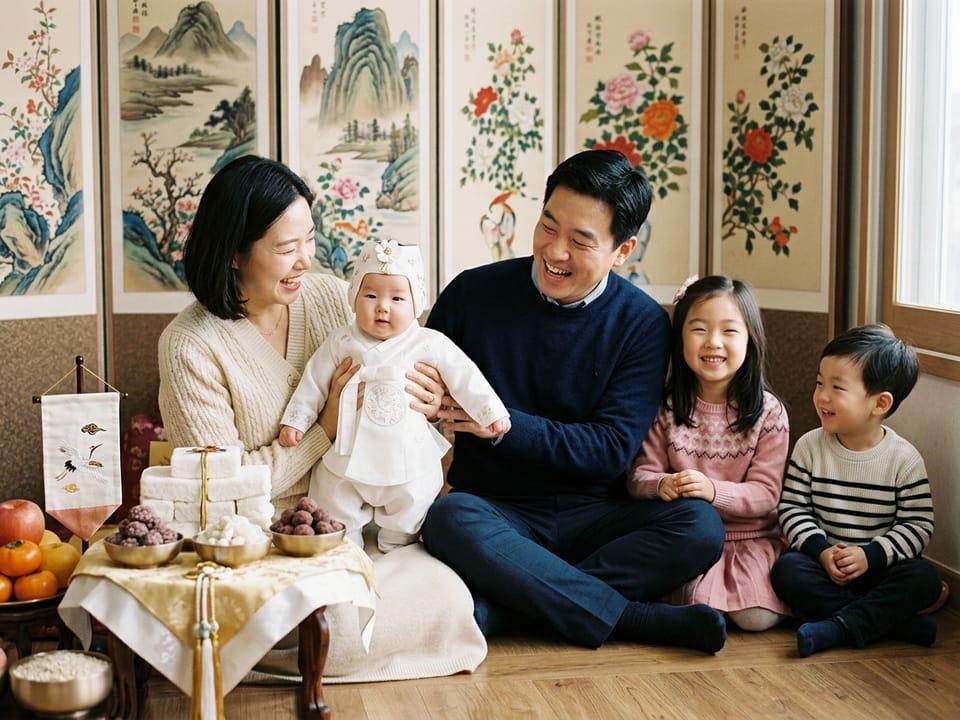
A growth album in Korea, or seongjang album (성장앨범), is a studio package that photographs a baby's first year in stages under one contract, typically from the late-pregnancy mansak (만삭) shoot through 50 days, 100 days and the first birthday. The early shoots are often advertised as free, but the Korea Consumer Agency warned as far back as 2014 that they are only conditionally free. If you cancel after shooting has begun, Korea's consumer dispute standard has you pay for the stages already shot plus 10 percent of the rest, so the cheapest exit is the 14-day withdrawal window that applies to many contracts signed at baby fairs.
One contract covers four or five shoots
Growth albums are sold where new parents gather. When the Korea Consumer Agency (한국소비자원) looked at complaints about them, as the Kyeonggi Ilbo reported in 2014, the package ran from mansak through the newborn weeks, 50 days, 100 days and six months to dol, and the free vouchers covered the shoots from mansak to 50 days. Complaints had risen from 174 in 2011 to 208 in 2012 and 316 in 2013, and more than three quarters of the 2013 complaints (244 cases, 77.2 percent) were about cancelling. Of the 31 cases where the place of signing was known, 14 were signed at childbirth and parenting fairs, 12 at postpartum care centers and 5 through online parenting communities. In the 150 cases with a known amount, nine in ten albums cost between 500,000 and 2 million won.
Those numbers are more than a decade old, but the pattern hasn't gone away. In June 2026 the Fair Trade Commission (공정거래위원회) and the agency met photography trade groups about pricing, citing 1,670 relief applications about photo shoots from 2022 to April 2026. According to Herald Economy, 262 of them (15.7 percent) involved "free shoot" sales tactics, 190 of those were disputes over cancellation, and where the amount was known the average contract came to 787,705 won. That figure covers every kind of free-shoot offer, not just growth albums, and it isn't a price guide. Packages vary by region, studio and plan.
The free shoots assume you finish the package
The agency's warning in 2014 was plain: the free vouchers are offered on condition that you sign for the whole growth album, so don't sign on impulse because the first shoot costs nothing. Of the 198 complaints where the timing of cancellation could be confirmed, 74 (37.4 percent) came from parents who had already used the free shoots.
That is the trap. The maternity and 50-day sessions feel like gifts, but once you've used them and want out, they count as completed stages. Before signing, ask for a price against every stage in the contract, the free ones included, and a list of what each stage delivers: how many retouched images, which outfits, and whether a printed album is part of it.
Cancelling after the first shoot costs the shot stages plus 10 percent
The Fair Trade Commission's consumer dispute resolution standard (소비자분쟁해결기준), which the agency attached to its April 2025 warning about free photo shoots, has a rule for commemorative photos taken more than once, naming growth albums as the example. It splits cases by who caused the cancellation and whether shooting had started.
If you cancel for your own reasons before any shooting, you bear 10 percent of the total fee. If you cancel after shooting has started, you bear the cost of the stages already shot plus 10 percent of the remaining amount, but not the price of any album not yet made. Where the contract gives no cost for each stage, the standard works it out by proportion: stages shot, divided by total stages, times the total fee. The studio has to prove any album price it claims.
So a five-stage package cancelled after two shoots, with no stage prices written down, would leave you owing two fifths of the total fee plus 10 percent of the remaining three fifths, even if those two shoots were advertised as free. If the studio is the one at fault, the deposit comes back either way. Before shooting, the studio also owes you 10 percent of the total fee; after shooting has started, it must hand over the original images from the stages already shot.
A baby-fair contract usually gives you 14 days
Korea's Door-to-Door Sales Act (방문판매법) gives buyers in a door-to-door sale 14 days to withdraw. The government's legal information site counts them from the day you receive the contract, or from delivery if goods arrive later, with a later start if you were never given a contract. The agency treats a fair, which isn't a seller's permanent place of business, the same way: in the 2014 report it said a growth album signed at a baby fair can be withdrawn within 14 days under that law, and that a contract signed at the studio, or one past the 14 days, can still be cancelled under the law and the dispute standard, just not for free.
Check where the fair takes place. In a wedding-fair case that SBS Biz reported in May 2026, a buyer who had paid a deposit for wedding jewelry asked to cancel seven days later, and the agency decided the deposit had to be returned because the request came within 14 days. Its dispute mediation team also noted that a contract signed at a fair the business holds on its own premises may not carry the right to withdraw. Send the withdrawal in a form you can prove later, and keep the contract, payment records and booking messages.
Put the files, the album and the payments in writing
For the originals of 100-day and dol portraits, the same dispute standard lets the contract decide. Only when the contract is silent do the digital files go to the customer, at the cost of materials, and the standard's "original" is the final retouched file rather than every frame from the session. Handing files over doesn't transfer copyright, and a business that keeps originals keeps them for one year. A growth album can run from late pregnancy to past the first birthday, which is longer than that, so ask for each stage's files when the stage is finished instead of waiting for the album. If you want the unedited frames too, write that down, with the number of images, the resolution and the delivery date.
The request that came out of the June 2026 meeting was for businesses to post itemized price lists and to explain extras such as original files, albums, frames and outfit rental before the shoot. For a package, ask for that list stage by stage. The agency's 2014 advice on payment still makes sense: pay stage by stage, and by credit card where you can, so you can use your right to withhold payment if the studio closes or the photos are lost. If you can't settle a dispute directly, the 1372 Consumer Counseling Center and the Consumer 24 website take complaints.
Sign for the stages you know you want
A package earns its price when you've seen this studio's own sample photos for every stage and like them, when you want the same lighting and style across the whole year, when a photographer experienced with newborns matters to you, and when the studio is close enough to return to four or five times with a baby. Outfits, sets and retouching are all handled for you. If you aren't sure, book one milestone at a time, or shoot some of them at home with a matching frame, as our DIY growth album guide explains; first-birthday coverage on the day has its own price logic, covered in dol snap costs. If the gap in the album is a grandparent abroad, pokesta can create a family photo in hanbok with AI from each person's own phone snapshots, at $1 per photo with the first one free. You can see other families' 100-day photos on the baegil page.
A free shoot is worth exactly what the cancellation clause says it is. Read that clause first.
References
- Don't be caught out by "free" photo shoots, with the dispute resolution standard attached (Korea Consumer Agency, 2025, in Korean)
- "Free shoot" vouchers and baby growth albums (Kyeonggi Ilbo, 2014, in Korean)
- Government moves on photo studios' hidden fees (Herald Economy US edition, 2026, in Korean)
- Wedding fair contracts and the 14-day withdrawal (SBS Biz, 2026, in Korean)
- Buying goods: cooling-off periods for special sales (Easy-to-Find Korean Law, in Korean)