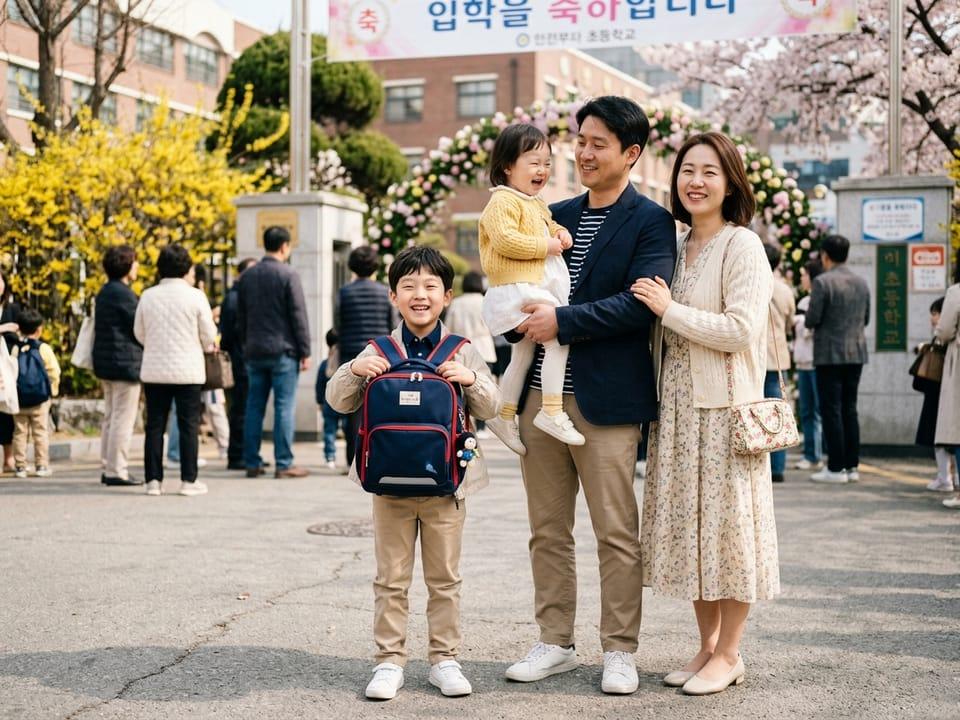
A Korean elementary school entrance ceremony (입학식) is usually held on March 2, the first school day after the March 1 holiday, and it is short, on a weekday morning and crowded with parents. The photos that work tend to be taken around it rather than during it: the banner on a quieter morning, one picture outside the classroom before the ceremony, and the new backpack at home the night before. Dress your child for a morning not far above freezing, and check the fine dust grade the evening before.
A short weekday ceremony, and everyone wants the same spot
The Korean school year starts in March. Because March 1 is a national holiday, most entrance ceremonies fall on March 2, moving to the following Monday when that date lands on a weekend. In 2027 March 1 is a Monday, so most schools will hold the ceremony on Tuesday, March 2. The programme is brief: an opening, the national ceremony, the new pupils' pledge, the declaration of admission, speeches from the principal and guests, and the announcement of each class's homeroom teacher.
Then every family heads for the same place, the welcome banner (입학을 축하합니다) or the decorated gate. How many parents may come in, and where they can stand, differs from school to school. Read the family letter (가정통신문) sent before the day for the start time, the entry rules and whether the ceremony is in the hall or in classrooms.
Take the banner photo before the crowd does
The queue at the banner forms in the minutes after the ceremony, when every child is released at once. If the school puts the banner or gate decoration up ahead of time, a weekend morning before the first day, or the morning itself before the gate gets busy, gives you the photo without a line. Ask the school office whether families may come onto the grounds outside school hours, because some schools keep the gate shut.
On the day, aim for one photo outside the classroom or by the shoe lockers before the ceremony, while your child is still curious rather than overwhelmed. Afterwards, follow their lead. A first-grader who has just spent an hour being brave may simply want to go home, and that is a reasonable end to the morning.
Cold snaps and fine dust: plan for both
Early March can turn cold again after a run of mild days, the spring cold snap known as kkotsaem-chuwi (꽃샘추위). Seoul's 1991–2020 normals from the Korea Meteorological Administration put March's average high at 11.0°C and its average low at 1.9°C, and a morning ceremony sits near the low end. Dress your child in layers under a coat that comes off only for the photo, and keep outdoor pictures short. Cold mornings drain phone batteries faster, so keep the phone in an inside pocket until you need it.
Air quality is the other variable. AirKorea sorts fine dust into four grades. For PM10, in micrograms per cubic metre, good is 0–30, moderate 31–80, bad 81–150 and very bad 151 or more. For PM2.5, good is 0–15, moderate 16–35, bad 36–75 and very bad 76 or more. Check the forecast the night before. If it's bad or worse, take the outdoor pictures quickly, keep masks on until the moment you press the shutter, and move the bigger family photo indoors or to another day.
Yellow dust (황사) blown in from the continent is a separate problem. The Korea Meteorological Administration notes that it reaches Korea mainly in spring, though it now arrives in autumn and winter as well. On a hazy morning colours look flat, so an indoor photo by a window will usually look better than the schoolyard.
A nervous child gets one photo, not twenty
Some children cry at the gate. Keep the ritual small: one photo before the ceremony, holding your hand if they want to, and no restaging for a better angle. Agree the night before on where that one photo will be, so it feels like a plan the two of you made rather than something sprung on them at the gate. The more relaxed pictures often come the night before. Pack the new school backpack (책가방) together and photograph your child wearing it at the front door, with the name tag on and the indoor shoes ready. That picture is calm, well lit and entirely yours, whatever happens in the morning.
Studio, a hired photographer or your own phone
|
Studio session |
Photographer at the ceremony |
Your own phone |
| How cost works |
Session, retouched images, frames |
By the hour, plus travel |
Free |
| Cold and dust |
Indoors |
Same weather as you |
Same weather, but you pick the moment |
| Changing the date |
Rebook |
Tied to the ceremony |
Nothing to change |
| What you get |
A portrait, not the day |
Everyone in the frame |
Real moments |
| Suits |
A framed gift for grandparents |
Rarely needed |
Most families |
A studio session in February is worth booking if you want one polished portrait for the wall or for the grandparents; where to take starting-school photos compares that with the gate and home. A hired photographer rarely suits a ceremony this short, and a school may not let one in, so ask before you book anyone.
When the morning didn't give you the photo
If the dust grade or a tearful goodbye cost you the picture, pokesta can create a starting-school family portrait with AI from the photos already on your phone, with the backpack and a spring school gate. It's $1 per photo and your first photo is free, so try it with one recent picture of your child. The result is a made image, not a record of the ceremony, so keep it next to your real snapshots: create a starting-school photo. Ideas from other families are under the starting-school tag.
References