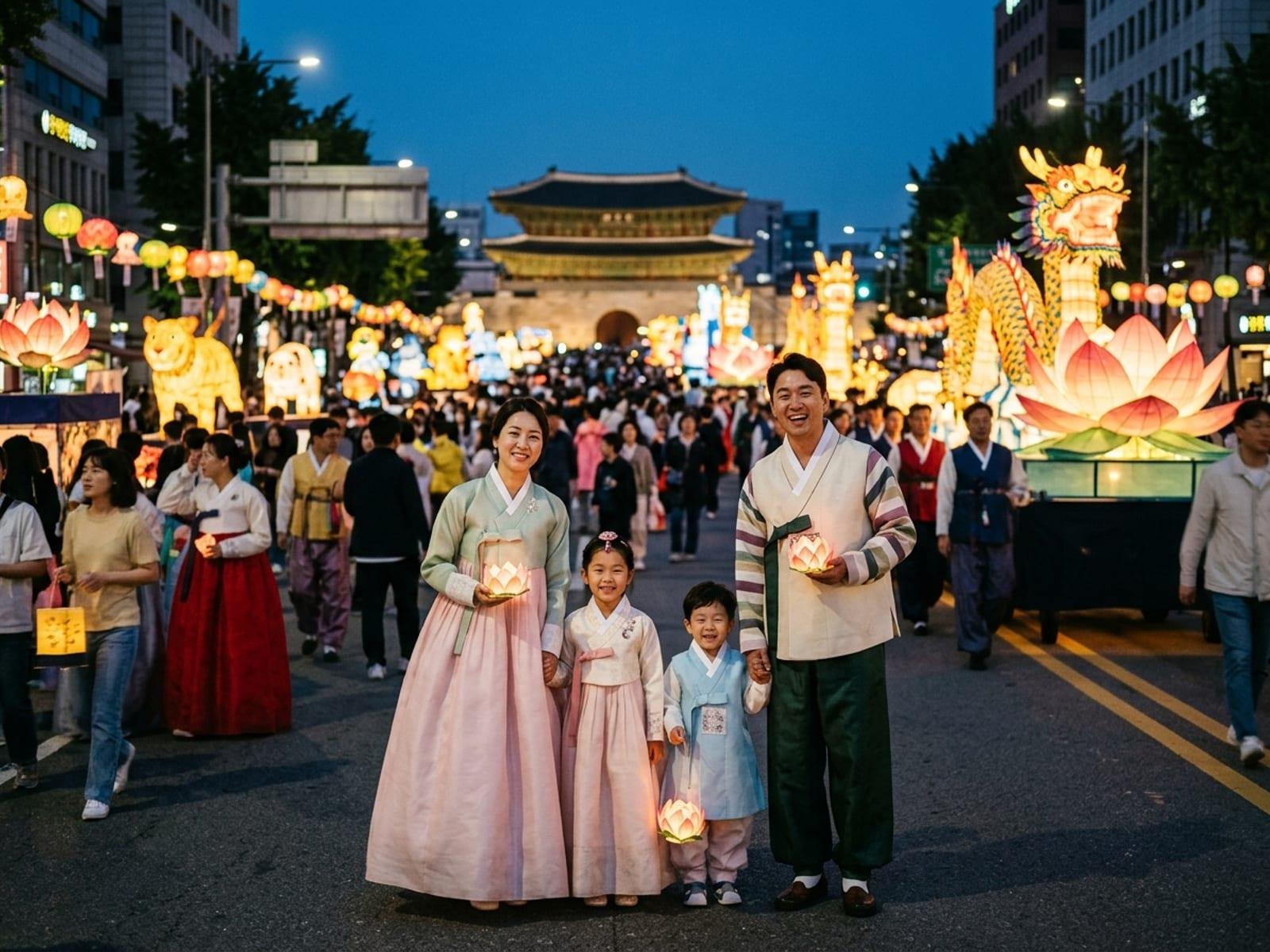
The Lotus Lantern Festival (Yeondeunghoe) is Seoul's festival of light before Buddha's Birthday (the 8th day of the fourth lunar month): on the Saturday night of the preceding weekend, a parade of lotus lanterns travels from Dongdaemun along Jongno to Jogyesa temple (May 16 in 2026). It's a Buddhist event, but anyone can watch from the roadside, and on Sunday there are hands-on activities such as lantern making around Jogyesa. With children, claim one spot on the route early and check your walk to the subway in daylight.
As Buddha's Birthday approaches, Seoul's temples and streets fill with colorful lotus lanterns, and on parade night they become a single river of light moving down the city's old main avenue.
Lighting lamps since the Silla kingdom
Yeondeunghoe celebrates the birth of the Buddha by lighting lamps, with light standing for his teaching. One view traces it back to the Palgwanhoe, which began in 551 under King Jinheung of Silla, and there's a record of a lantern ceremony at Hwangnyongsa Temple in Gyeongju in 866. Silla's lantern rites combined offering light to the Buddha with rituals for the dragon spirits believed to protect farmers and the nation. Buddha's Birthday falls on the eighth day of the fourth lunar month and is a public holiday in Korea, known as Bucheonnim Osin Nal. Because it follows the lunar calendar, the Gregorian date changes each year, landing somewhere between late April and late May.
Yeondeunghoe is designated a National Intangible Cultural Heritage in Korea, and in 2020 it was inscribed on UNESCO's Intangible Cultural Heritage list. One reason cited is that it's an open event where people of every age and background take part together. The Seoul parade has not always gone ahead: it was canceled in 1961, 1970 and 1980, and again in 2020 because of the pandemic. That it has continued at all gives the festival some of its weight.
The most common lantern subject is the lotus, a flower held dear in Buddhism. Large lanterns are also built by stretching hanji, traditional Korean paper, or silk over bamboo or metal frames, in the shapes of cranes, fish, drums and flowers. These days LEDs increasingly replace candles for safety. There are also lanterns of King Sejong, who created the Korean alphabet, and of figures in hanbok, so different kinds of subjects share the same procession.
The parade is Saturday night, the activities are Sunday
Seoul's festival takes place on a weekend before Buddha's Birthday. Here's how it ran in 2026:
- Saturday (May 16), from 4:30 p.m.: pre-parade gathering at the Dongguk University sports ground
- Saturday, 7–9:30 p.m.: lantern parade from Heunginjimun (Dongdaemun Gate) along Jongno to Jogyesa Temple
- Saturday, from 9:30 p.m.: post-parade dancing and performances at the Jonggak intersection
- Sunday (May 17), 11 a.m.–7 p.m.: traditional culture events and activities on the streets around Jogyesa
- Sunday, 7–9 p.m.: closing parade along Insadong's main street
About 50,000 people marched in the 2026 parade, and roughly 100,000 lanterns lit up Jongno. Four robot monks in Buddhist robes joining the procession made headlines. That year's theme was "Peace in the Mind, Harmony in the World." The president of the Jogye Order urged people to light a lantern of peace within and carry a lantern of harmony to dispel the darkness of the world. The schedule is announced each year by the festival's preservation committee.
Sunday's traditional culture events line the streets with booths for making lotus lanterns, tasting temple food, playing traditional games and trying Buddhist art. Most involve working with your hands, so children too young for the parade can still have fun here. The lotus lantern you make is simple: you glue thin paper cut into petal shapes, one by one, onto a round white lantern frame. A primary-school child can finish one from start to end and carry it home. Jogyesa, Bongeunsa in Gangnam and the Cheonggyecheon stream also display traditional lanterns around Buddha's Birthday, so you can see lantern decorations in daylight too.
In hanbok, add a layer for the evening chill
There's no dress code for the festival. Many people in the parade wear hanbok, so a family watching from the roadside in hanbok fits right in. May in Seoul can be warm in the daytime and cool at night, and the parade runs for more than two hours from 7 p.m., so bring a light down jacket or a cardigan.
Jogyesa is also a place of worship. Services may be under way in the temple grounds, so let your children know not to shout or cut in front of people praying. The lanterns are handmade and fragile; look, but don't touch.
If you'd like a picture of your family in hanbok beneath the lotus lanterns, you can try one with pokesta's AI photos ($1 per photo, and the first one is free).
With kids, pick your spot and your way home first
Crowds build along the parade route well before dark. With small children, the realistic plan is to settle early in one place, either near the start on the Dongdaemun side or near the end by Jogyesa, and stay put. Lifting a child onto your shoulders blocks the view of people behind you, so avoid it where it's crowded. If you're waiting on the Dongdaemun side, an early dinner at the nearby Gwangjang Market food stalls keeps hungry kids from melting down before the lanterns arrive.
Roads around Jongno and Jogyesa are closed before and after the parade. Plan to go home by subway, and walk the route to your nearest station in daylight so you know it. After the parade, dancers, performers and spectators keep the party going at the Jonggak intersection, but there's no need to stay that long with children. Many kids are flagging by 9 p.m., so with preschoolers it's perfectly fine to decide in advance to watch only the first part of the parade and then leave. Even if you miss the parade, Sunday's daytime activities and the temple lantern displays give you a real taste of the festival.
When it happens and how to get there
The dates are worked out backward from Buddha's Birthday on the eighth day of the fourth lunar month, and the parade usually falls on the weekend before. In 2026, Buddha's Birthday was May 24 and the parade was May 16. On Buddha's Birthday itself, temples across the country, including Jogyesa and Bongeunsa, hold services and the bathing-the-Buddha ritual, in which water is poured over a statue of the infant Buddha with a ladle. Temples get very crowded that day, so families will find it easier to plan around the parade weekend beforehand. The 2027 dates had not been announced at the time of writing.
The gateway is Incheon International Airport (ICN). The AREX airport railroad reaches Seoul Station in about an hour. Jongno, Insadong and Jogyesa are all in the city center and easy to reach by subway from anywhere. Entry requirements for Korea depend on your nationality, so check your own government's official information.
If you're also heading south for spring blossoms, see our article on the Jinhae Gunhangje Festival; for the season of new tea leaves, there's Boseong's green tea fields.
You don't need to see the whole parade. If you can stand by the roadside with your children for the first few minutes as the lights come toward you, you've seen what Yeondeunghoe is about.
References