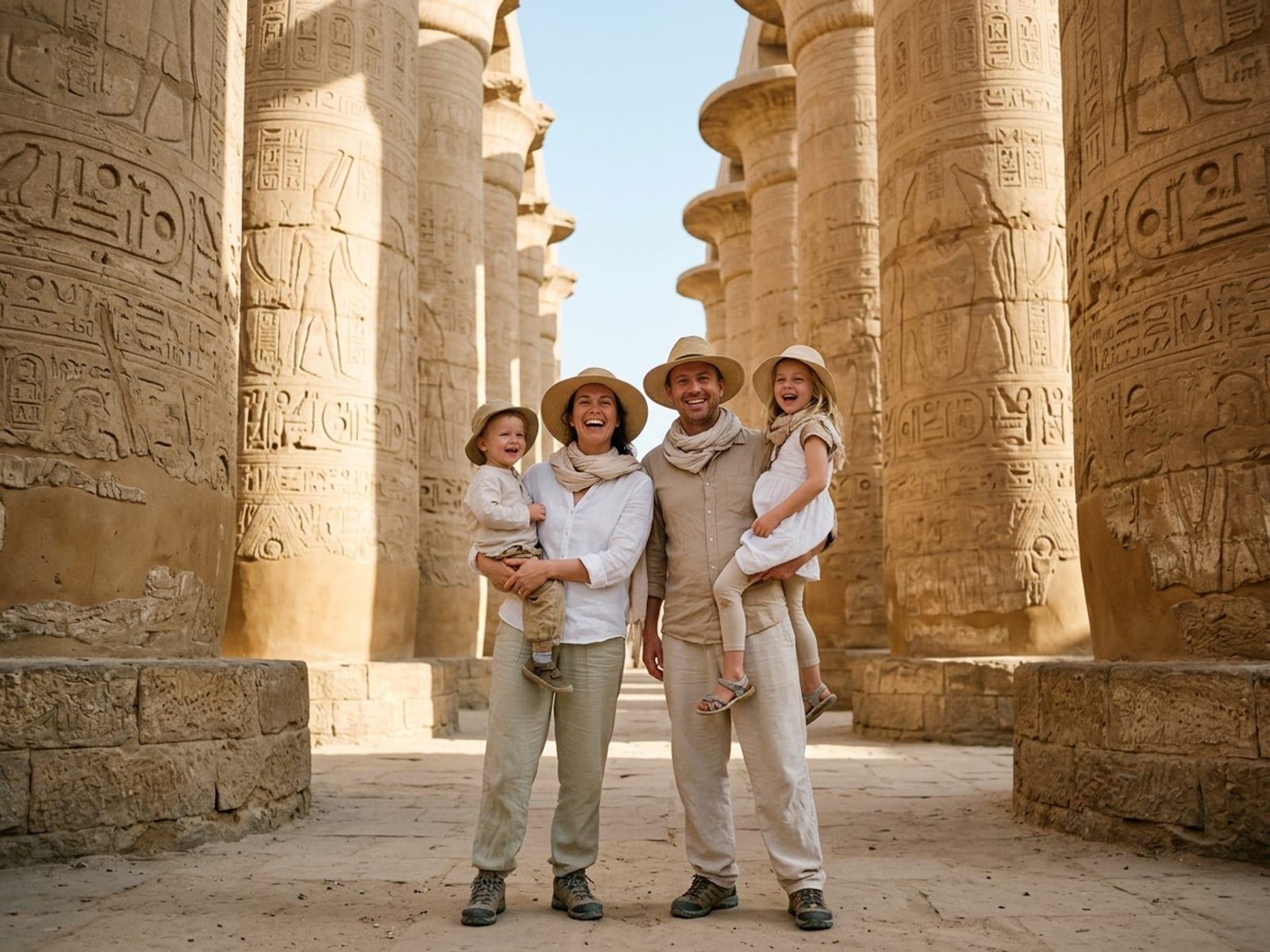
Stone columns so thick you cannot see past them stand like a forest. Karnak Temple in Luxor, a vast temple complex at the heart of the ancient capital of Thebes, is said to be the second most visited ancient site in Egypt after the pyramids of Giza. With children, the way to beat the heat is simple: go in right at opening on a morning between November and February, see the Hypostyle Hall and the obelisks, and wrap up before noon.
A temple enlarged by some 30 pharaohs over nearly 2,000 years
Karnak lies about 2.5 km north of the town of Luxor, on the east bank of the Nile. Construction began under Senusret I in the Middle Kingdom and continued into the Ptolemaic period. Most of what survives dates from the New Kingdom, and around 30 pharaohs are thought to have contributed to it. Its ancient name was Ipet-isut, "the most selected of places." The modern name, Karnak, comes from the nearby village of el-Karnak and is said to mean "fortified village."
The complex is divided into several precincts, but only the largest, the Precinct of Amun-Re, is open to the public. Together with Luxor Temple and the Valley of the Kings across the river, it was inscribed as a UNESCO World Heritage Site in 1979 as "Ancient Thebes with its Necropolis."
The Hypostyle Hall, the obelisks and the sacred lake
The highlight is the Great Hypostyle Hall. In about 5,000 square meters stand 134 columns in 16 rows. Of these, 122 are 10 meters tall, and the 12 along the central aisle are 21 meters tall. The stone architraves laid across the tops of the columns are estimated to weigh about 70 tons each. The column surfaces are densely carved with gods, kings and hieroglyphs. Ask children how many columns they can count, and walking between them feels like wandering through a forest.
Of the two obelisks Queen Hatshepsut raised at the temple's entrance, one still stands and is the second-tallest ancient obelisk still standing anywhere in the world. The other has fallen and broken. The Precinct of Amun-Re also has an obelisk 29 meters tall and weighing 328 tons, as well as a 10.5-meter statue of Pinedjem I. A sacred lake, still filled with water, also survives in the Precinct of Amun-Re.
Ram-headed sphinxes line the approach at the entrance. Children easily recognize the sheep faces, and they make a good backdrop for photos. Four of the ram-headed sphinxes brought from Karnak have stood since 2020 in Tahrir Square, the gateway to Downtown Cairo. Another game that tends to absorb children is hunting through the carvings on columns and walls for cartouches, the oval frames around a king's name. Find the same frame several times and you can guess the same king built that part. Before the trip, look up the cartouches of Ramesses II and Queen Hatshepsut together in a book, and the treasure hunt on site becomes much more fun.
The 2.7 km Avenue of Sphinxes to Luxor Temple
In ancient times, Karnak and Luxor Temple were linked by a single processional way: the Avenue of Sphinxes, 2.7 km long and lined on both sides with 1,057 statues. Of these, 807 are human-headed sphinxes and 250 are ram-headed figures. After more than 70 years of excavation and restoration, it opened to the public on November 25, 2021. During the ancient Opet Festival, the statue of the god Amun was carried by river from Karnak to Luxor Temple, where it is said to have stayed for a time with his consort, the goddess Mut.
Luxor Temple stands in the middle of town on the east bank of the Nile. Amenhotep III built its inner sanctuary, and Tutankhamun and Ramesses II added to it. Of the two obelisks that once stood at its entrance, the smaller one now stands in the Place de la Concorde in Paris. Inside the temple is the Abu Haggag Mosque, still in use and built on top of ancient columns. Walking the full 2.7 km avenue with children can be quite a burden depending on the season. You can also travel between the two temples by car, so walk only part of the avenue, or decide based on how the children are doing.
With kids, go on a winter morning
Luxor's heat is harsh: the average high is about 23°C in January, about 35°C in April and about 41°C in July. October is still around 35°C. It almost never rains. For walking the ruins with children, the cool season from around November to February is easiest, and the first hours after opening best of all. The columns of the Hypostyle Hall cast some shade, but most of the temple is wide open ground with nothing to block the sun. Bring hats, water and sunscreen, and plan to rest at your hotel through the hottest part of the day.
The temple floor is stone and sand, with steps here and there. Strollers are hard to push in many places, so a baby carrier suits small children better. Before going in, agree with the children that they will not climb on or touch the ancient statues or wall carvings. Opening hours and admission fees can change, so check the Egyptian tourism authorities' official information before you go.
Getting there and spending time in Luxor
The gateway airport is Luxor International Airport (LXR), on the east bank. Luxor is about 670 km from Cairo; besides domestic flights, several trains run each day, including overnight services. Luxor station is only about 400 meters from Luxor Temple.
The town is split by the Nile: Karnak, Luxor Temple and the Luxor Museum are on the east bank, and the Valley of the Kings and the Valley of the Queens on the west bank. You can cross between the banks on the local ferry that leaves from opposite Luxor Temple, or by slightly pricier motorboat. By road, you cross on a bridge upstream. With children, spending the first day on the east-bank temples and the second on the west-bank tombs, one bank per day, keeps travel to a minimum.
The Valley of the Kings on the west bank is where royal tombs were built for about 500 years, from around 1539 BC to around 1075 BC, spanning the 18th to 20th Dynasties, and 65 tombs and chambers are known. It was here, on November 4, 1922, that Howard Carter found the tomb of Tutankhamun (KV62). Because of its many visitors, Tutankhamun's tomb requires a separate ticket. His golden funerary treasures have been moved to the Grand Egyptian Museum in Giza, but the king's mummy remains in the valley. See the treasures in the museum and then visit the tomb in Luxor, and for children it all links up into one story.
You can also see what your family standing among the giant columns might look like with pokesta's AI-generated photos ($1 per photo). If you are continuing south along the Nile, feluccas and Nubian villages in Aswan fit into the same itinerary, and beyond them lies Abu Simbel, where the sunrise reaches the inner sanctuary on February 22 and October 22. Entry requirements for Egypt vary by nationality, so check your own government's official information before you travel.
References