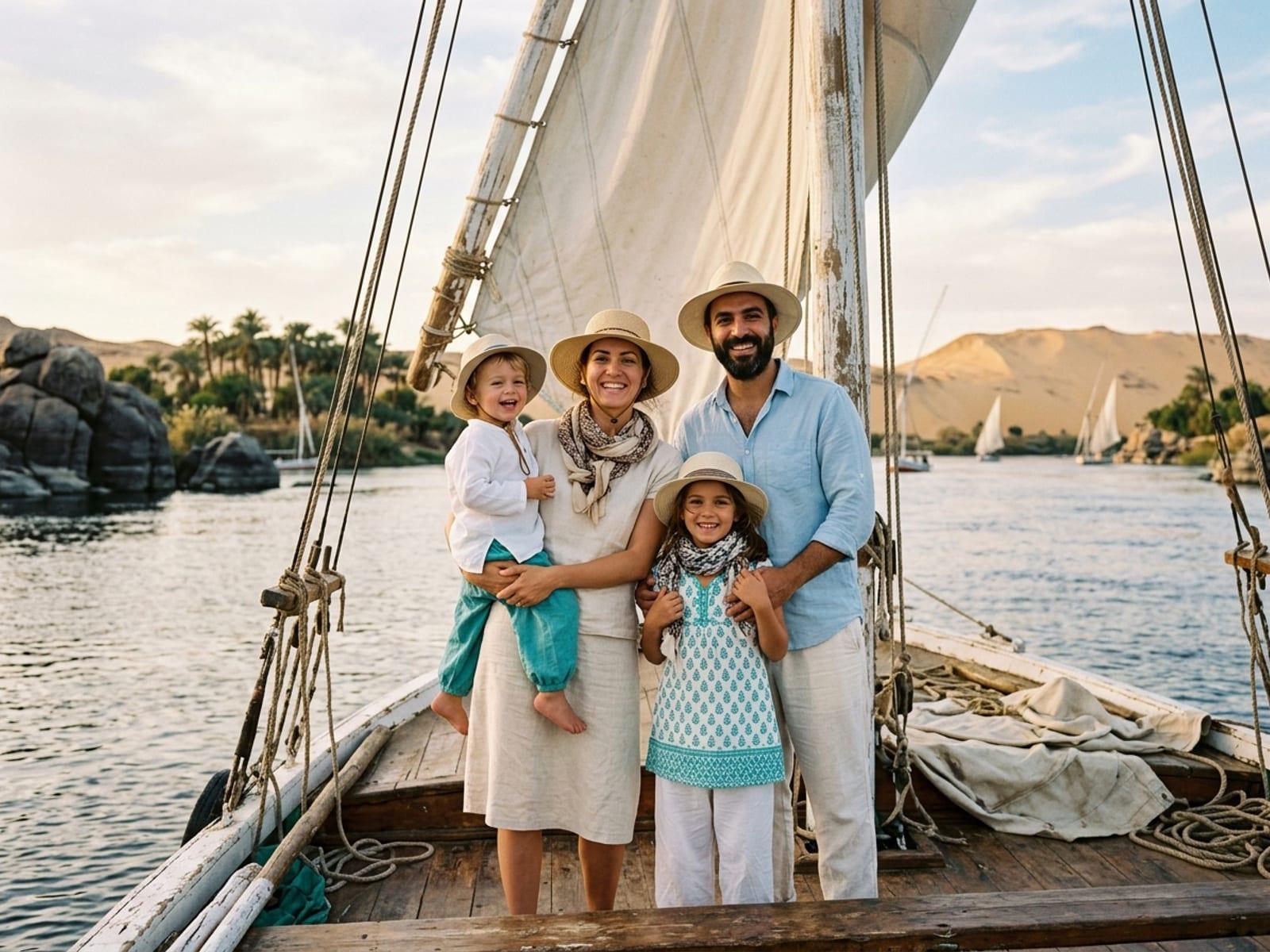
Wooden boats with white triangular sails glide slowly between black granite boulders and palm-covered islands, while golden dunes rise on the far bank. Aswan, in southern Egypt, is one of the most beautiful places to see the Nile. With children, the plan is to sail out on a felucca on a cool winter evening, then spend the next day in the brightly painted village where Nubian people live and at the Nubian Museum. Split over two days, that leaves the hot middle of each day free for a rest at the hotel.
Aswan, the town on the First Cataract
Aswan is an Upper Egyptian city on the east bank of the Nile, facing the First Cataract (a stretch where the river runs fast over rocks), and it is the capital of Aswan Governorate. Its population is about 370,000 (2024). Just south of the city are the Aswan Low Dam, completed in 1902, and the Aswan High Dam, built between 1958 and 1970, which created Lake Nasser.
Islands large and small dot the river. Elephantine Island was once a separate town but is now part of the city of Aswan, and the remains of its ancient town are one of the sites making up the UNESCO World Heritage Site "Nubian Monuments from Abu Simbel to Philae." Nearby is El Nabatat Island, known as Kitchener's Island, which is entirely a botanical garden: about 17 acres (about 7 hectares) divided into seven sections and greenhouses. From the Nile Corniche, the landscaped riverside promenade, you can watch Elephantine Island and the feluccas sailing past.
Sailing between the islands by felucca
A felucca is a traditional wooden sailboat with one or two triangular sails. It usually carries up to about ten passengers and is handled by a crew of two or three. In Aswan and Luxor, feluccas are still used to get around on the river, even with motorboats and ferries available. With no engine noise and an easy pace, they are popular with travelers too.
In Aswan, many destinations are on islands in the river, so water taxis are an important way to get around town. A felucca is less about getting somewhere and more about enjoying time on the water itself. Watch the shoreline rocks of the islands, the palm groves and the dunes on the far bank shift slowly past, at an easy pace with the children. Because a sailboat depends on the wind, how it moves and how long it takes vary with conditions. Before boarding, agree clearly with the boatman on the route, the time you will be back, the price, and whether it is per boat or per person.
Late afternoon, when the sails and rocks turn gold, is the most beautiful time. On the river, though, the wind blows through, and in winter it turns cold quickly after sunset. Bring an extra layer on board.
Gharb Soheil, a Nubian village
South of Aswan, spreading across the sandy slopes of the Nile's west bank, is Gharb Soheil, a village of Nubian people. It was founded about 100 years ago, around the time the old Aswan Dam was built, and takes its name from its position west of Soheil Island. Nubia is the name of the lands along the Nile from Aswan to northern Sudan.
The village houses are mud-brick buildings with domed roofs, painted in bright colors like blue and yellow and decorated with birds, trees and flowers. From Aswan, people usually cross the river by motorboat or similar. In the village, Nubian handwoven textiles, jewelry, pottery and spices are on sale. Various companies also offer tour-style visits to Nubian homes to share a meal or tea. One tour company's description mentions that "Nubian red tea," made with milk, cardamom, cloves and ginger, may be served. The spices are strong, so let children try a sip first. The village is a place where people live, so always ask permission before photographing inside homes or photographing people, and in particular refrain from photographing children.
To learn more about Nubian culture, visit the Nubian Museum in town. This archaeological museum opened on November 23, 1997, and houses finds from the international campaign UNESCO led to save Nubia's monuments. The building, designed by the Egyptian architect Mahmoud El-Hakim, won the Aga Khan Award for Architecture in 2001. Inside, objects are arranged by period, from prehistory through the pharaohs to Coptic, Islamic and Nubian times, and the building is surrounded by a garden of Egyptian plants. If the galleries get tiring you can rest in the garden, which makes it an easy museum to tour with children. Learn how the monuments that would have been flooded by the High Dam were saved, then visit Abu Simbel or the temples of Philae, and the trip takes on more meaning. After the dam was built, the Philae temples were moved from their original island to neighboring Agilkia Island.
Taking children on a boat
A felucca is a small wooden boat carrying about ten people. Put life jackets on small children, and have an adult carry them when getting on and off. Check before boarding whether there are life jackets that fit your children; if you are worried, bringing your own child-size life jacket is one option. When the crew turns the sail to catch the wind, the sail and ropes swing widely. Let the boatman decide where you sit, and keep an eye on children so they do not suddenly stand up.
Aswan is a dry place where it almost never rains, with annual rainfall of about 2 mm and around 3,860 hours of sunshine a year. The average high is about 23°C in January and climbs to about 42°C in July. For enjoying the river and villages with children, winter, from around December to February, is the best time. The sun is strong even in winter, so do not forget hats, sunscreen and water.
Getting there and planning the trip
The gateway airport is Aswan International Airport (ASW), about 10 km from town. The railway runs from Cairo via Luxor to Aswan, the southern terminus of Egypt's rail network. To combine Aswan with Luxor, you can see Karnak Temple in Luxor and then take the train south to Aswan.
For two days with children, here is a plan that is easy to manage. On day one, board a felucca once the midday heat has eased, sail around Elephantine and the botanical island, and watch the sunset from the river. On day two, see the Nubian Museum in the morning, rest at your hotel at midday, and cross by boat to Gharb Soheil in the afternoon. Both days involve time on the water, so if seasickness is a worry, try a shorter boat ride first.
You can also see what your family sitting under a white sail might look like with pokesta's AI-generated photos ($1 per photo). Entry requirements and safety information for Egypt vary by nationality, so check your own government's official information before you travel.
References