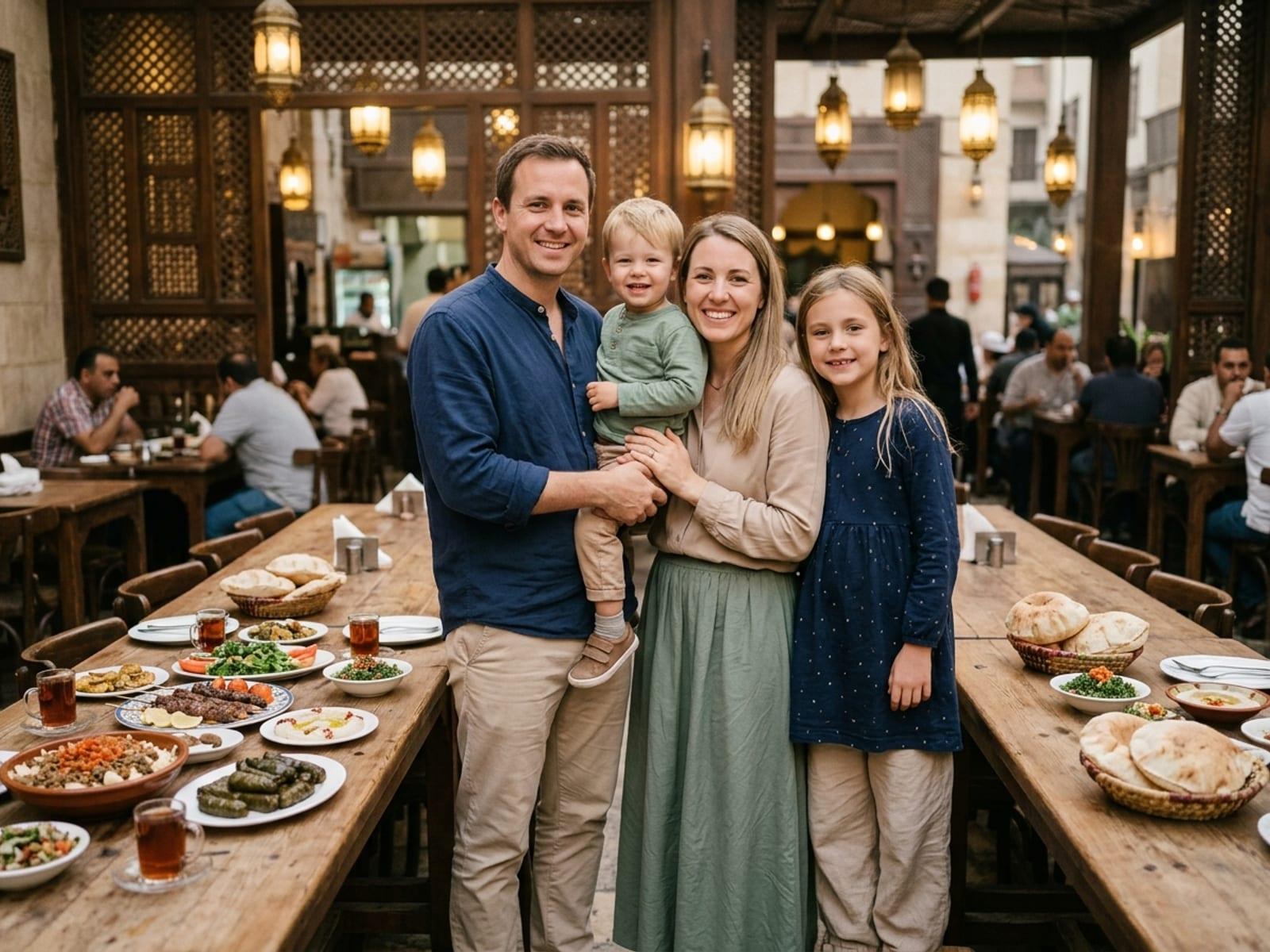
In Egypt, lunch is the biggest meal of the day and dinner starts late. Portions are large, people gather around shared platters, and round bread is used to scoop up beans and sauces. Restaurant bills often include a service charge, and on top of that there is the custom of baksheesh, a tip or gratuity. If you are eating out with children, knowing about mealtimes, how much to order and how to check the bill in advance makes things much easier.
Lunch is the main event, and dinner gets going at 10
Mealtimes in Egypt run late overall. Lunch is the main meal, and the evening meal is often something light or a snack. Even so, when people eat out at night they eat late, and it is not unusual for restaurant customers to arrive around 10 p.m. or even later. In the heat of summer especially, eating out starts once the sun has gone down and the air has cooled.
For families with children, this sense of time is the biggest hurdle. If you want the kids to eat dinner early, plan a substantial lunch and a light early evening meal; this also fits the rhythm of Egyptian meals. Restaurants are often fairly quiet early in the evening, so it is easier to choose a table, and children will find the wait for food easier to handle.
Long, leisurely meals with family and relatives are perfectly normal in Egypt. A family with small children sitting next to a lively large group will not stand out at all.
Share the platters, scoop with bread
The center of the Egyptian table is a round bread called aish baladi. It is baked in a very hot oven so that it puffs up hollow, and it appears at almost every meal. Torn into pieces, it scoops up stewed beans and dips or wraps around kebab or ta'ameya (fava bean fritters), standing in for both spoon and plate. For children, picking up food with bread is fun in itself.
Portions are generally large, and wasting food is frowned upon. At a new restaurant, a sensible approach is to order for fewer people than you are, put the platters in the middle and share. You can always order more, and finishing the meal that way feels better than leaving food behind. If you are unsure what to order, start with dishes known as Egyptian home cooking, such as koshary in Cairo or mahshi in Cairo, and you will find things the children can eat easily.
Knowing the names of the places helps when looking for somewhere to eat. Mataam (restaurant) covers everything from small eateries to upscale dining. A bakery is a forn or makhbaz, a shop for sweets and desserts is a halawani, and a fruit seller is a fakahani. The traditional coffeehouse, the ahwa, is a social place to relax over tea or coffee, while modern places serving espresso and pastries are called "cafés." Tea often comes after a meal, and serving tea to guests is considered a duty of hospitality.
If anyone in the family has allergies, prepare a card reading "عندي حساسية" (I have an allergy) in Arabic, with the names of the trigger foods, so you can show it to staff before ordering. Spiciness varies by restaurant and dish, so the surest way is for an adult to taste a bite before serving the children.
Check the breakdown on the receipt before you pay
Restaurant bills often include a service charge on top of the food. An Egyptian tour company's guide explains that restaurant bills typically include a service charge of around 12%, that this money does not necessarily go to the person who served you, and that people therefore often leave a separate tip. First look at the bottom of the receipt to see whether a service charge has been added.
A tip in Arabic is baksheesh. The word comes from Persian and has a broad range of meanings, from a gratuity to alms and even a bribe. In Egypt it is part of everyday dealings, given not only at meals but also to guides, restroom attendants and others. There is no fixed amount: rounding up the bill at a small eatery, and a little more at a restaurant with good service, is a reasonable way to think about it. That is why it helps to keep small Egyptian pound notes on hand. Banks and hotels can sometimes break larger notes for you.
Ramadan, smoking, alcohol and photo etiquette
During Ramadan, the Islamic month of fasting, eating, drinking or smoking in public during the day is considered culturally insensitive. Hotels and restaurants sometimes set aside screened-off areas for guests who are not fasting. Opening hours change too, so check ahead. The dates of Ramadan shift from year to year. After sunset comes the meal at which families break the fast, and the whole mood of the city changes. Travel advice also warns that driving can become erratic around dusk, as sunset approaches. If you are heading to a restaurant for dinner during Ramadan, avoid traveling right around sunset and arrive early, so you are not rushing with children in tow. Cairo's nights at this time of year are covered in Ramadan and the fanous in Cairo.
It is also worth knowing that many people in Egypt smoke at the table. Shisha, the water pipe, is a staple of traditional coffeehouses. If smoke bothers you, choose where you sit carefully, for example an outdoor table upwind. Drinking alcohol is permitted only in licensed restaurants and bars, private homes and some tourist resorts; drinking elsewhere is illegal.
Modest dress is expected, especially in rural areas, at mosques and in markets. Clothes that cover shoulders and knees are safe everywhere. There are things to keep in mind when taking photos at meals, too. Photographing Egyptian citizens officially requires their written permission, and some guidance states that photographing children is prohibited. When taking family photos, angle the camera so that other diners, especially children, are not in the frame. If you would like to photograph staff or the kitchen, it is polite to ask first.
When to go and getting there
Dining etiquette is the same all year round, but think of Ramadan as running on a different clock. Cairo's main gateway is Cairo International Airport (CAI). You can also see what your family around a shared platter might look like with pokesta's AI-generated photos ($1 per photo). Entry requirements and safety information vary by nationality, so check your own government's official information before you travel.
References