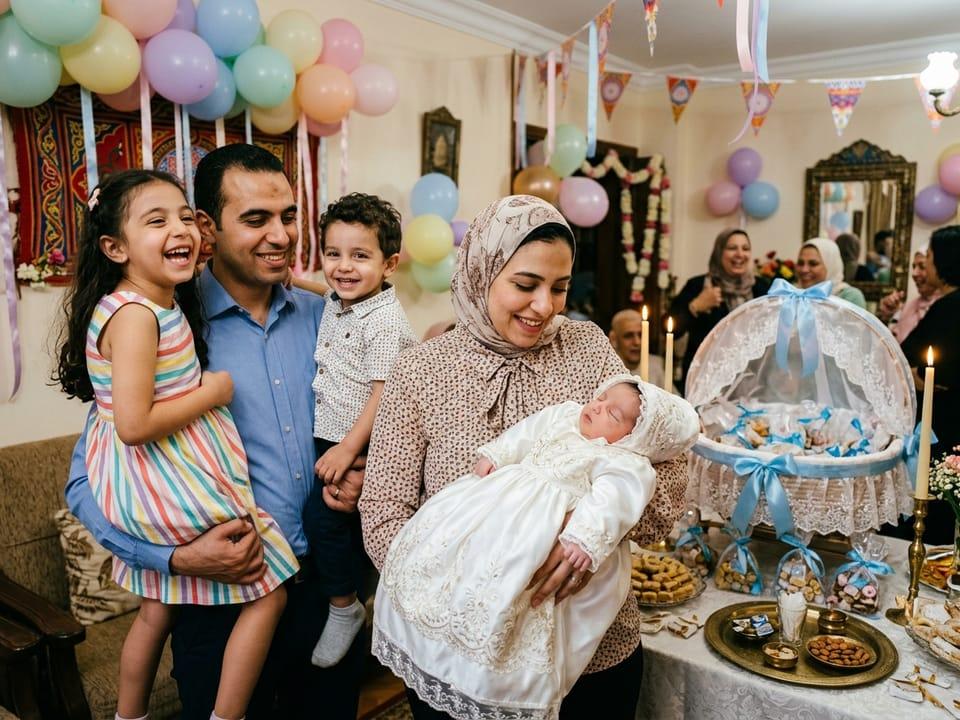
On a baby's seventh day, Egyptian families hold the Sebou' (سبوع, also written Sebooa, Subu' or el-Sebou'). The baby is laid in a sieve, a grandmother pounds a metal mortar, the mother steps over the baby seven times, and children carrying candles walk around the baby singing. Muslim and Coptic families alike keep the custom. Plan the photos around not wearing out a week-old baby or a mother who gave birth a week ago, and most other decisions make themselves.
A celebration of mother and child said to date back to ancient Egypt
The Sebou' is said to go back to ancient Egypt, with murals and papyri from the New Kingdom showing similar celebrations. There are several explanations for the seventh day. One holds that people believed a newborn began to hear on the seventh day. Another links the number seven to Hathor, the goddess of fertility and motherhood. How the ceremony took its present form, though, is unclear.
When many babies did not survive, a mother and child coming safely through the birth and the first week was reason enough to celebrate. Hania Sholkamy, an anthropologist at the American University in Cairo, told NPR that the Sebou' is one of the few ceremonies that celebrate the baby's mother, and the first rite of passage that sets a boy apart from a girl. The loud ringing of the mortar is meant to build the baby's character and make the child brave.
The sieve, the mortar, the mother's seven steps and the candles
First the baby is laid in a ghorbal, a kitchen sieve with a mesh base used for sifting flour. It used to be set on a high table; these days many families put it on the floor. Beside it goes an ibrik, a spouted water jug, for a boy, or a qolla (olla), an unglazed clay water jug, for a girl.
Then an older woman, very often a grandmother, strikes a metal mortar (hon) with its pestle and calls out instructions to the baby: listen to your mother and father. To the ring of the mortar and the chant of "the first step in the name of God, the second in the name of God…", the mother steps over the baby seven times. The seven steps are believed to ward off the evil eye. Some families also scatter salt to keep evil away from the newborn.
Finally, children and adults holding lit white candles walk around the baby, singing. The best-known Sebou' song begins "Halaatak bergalatak" and wishes the newborn happiness and joy. Afterwards the children are handed sweets.
Details differ from family to family. Ask whoever is running the ceremony, usually a grandmother or an aunt, where the sieve will go and who does what in which order. Then you'll know where to stand.
Seven grains soaked overnight, and the bags of sweets
Some families soak seven kinds of grain and pulse in water the night before, on the baby's sixth night: wheat, fava beans, chickpeas, lentils, black-eyed peas, rice and fenugreek. On the day they are ground in the mortar and sprinkled over the baby, in the hope that good fortune and growth will spread to everyone around.
The giveaways are bought ahead of time along with the candles. Shops in Cairo sell candles, jugs and cradles for the Sebou', and the decorations are blue for a boy and pink for a girl. Typical favors are little bags of sugared almonds and chocolates, or small figurines on bases engraved with the baby's name and date of birth. Some households serve guests moghat, an herbal drink believed to help nursing women produce milk. Wealthier families sometimes hire a venue and a DJ, but as Sholkamy points out, the ritual can be done simply with food, water and a jug.
Photograph the sieve, the jug and the bags of sweets the day before, by a window in daylight. On the day itself you can concentrate on people. The Dutch welcome a newborn with sweets too, and our piece on newborn photos during the Dutch kraamtijd shows how.
Muslim families may add the aqiqah; Coptic families baptize on a later day
In Muslim families, the aqiqah is sometimes held on the same seventh day: a sheep is sacrificed and the meat shared among friends, relatives and neighbors in need.
For Coptic Orthodox families, church baptism is a separate occasion. By custom it waits until 40 days after birth for a boy and 80 days for a girl. A Coptic Orthodox diocese explains that the Church can baptize a child on any day, and that these periods are about when the mother can take part in the baptism. One Egyptian writer observes that church baptism celebrations in Egypt, with their crowd of relatives, come close to the atmosphere of the aqiqah. In both kinds of household, the sieve, the mortar and the candles have long been part of the celebration at home.
One photographer, and keep the room lights on
The ceremony keeps moving and doesn't pause for anyone. If everyone is holding up a phone, gaps open in the candle circle and the mother has people underfoot. Choose one person to take pictures and let everyone else sing and walk. The ceremony and the photos both go better that way.
With a candle procession coming, it's tempting to dim the room. But candlelight alone barely lights a face. Leave the overhead lights on, or at most switch a few of them off. Turn the flash off: a burst of light at close range can startle a newborn, and it wipes out the candle glow anyway. If the room feels dark, let night mode do the work and brace your elbows against a wall or a piece of furniture. For matching the color of your lamps, see brighter indoor photos.
The sieve from an angle, the mortar on video, the procession from outside the circle
Don't hold your phone right over a baby lying in a sieve on the floor. If it slips, it lands on the baby's face. Kneel beside the sieve and shoot from a diagonal, with your wrist through the phone strap if you have one. That angle also gets the baby's face, the rim of the sieve and the ibrik or qolla into one frame.
The ring of the mortar and a grandmother's voice calling out to the baby don't come through in a still photo. Take 30 seconds of video here. It's something to watch together when the child is older. For the seven steps, stand a little way off to the side so that the mother's whole figure and the sieve are both in the frame. She's a week out from giving birth, so have someone standing close enough to take her hand, and don't ask her to repeat anything for the camera.
Follow the candle procession around with a phone and you'll collide with children. Stand still at one spot outside the circle and let them come past you. It's safer, and you get their faces. Faces lit from below by candle flame are the picture that says Sebou'. Have an adult walk beside the little ones so sleeves and hair stay clear of the flames; for the very youngest, an LED candle is an option. And remind everyone to hold their candles upright as they pass the sieve, so no wax drips onto the baby.
Seat the mother for the family portrait, and ask before you post
Once the ceremony is over and the sweets have gone round, take the family photo before guests start leaving. Seat the mother on the sofa holding the baby, with the father beside her, grandparents standing behind and older siblings at her feet. That's far easier on her than everyone standing in a line. Keep the phone on the standard 1x lens and step back rather than going wide, or prop it on a shelf and use the self-timer so the photographer can be in it too. Babies are often calmest right after a feed, so aim for then and plan to be done in five minutes.
Before posting anything on social media, ask the people in the photo. Some women in the family may not want pictures of their faces online. The same courtesy applies when relatives gather in the sitting room for Eid al-Fitr in Egypt.
Sometimes relatives working abroad or grandparents who live far away can't make it to the Sebou'. pokesta can create an AI family photo, everyone gathered around the baby in a room decorated for the Sebou', from each person's own phone photos. Your first photo is free after signing up, and after that it's $1 per photo.
References