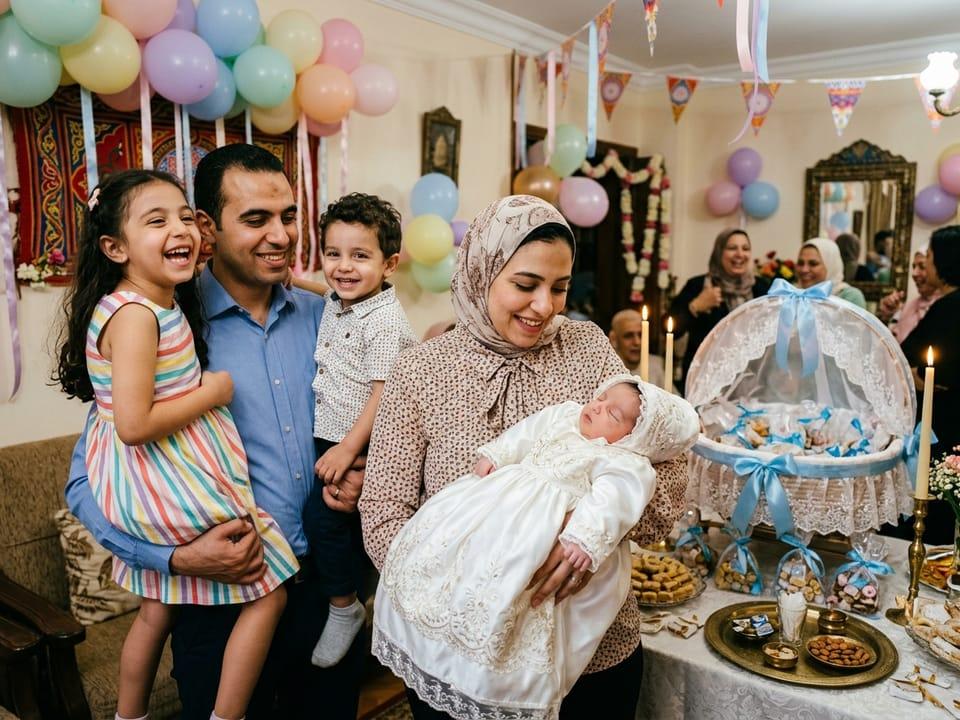
If your baby is under jaundice lights or in an incubator, the hadana, on the seventh day, move the Sebou'. It is an ancient family celebration that Christian and Muslim Egyptians alike keep, and the sieve, the mortar, the seven steps and the candles work just as well on day 12 or day 20. For Muslim families who hold the aqiqah at the same time, Egypt's Dar al-Ifta states that if the seventh day is missed, the fourteenth or twenty-first is recommended, and some jurists allow it at any later time. Let the doctors set the pace; the family can fit the ceremony around the baby.
A custom that can wait for the baby
The seventh day is about a baby coming safely through the first week. Dar al-Ifta explains the timing of the aqiqah in those terms: the sacrifice thanks God for the newborn's survival. In a fatwa issued in December 2021, it set out the order for a family that misses the day: the second or third week, recommended without disagreement among scholars, and after that, in the Shafi'i view, any time before the child reaches puberty, or as a make-up at any time according to some jurists. If you have a question about your own situation, ask a scholar you trust.
The Sebou' itself, the sieve, the mortar and the candle procession, is a home custom rather than a rite fixed by either faith, and nothing in it depends on the date. A grandmother can call out to the baby to obey their mother and father on day 15 just as she would on day seven. What changes is only the guest list and the calendar.
What phototherapy usually means for the week
This is general information, not medical advice. The NHS describes newborn jaundice as common and usually harmless. The yellowing tends to be most noticeable around day three, and it usually takes around two weeks to go. When a baby does need treatment, it is usually phototherapy, a special light shone on the skin, most often given in hospital with the baby lying in a cot. The NHS says most babies need around 48 hours of it, and some families are given equipment to use at home instead.
So a short delay is common, but the baby's doctors decide when treatment ends and when the baby is ready for a houseful of visitors. Don't take a baby out from under the lights, or out of the incubator, for a picture. If you want a photo in the unit, ask the nurses first, keep the flash off, and stick to what they allow.
Telling the guests and moving the photographer
You don't owe anyone medical details. A short message is enough: the baby needs a few more days of care, the Sebou' will be held once you are home, and you will send the new date. Candles and favour bags you have already bought will keep until the new date.
Some families soak seven kinds of grain on the sixth night, the eve of the Sebou', to grind and scatter over the baby the next day. Wait until the new date is fixed before you soak anything.
Call a booked photographer as soon as you know, and ask to move the deposit to a new date rather than cancel. Be realistic about what kind of session it becomes. SLR Lounge prefers five to ten days after birth for posed sleepy images, while noting that sessions can still happen up to eight weeks, with earlier being easier. A session at three or four weeks may work better as relaxed photos of an awake baby with the family than as a list of curled-up poses. That is a perfectly good outcome.
The small pictures that belong to this week
The week you didn't plan for still deserves a few frames. Photograph the hospital bracelet on a tiny wrist, the car seat by the front door, a grandparent meeting the baby on the doorstep, the first nap in the cot at home. None of these needs a photographer, and a phone with the flash off will do. When the rescheduled Sebou' comes, our guide to the Sebou' at home walks through each step and where to stand.
Studio, a photographer at home, or your own phone after a hospital stay
|
Studio |
Photographer at home |
Your own phone |
| Changing the date |
Depends on the studio calendar |
Depends on the photographer |
Any day |
| Baby and mother after hospital |
Another car trip |
Stays at home |
No effort |
| Older baby (3 weeks and up) |
Props may suit less |
Natural family photos |
Daily life |
| Suits |
Families who want a full set later |
Most families after a stay |
The coming-home days |
After a hospital stay, a home session tends to be easier on everyone. A studio still makes sense if you want a full posed set and the baby is well enough for the trip. If you are torn about splitting the photo session from the ceremony anyway, our piece on timing newborn photos around Sebou' day lays out the options.
A family picture while the date is still open
If the grandparents are waiting to meet the baby, or relatives abroad won't make the new date, pokesta can create an AI portrait of everyone together around the baby in Sebou' clothes, from the phone photos each of you already has. It is an image the app makes, not a record of the celebration. It costs $1 per photo, with your first photo free, so try it with the first picture you took after the baby came home: create a Sebou' family portrait.
References