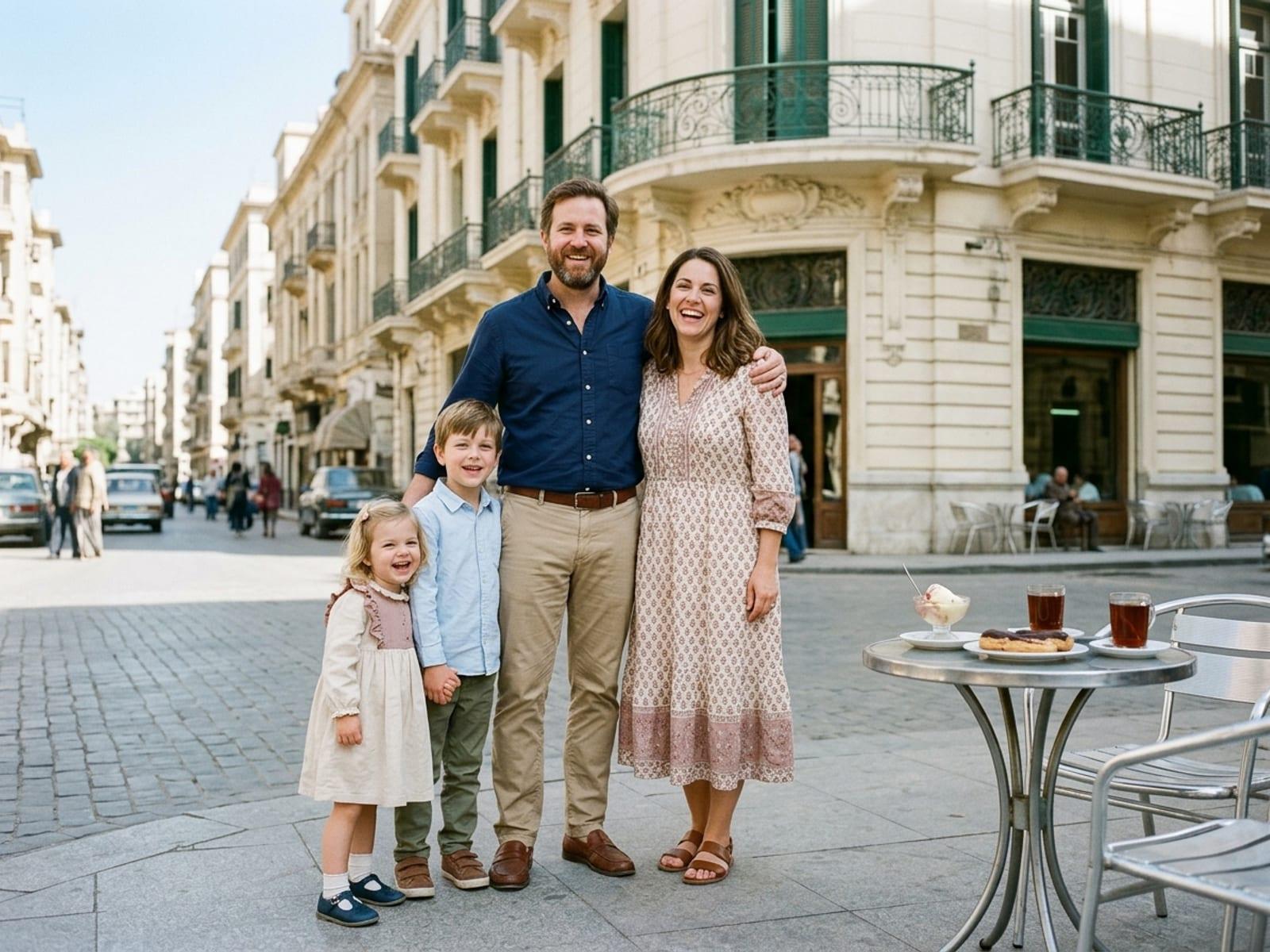
Straight boulevards lined with ornate stone buildings and wrought-iron balconies. Downtown Cairo, known locally as Wust el-Balad ("the middle of town"), looks nothing like the Islamic quarters of the old city. Here you will still find Groppi, a confectioner that opened in the early 1900s, and Café Riche, where writers and revolutionaries once gathered. Tahrir Square and Talaat Harb Square are within walking distance of each other, and a half-day stroll between them gives children ice cream at Groppi and adults a pot of tea.
A "new Cairo" laid out in the 19th century
Downtown is the newer, western part of Cairo, built in the 19th century between the medieval old city and the Nile. In the 20th century it became the commercial center, and it was once home to the wealthy. Its many ornate buildings in Beaux-Arts and Moorish Revival styles are described as remnants of Egypt's "Belle Époque." After the Cairo Fire, which came before the 1952 revolution, and the departure of the upper classes that followed, the area went through a long period of neglect, but since the 2000s government and private interest has grown and building facades have been restored.
The gateway to the district is Tahrir Square. It was originally Ismailia Square, named after Khedive (viceroy) Ismail, who had the new city built. After the 1919 revolution it came to be called Tahrir ("Liberation") Square, and it took that name officially in 1953. In 2020, an obelisk from the reign of Ramesses II and four ram-headed sphinxes brought from Karnak Temple in Luxor were installed in the center of the square. The Egyptian Museum is also on the square.
Linking Tahrir Square and Talaat Harb Square is Talaat Harb Street, known for its cafés and restaurants. Talaat Harb Square sits where the street meets Qasr El Nil Street, surrounded by 19th-century neoclassical buildings. Until 1954 the street was called Soliman Pasha Street; it was renamed after Talaat Harb, the economist who founded Egyptian banks and businesses in the first half of the 20th century, and his statue stands in the square.
If you want to look at buildings as you walk, Qasr El Nil Street is a good choice too. It is lined with late 19th- and early 20th-century buildings in Beaux-Arts style and in the Moorish Revival style, which borrows motifs from Islamic architecture, and just comparing the carvings around windows and the ironwork on balconies is enjoyable. Nearby Mostafa Kamel Square was laid out in 1867 and renamed in 1940 after the nationalist leader Mostafa Kamel. Hunting for "the strangest balcony" with the kids gives a walk down the boulevards a purpose.
Groppi, started by a Swiss confectioner
Groppi was founded in Alexandria in 1890 by Giacomo Groppi, a Swiss chocolatier. It opened in Cairo in 1909, and in 1924 opened its well-known branch on Talaat Harb Square. It is credited with introducing éclairs, Chantilly cream (sweetened whipped cream), Swiss-style chocolate, ice cream and jams to Egypt. There is also a story that King Farouk loved its chocolates and sent 100 kilograms to Britain's King George VI and the princesses.
Groppi survived the January 1952 Cairo fire, which burned much of downtown, and remained a family business until 1981, when the Groppi heirs sold it to an Egyptian food company. It closed in 2017 for major renovations and reopened in 2018. A September 2025 report describes it as still open, but closures for renovation are always possible, so check recent Egyptian news or the shop's official channels before you go.
Café Riche, the café of writers and revolutionaries
Café Riche, on Talaat Harb Street, opened in the early 1900s. Sources differ on the year, some giving 1908 and others 1921. A Frenchman bought it in 1914 but soon sold it to a Greek owner, who added a theater, where Umm Kulthum, who would become a national singer, performed. During the 1919 revolution it became a meeting place for revolutionaries, and leaflets are said to have been printed in its basement.
In the 20th century the writer Naguib Mahfouz was a regular, and the owner is said to have closed the café on Fridays so that he could hold meetings with his circle there. He was also a customer at El Fishawy, the 18th-century coffeehouse in Khan el-Khalili in the old city. Gamal Abdel Nasser, who later became president, also frequented it. It was closed for nearly ten years in the 1990s, and in recent years, as younger people have moved to shopping malls and online spaces, it is said to have quietened from its busier days. It is best thought of not as a place for children's fun but as a place for adults to drink a cup of tea while thinking about the city's history. Hours can change, so check before you go.
Walking with kids
Downtown is a series of big intersections with heavy traffic. Under Tahrir Square is Sadat station, where two lines of the Cairo Metro cross, and using the station's underground passages is safer than crossing the busy roads around the square on foot. The metro also connects to other parts of the city, such as Giza and Maadi.
With children, starting with the sweet shops works best. Let each child pick an ice cream or an éclair while the adults order tea, and everyone has something to enjoy. Try Egyptian sweets such as Om Ali and basbousa on another day, and even children will notice how different they are from the European pastries a Swiss confectioner brought to Egypt. When photographing the streets, keep in mind that in Egypt you need people's permission to photograph them, and some guidance states that photographing children is prohibited. Focus on the buildings and make sure passers-by, especially children, are not in the frame. Summer days are fiercely hot, so walk in the morning or evening and rest somewhere cool at midday.
Cairo's main gateway is Cairo International Airport (CAI). You can also see what your family sharing sweets on an old street corner might look like with pokesta's AI-generated photos ($1 per photo). Entry requirements and safety information vary by nationality, so check your own government's official information before you travel.
References