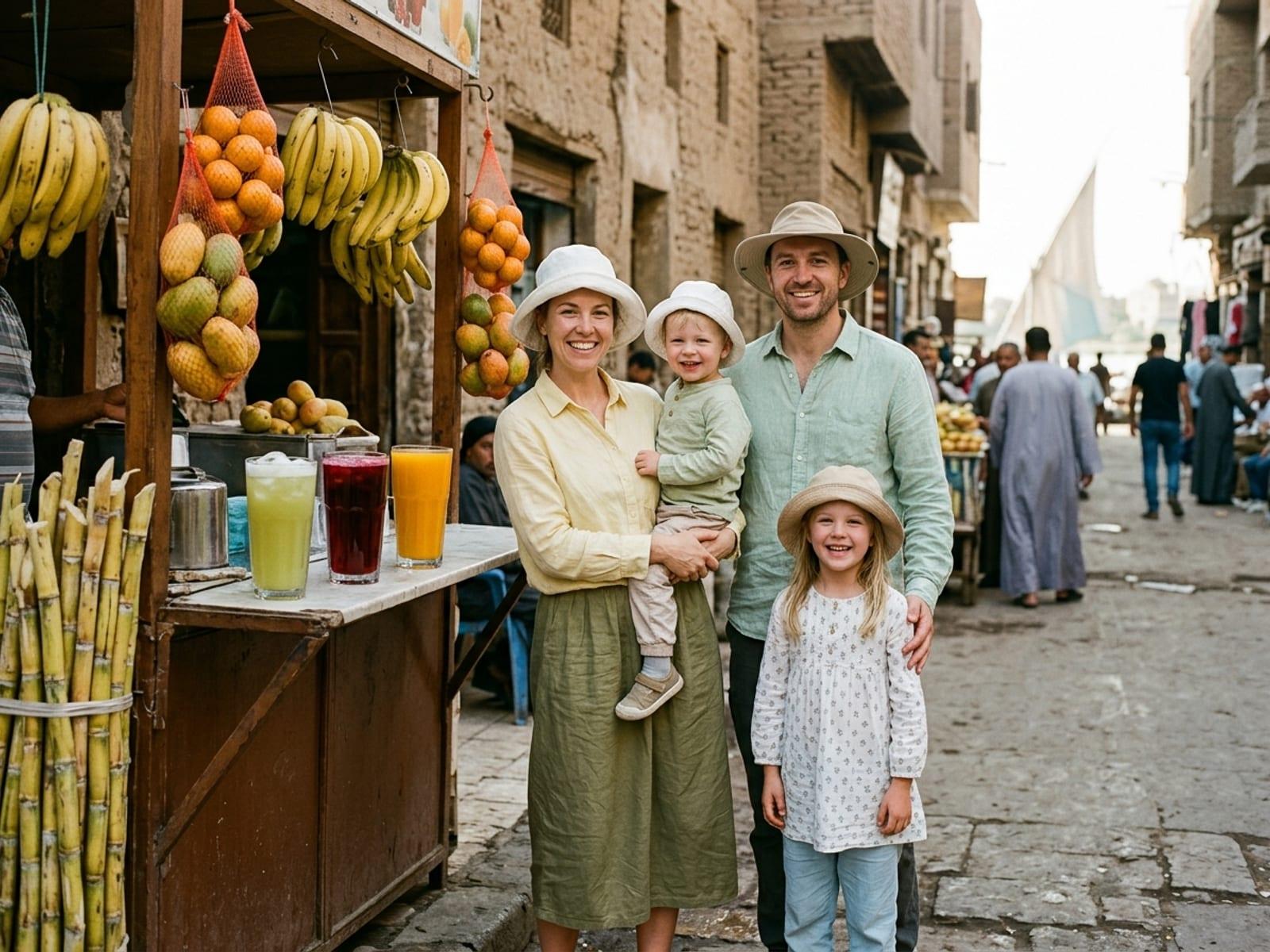
Bunches of bananas and net bags of oranges and mangoes hang in a row over the shopfront, and long stalks of sugarcane lean beside the counter. On a hot day, an Egyptian street-corner juice shop is where you stop to cool down. Pale green sugarcane juice, asab, and deep red hibiscus karkadeh are the two drinks that taste most of the country. With children, start with fruit juices and pay a little attention to ice and hygiene.
Fruit hanging outside, pressed one glass at a time
In Arabic, a juice shop is called mahal asir. These shops are known for freshly pressed juice in the hot season, and the giveaway is fruit hanging outside in net bags. The lineup includes bananas, guavas, lemons, mangoes, oranges, pomegranates, strawberries and sugarcane. When you order, the fruit is pressed or blended on the spot and poured into a glass.
The most Egyptian of them all is asab, juice pressed from sugarcane. It is sold at juice shops all over the country. The finest asab in Egypt is said to come from Minya, south of Cairo on the Nile. Freshly pressed asab has a grassy aroma and a clean sweetness; it is plenty sweet without any added sugar. It is sometimes mixed with lemon juice and fermented, too.
Karkadeh, tamarind, sobia and winter sahlab
Beyond the juice shops, you can find distinctly Egyptian drinks at street stalls, at cafés open to the street, and at the traditional coffeehouse, the ahwa. The best known is El Fishawy, an 18th-century coffeehouse in the Khan el-Khalili market.
Karkadeh is a ruby-colored drink made by steeping the calyces of hibiscus (roselle). It is drunk both chilled over ice and hot. In Egypt and Sudan there is a custom of raising glasses of karkadeh at weddings, and in Cairo's older neighborhoods it is sold at stalls and open-air cafés. Ancient Egyptians are said to have prized it as a restorative drink, and it is sometimes called "the tea of the pharaohs."
A summer favorite is tamr hindi, a sour, cold drink made with tamarind. The name, the Arabic word for tamarind, means "Indian date." Sobia is a sweet drink made with coconut milk and sold chilled. In winter, the ahwa serves hot sahlab, a thick, sweet milk drink that is one of the pleasures of the cold season. During Ramadan (the Islamic month of fasting), the traditional drinks are erk sous (licorice), kharoub (carob) and amar el din, made from dried apricot paste dissolved in water.
The ahwa also serves limoon, a lemonade sometimes made with mint, in summer, and in winter helba, simmered from fenugreek seeds, and yansoon, an anise tea. Limoon has a nice balance of sour and sweet and contains no caffeine, which makes it the safest choice to order for a child.
For adults there is Egyptian coffee, made the Turkish way: the grounds are boiled in a small long-handled pot called a kanaka and served in a small cup called a fengan. You state the sweetness when you order. Saada is no sugar, aryha is just a touch, mazbout is medium, and ziyada is sweet. The grounds settle at the bottom of the cup, so the trick is not to drink it to the last drop.
Mango in summer: choose what's in season
Mango is the star of the Egyptian summer. The largest growing area is Ismailia Governorate on the Suez Canal, with Sharqia, Giza, Fayoum and Qena among the other main regions. Egypt is said to have around 15 varieties, with names like Eweis, Hindi, Seddeka, Alphonse and Baladi. In summer, mango juice is the drink you see most at juice shops. As a fruit, a popular way to cut it is to score the flesh into a grid through the skin and push it outward so it stands up like hedgehog spines; some people simply bite into it. In years when Ramadan falls in summer, mango konafa and mango cakes appear too.
Since the fruit in season changes through the year, the surest way to know what is available is to look at the fruit hanging outside. Think of what is hanging there as the day's menu and choosing gets easier. Part of the fun of Egyptian juice shops is meeting fruits like guava and pomegranate that are rarely juiced elsewhere, and ordering two different-colored glasses to compare with your children is one way to enjoy them.
With kids, watch the ice, hygiene and sugar
Fresh juice helps you stay hydrated on hot walks, but there are a few precautions against stomach trouble on the road. Ice, and juice diluted with water, can make you ill if the water does not agree with you. With small children or anyone with a sensitive stomach, order without ice, have the juice pressed in front of you, and choose a shop where the press and glasses look clean. Studies have also reported testing sugarcane juice for mycotoxin contamination. If that worries you, try a small amount later in the trip, on a day when everyone is feeling well.
Both asab and karkadeh are very sweet. A full glass is a lot for a small child, so share one glass as a family and top up with water if needed. When ordering karkadeh, ask whether they can make it less sweet. Showing "من غير سكر" (without sugar) written in Arabic is one way to do it. For children with fruit allergies, check what goes into a mixed juice before ordering. Prices and size options vary from shop to shop, so point to confirm the price per glass and whether you want small or large before ordering, and you will avoid confusion when paying.
In the season of strong sun, the basic rule is to avoid the hottest part of the day and walk the city in the morning or evening. Taking a break at a juice shop before moving on to the next place helps keep children from tiring.
When to go and getting there
Juice shops are open all year, and the treats change with the seasons: mango in summer, sahlab in winter. Cairo's main gateway is Cairo International Airport (CAI). Pair a juice stop with the classic Cairo breakfast of ful and ta'ameya and a lunch of koshary in Cairo, and you have a route for a day of eating your way around the city. You can also see what your family standing on a street corner, juice in hand, might look like with pokesta's AI-generated photos ($1 per photo). Entry requirements for Egypt vary by nationality, so check your own government's official information before you travel.
References