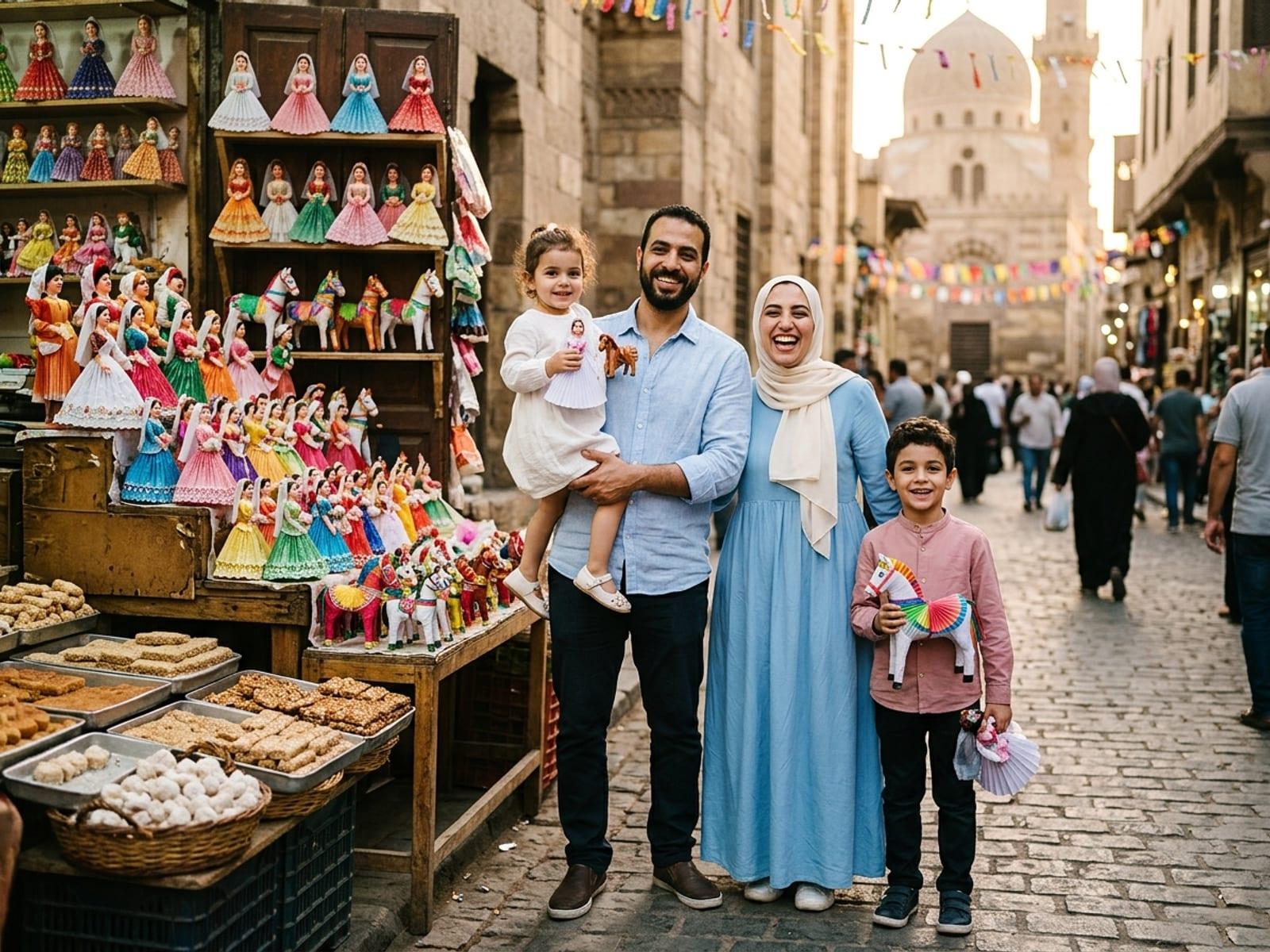
A little bride in a frilly dress of colored paper, with a crown on her head. In Egypt this doll is called the "bride of the Mawlid" (arousat al-mawlid), and it began as a sweet made of sugar. Around Mawlid al-Nabi, the birthday of the Prophet Muhammad, shops fill with these brides, sugar horsemen, and traditional sweets made with sesame and peanuts. In 2027 the Prophet's birthday is expected around August 14. This is less a festival to watch than a chance to get to know a holiday through its seasonal sweets.
The date follows the Islamic calendar and moves earlier each year
For most Sunni Muslims, Mawlid al-Nabi falls on the 12th of Rabi al-Awwal, the third month of the Islamic calendar. In Egypt it is a public holiday. Because the Islamic calendar follows the moon, the date moves about 11 days earlier each year on the solar calendar. In 2026 it fell in late August; in 2027 the holiday is expected on Saturday, August 14, and by around 2029 it will slip into late July. The official date depends on moon sighting, so check shortly before you go.
Some scholars credit the Fatimids, who ruled Egypt from the 10th to the 12th century, with turning the occasion into a major celebration. The Mamluk-era historian al-Maqrizi described the Mawlid of 1122, with sermons, honey sweets and other treats handed out, and alms given to the poor. Opinions differ on whether it was a court ceremony or a festival that ordinary people took part in.
In Egypt, the word mawlid also refers to festivals celebrating the birthdays of local saints. The mawlid of the saint Ahmad al-Badawi in Tanta, in the Nile Delta, is said to draw up to about 3 million people. These saints' festivals get extremely crowded, so we don't recommend wading into them with small children.
Sugar brides and horsemen
To make the sugar dolls, sugar is boiled down with water, poured into wooden molds and left to set, then taken out, colored and decorated. The bride gets a crown made of wooden skewers and a dress of colored paper. In the past, girls are said to have played with the doll for a while before eating it. The molds are two-part wooden forms, and besides brides there are horses too, traditionally given to children.
There are several stories about why the doll is a bride. In one, a confectioner modeled the Fatimid caliph al-Hakim and his wife in sugar after seeing them in the Mawlid procession, with the caliph shown as a horseman. In another, weddings were restricted to the Mawlid season, so the bride sweet became a kind of wedding announcement. A third says the caliph gave sugar brides to soldiers as a reward for victory, the gift became a yearly custom, and the court confectioners began making dolls for commanders, ordinary people and children. None of these is backed by solid records, so they're best enjoyed as old tales.
Today most of the dolls are made of plastic rather than sugar. Sugar dolls get sticky and spoil easily in the heat, so if you want one to take home, plastic is the practical choice.
Sesame, peanuts and coconut on the sweets tables
Alongside the dolls you'll find the traditional sweets known as halawet al-mawlid, the Mawlid sweets. The best known include simsimiya, made of sesame seeds pressed together; fuliya, peanuts set in sugar; hummusiya, made with chickpeas; goziya, a soft sweet of coconut mixed with milk or honey and raisins; and malban, a chewy sweet of sugar and starch. There are also versions made with hazelnuts, almonds and pistachios.
The coconut sweet is also known as ladida. Basima, a baked sweet of semolina, coconut and ghee, is another one you'll often see at this time of year. It is a different line-up from the year-round sweets such as Om Ali and basbousa that fill sweet shops in every season. The tradition of Mawlid sweets is said to go back to the Fatimid era, and some accounts add that laying on particular sweets for each celebration was also a way of winning over the people.
Hard sweets are tough for small children to bite through, and nuts raise allergy concerns. If you're buying as a family, start with a small mixed box to taste, then add more of whatever the kids like; that way nothing goes to waste. Many of the sesame and bean sweets keep well, so they make good gifts. To get them home, seal them in a bag so they don't melt or turn sticky in the heat, pack them in a box, and nestle the box between clothes in your suitcase so they hold their shape.
Walking around Cairo in August with kids
Mawlid season in Cairo is high summer. Walking the streets in the middle of the day is exhausting, so save the sweet shops for the evening and spend the day in air-conditioned museums or at your hotel. Bring water and hats. Airy long-sleeved cotton or linen with loose trousers or a long skirt keeps the sun off and fits in with the feel of the old city.
The Mawlid is also a religious occasion. Prayers and gatherings with religious songs may take place around mosques, so keep quiet when you pass and don't point your camera at people. Some government travel advice notes that in Egypt you need people's permission to photograph them, and that photographing children is prohibited. If you'd like a photo of a shop's shelves of sweets, ask the shopkeeper first.
Before you head out, tell your children briefly that this is the day people celebrate the birthday of the Prophet Muhammad, the prophet of Islam, and that there are sweets you only see at this time of year. It changes how they react when they spot the dolls in a shop window. Why is the bride wearing a crown? Where is the horseman riding to? Stand in front of the dolls and make up a story together.
You can see how a photo of your child cradling a doll in a paper dress might turn out with pokesta's AI photos ($1 per photo, and your first one is free).
When to go and getting there
Cairo's gateway is Cairo International Airport (CAI), about 15 km northeast of the city. The Prophet's birthday is a public holiday, so government offices and some attractions may close. Check opening days in advance for anywhere you plan to visit.
An August trip means coping with the heat, but you'll meet a sweet-smelling side of Cairo that's quite different from the lantern-lit Ramadan season (Ramadan and the Fanous in Cairo). Breaking up a walk through the old city with lunch at a koshary shop is a good pairing, too (Koshary in Cairo). Entry requirements and safety information for Egypt vary by nationality, so check your own government's official information before you leave.
References