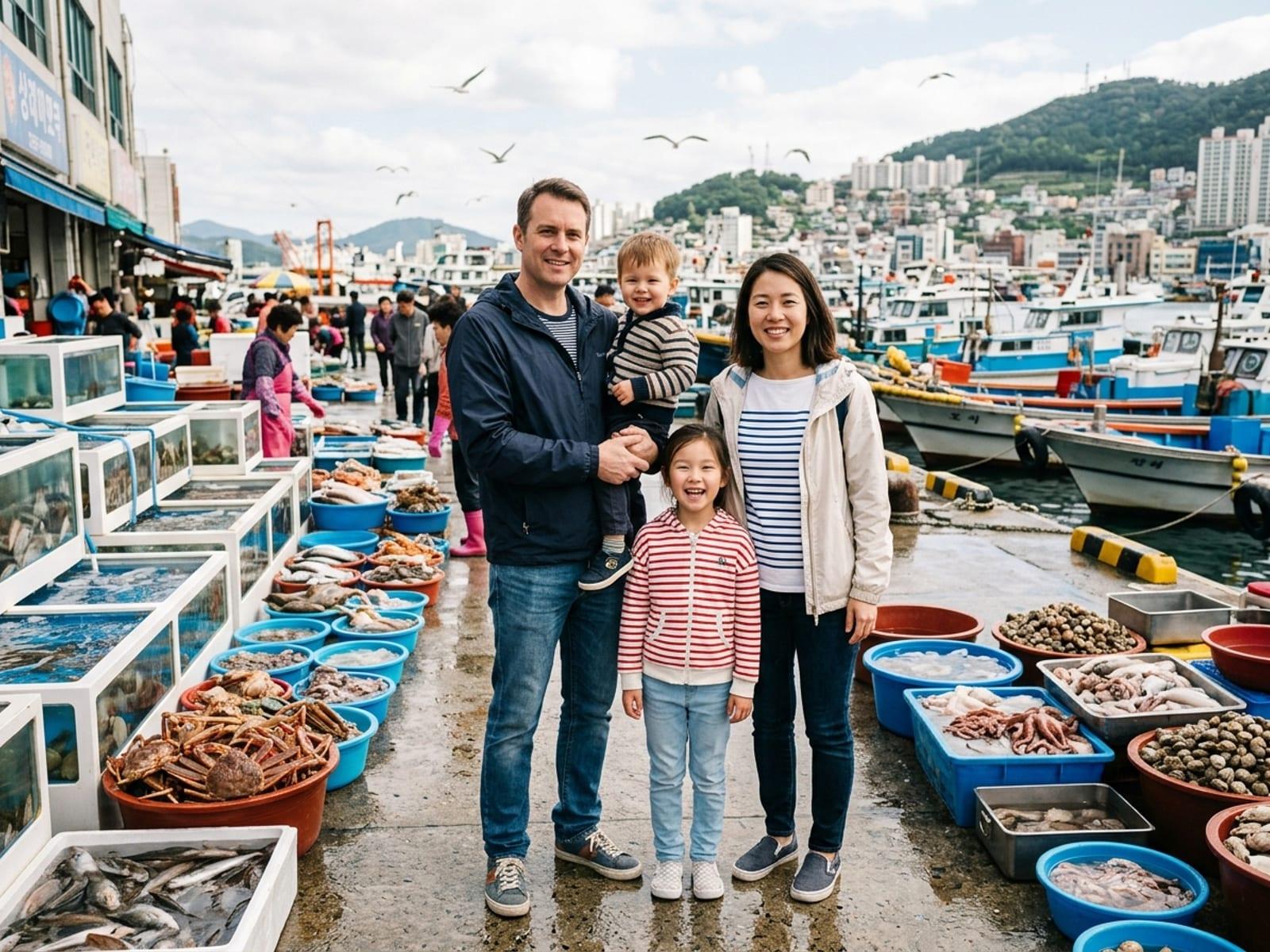
Jagalchi Market is Busan's harbor-front fish market on Nampo Harbor, a short walk from Jagalchi Station on subway Line 1. The basic routine is to buy fish or shellfish on the ground floor and have a second-floor restaurant serve it raw, grilled or in a stew. With children, confirm the price and any cooking charges before you buy, wear non-slip shoes and keep hold of small hands, and it's an easy place to enjoy.
Along the quay, tanks and tubs stretch as far as you can see: flounder swimming in circles, heaps of shellfish, octopus waving their arms. This is the market that has kept the port city fed for generations.
A market that grew from women's street stalls
The name "Jagalchi" is said to come from jagal, gravel, because this stretch of coast was once a pebbly beach. Trace the records back and you reach the Busan Fisheries Company, founded by Japanese investors in 1889 with capital of 50,000 yen; in 1925 a fresh-fish merchants' association was formed. In the 1930s, during Japanese colonial rule, land was reclaimed along Nampo Harbor and the fish market moved to its current site. A central wholesale market opened in 1935.
The market as it looks today took shape after liberation in 1945. People returning from Japan and elsewhere set up stalls on the street, and during the Korean War refugees joined them, so the stalls kept multiplying. The ones selling fish to support their families were women: war widows, refugees and women who had come back from abroad. They became known as "Jagalchi ajime," Busan dialect for the aunties of Jagalchi, and today they're remembered as a symbol of Busan women who refused to be beaten by hard times.
A three-story market building went up in 1970. In 2006 a new building was completed, two floors below ground and seven above, shaped like a seagull spreading its wings toward the sea. It reopened in 2023 after renovation and remains a landmark of the port. The two basement levels are parking, the ground floor is the market, the second floor has restaurants, and the floors above hold a youth center and other facilities. Since you can do everything from shopping to eating under one roof, it's an easy plan for a rainy day. In the 2018 film "Black Panther," the market and the streets around it were used for a car chase.
Choose on the ground floor, eat on the second
The ground floor sells fresh seafood. The second floor has a raw fish center, where you can eat sashimi, plus shops selling dried seafood. The basic routine is to buy fish or shellfish from a ground-floor vendor and have one of the second-floor restaurants prepare it. Outside the building, old-style stalls and shops continue along the street.
A few things are worth confirming before you order. Fish is priced by type and weight, and prices move with the day's catch. Before you buy, agree clearly with the vendor on what you're getting, how much and for what price. Upstairs, restaurants may charge separately for preparation, seating, condiments or turning leftovers into a stew, so ask about that too and you won't be caught off guard at the till. It's also worth checking whether they take cash, card or both. If you're worried about the language barrier, showing a photo or the name of what you want in a translation app on your phone is the surest way.
If you can't judge quantities, tell them how many people are in your group and ask how many servings that makes. With kids along it's tempting to order a bit of everything, but sashimi goes further than you'd think. Order on the small side to start and add more if you need it.
If raw fish isn't for you, have it grilled or stewed
Sashimi isn't always a good fit for small children. If your kids aren't used to raw fish, or you have preschoolers with you, ask whether they can cook it instead, for example grilled fish or maeuntang, a spicy stew made with the fish's head and bones. Stews are usually made spicy, so ask whether they can tone it down for the children.
Around the market you'll also find shops grilling hagfish (kkomjangeo) and selling crab marinated in soy sauce. After a string of major fires in the 1950s, including ones near Busan Station and at Gukje Market, food stalls that cooked over open flames were moved near Jagalchi, and places grilling kkomjangeo and beef intestines gathered here. That is how today's eating streets began. By the 1980s an alley of grilled beef intestine restaurants had formed, and a 2022 report counted about 300 of them across three blocks.
The part children often like best is the choosing, before anyone eats. Shellfish in the shell and crabs become easy, fun-looking food for kids once they're grilled or steamed. Ask the vendors the names of the fish, then look them up in a picture book later; it's a way to keep the trip going after you're home.
The floor is wet, so keep hold of small hands
The market floor is always wet with seawater overflowing from the tanks and water used to wash the fish. Sandals and heels slip easily, so wear rubber-soled sneakers. Water can splash, so pick clothes you won't mind getting dirty. The smell of fish can cling to clothes and shoes, so if you have plans afterward, bring a change of clothes.
The fish and octopus in the tanks are like an aquarium to children, but they're for sale. Tell kids from the start not to put their hands in or open any lids. The aisles are narrow and handcarts come through, so a baby carrier is easier than a stroller, and hold your children's hands as you walk.
The market building sits on the quay of Nampo Harbor, and stepping out on the seaward side gives you a view of fishing boats tied up in the port. A few minutes in the sea breeze after your meal helps children settle down after the smells and crowds.
If you'd like a shot of your family picking fish on the market floor, or posing with the harbor behind you, you can try the look before you go with pokesta's AI photos ($1 per photo, and the first one is free).
The autumn festival and getting there
Every autumn the market hosts the Busan Jagalchi Festival. It started in 1992 as the Jagalchi Seafood Festival and took its current name in 1999. Its motto, in Busan dialect, is "Oiso, boiso, saiso": come, see, buy. The market's merchants have also held a Yongwangje, a rite for the Dragon King of the sea, every Lunar New Year since 1970. Festival dates are announced each year, so check as your trip gets closer.
The gateway is Gimhae International Airport (PUS). From the airport, take the Busan–Gimhae Light Rail, change to subway Line 2 at Sasang and to Line 1 at Seomyeon, and ride to Jagalchi Station. It's also walkable from neighboring Nampo Station. The market is surrounded by the busy Nampo-dong district, with Gukje Market and other markets and shopping streets close by, so it fits neatly into a half-day walk. In winter, a ssiat hotteok, the seed-filled pancake from a Nampo-dong street stall makes a good after-lunch treat. Opening hours and closing days differ by shop and floor, so check ahead if you plan to visit early in the morning or at night.
Entry requirements for Korea depend on your nationality, so check your own government's official information. For spring near Busan, see our article on the Jinhae cherry blossom festival; for another regional specialty, try tangerine picking on Jeju.
At Jagalchi, let your child pick the fish. The one they agonized over in front of the tank becomes the family's lunch, about as direct a lesson in where food comes from as a port city can give.
References