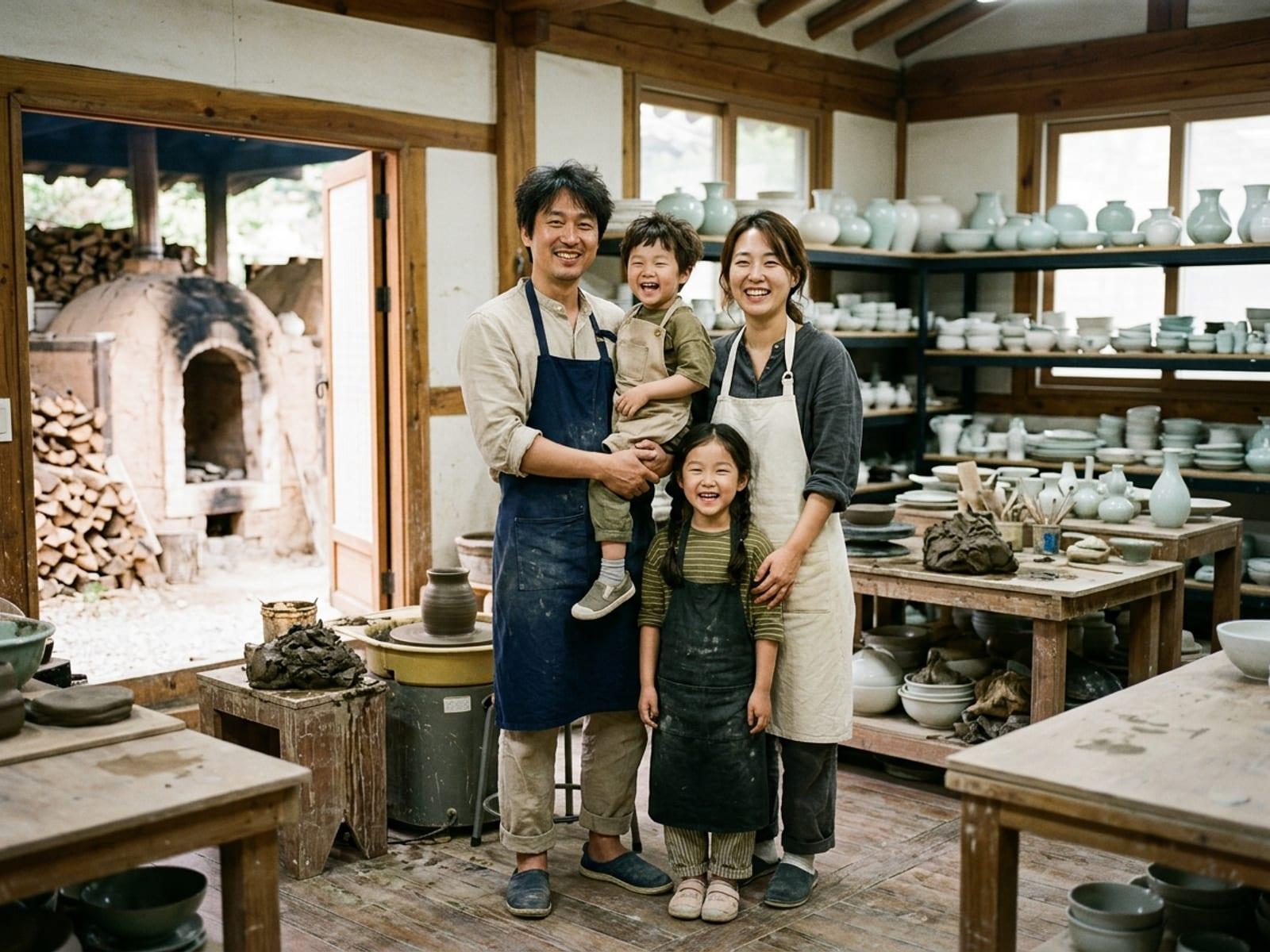
Icheon, southeast of Seoul in Gyeonggi Province, is the center of Korean ceramics, and at Ye's Park, an arts village of 300-odd studios, you can try the potter's wheel or paint a piece all year round. The Icheon Ceramic Festival is held there each spring (April 24 to May 5 in 2026). If you're doing a pottery class with children, ask when you book how the fired piece will reach you and whether it can be shipped abroad.
Celadon, white porcelain and buncheong stoneware line the shelves, tracing the whole history of ceramics on the Korean Peninsula. It's a town where you can do more than shop for bowls: you can spend the day getting your hands in clay with your children.
From 4,000-year-old earthenware to royal porcelain
According to Icheon City, pottery here goes back to the Bronze Age, around 4,000 years ago, when plain undecorated earthenware was being made. Records from the early 16th century list "white jade" and "pottery" among Icheon's specialties. With clay and firewood in good supply, the area drew potters from all over the country as well as local ones.
After China, the Korean Peninsula was the next place to make celadon and white porcelain. In the 12th century, during the Goryeo dynasty, potters produced jade-green celadon and inlaid celadon, and white porcelain flourished in the Joseon dynasty. Around 1467 the Joseon court set up official kilns to fire white porcelain for the royal household and government offices, and these kilns were privatized in 1884. Icheon City's history notes that white porcelain production declined in the 17th century, then revived in the 18th century under Kings Yeongjo and Jeongjo. Remains of Joseon-era kilns are said to survive in many parts of Icheon.
Today, according to the city, Icheon has around 420 studios making celadon, white porcelain, buncheong, onggi jars, dolls and other ceramics. Many studios hold on to traditional methods such as firing in wood-fired kilns. Icheon has craftspeople recognized as intangible cultural heritage holders by Gyeonggi Province, such as a sagijang, a master of white porcelain, and the city has a high school specializing in ceramics. In 2010 it joined UNESCO's Creative Cities Network in the field of crafts and folk art. UNESCO says the area centered on Icheon accounts for 55 percent of Korea's ceramics industry.
Ye's Park is the base for visiting studios
For a family visit, start at Ye's Park, the Icheon Ceramic Art Village. This arts village in Sindun-myeon brings together more than 300 studios working in ceramics and a range of other crafts. Each studio has its own building. Some display and sell their work, and others run pottery or craft classes by reservation.
Opening hours, closing days and classes vary by studio. If a studio catches your eye, contact it ahead by phone or social media to check whether it offers classes, so you don't arrive to find nothing on.
Besides ceramics, Icheon is known for its rice. Breaking up a day of studio visits with a set meal built around Icheon rice is a very local way to spend lunch.
Celadon, white porcelain, buncheong: know the difference, then choose
The pieces in studios and shops are easier to choose once you sort them into three groups. Celadon takes its blue-green color from a trace of iron in the glaze, and it flowered in the Goryeo period. White porcelain is white clay under a clear glaze, prized for its clean whiteness, and it was the favorite of the Joseon court. Buncheong is gray clay brushed with white slip or carved with patterns, a rustic style, and much of it is easy to buy as everyday tableware. Masterpieces of Goryeo celadon are on free display in the permanent galleries of the National Museum of Korea in Seoul; seeing them before the studios sharpens your eye for the pieces you'll handle.
If your child is choosing, start by letting them pick pieces up. Even rice bowls of the same size differ one by one in weight and in how the rim feels against the lips. Icheon City also runs a certification scheme recognizing the quality of ceramics made in the city.
Spring festival, or a studio class any time of year
The Icheon Ceramic Festival began in 1987 and is the town's biggest event. In 2026 it marked its 40th edition, held at Ye's Park from April 24 to May 5. The sales area ran for about 900 meters, linking Ye's Park's three villages, and the program included potter's wheel sessions, "make your own bowl," and a "Master's Workshop" where visitors could see the work of Icheon's master potters up close. A small shuttle bus looped around the grounds, and a nursing room was available. Dates are announced each year.
Studio classes run year-round even outside festival time, so if you'd rather avoid the crowds, booking a studio for another time of year is a good option.
Pottery with kids: ask about pickup before you book
The main thing to know about pottery classes is that you often can't take your piece home the same day. Shaped pieces need days to dry and then be fired in the kiln. Travelers may not be able to collect them later, so when you book, ask whether shipping is possible, what it costs, and especially whether they ship abroad. For children too young for the wheel, painting a pre-fired bisque piece is a good alternative (it still needs a final firing, so ask about pickup in the same way). Painting works for any child who can hold a brush and takes less time than the wheel, so it suits families with preschoolers.
Clay dries to white marks on clothes. Wear things you don't mind getting dirty, with an apron on top. The wheel is electric, so with small children, an adult should stay close enough to place their hands over the child's from behind. To see how a photo of your family in aprons at the wheel might look, you can try pokesta's AI photos ($1 per photo, and the first one is free).
When you buy ceramics, plan how you'll carry fragile pieces home. Ask whether the shop can wrap them, and if you're flying, take your own precautions too, such as wrapping them in clothes and packing them in the middle of your suitcase.
From Seoul on the Gyeonggang Line
Most international flights land at Incheon International Airport (ICN), and the simplest route on to Icheon runs through Seoul. From the Seoul area, you can reach Icheon on the Gyeonggang Line, a railway that opened in 2016. The city has three stations, Sindundoyechon, Icheon and Bubal, and Sindundoyechon is closest to Ye's Park. It's a long walk from the station, so take a taxi, or during the festival check for shuttle buses.
Entry requirements for Korea depend on your nationality, so check your own government's official information. For more of Korea's regional specialties, see our articles on bibimbap in Jeonju and Boseong's green tea fields.
If you're unsure where to start, book painting rather than the wheel for younger children, and on the way out let each child choose one rice bowl of their own. That alone makes a full day in Icheon.
References