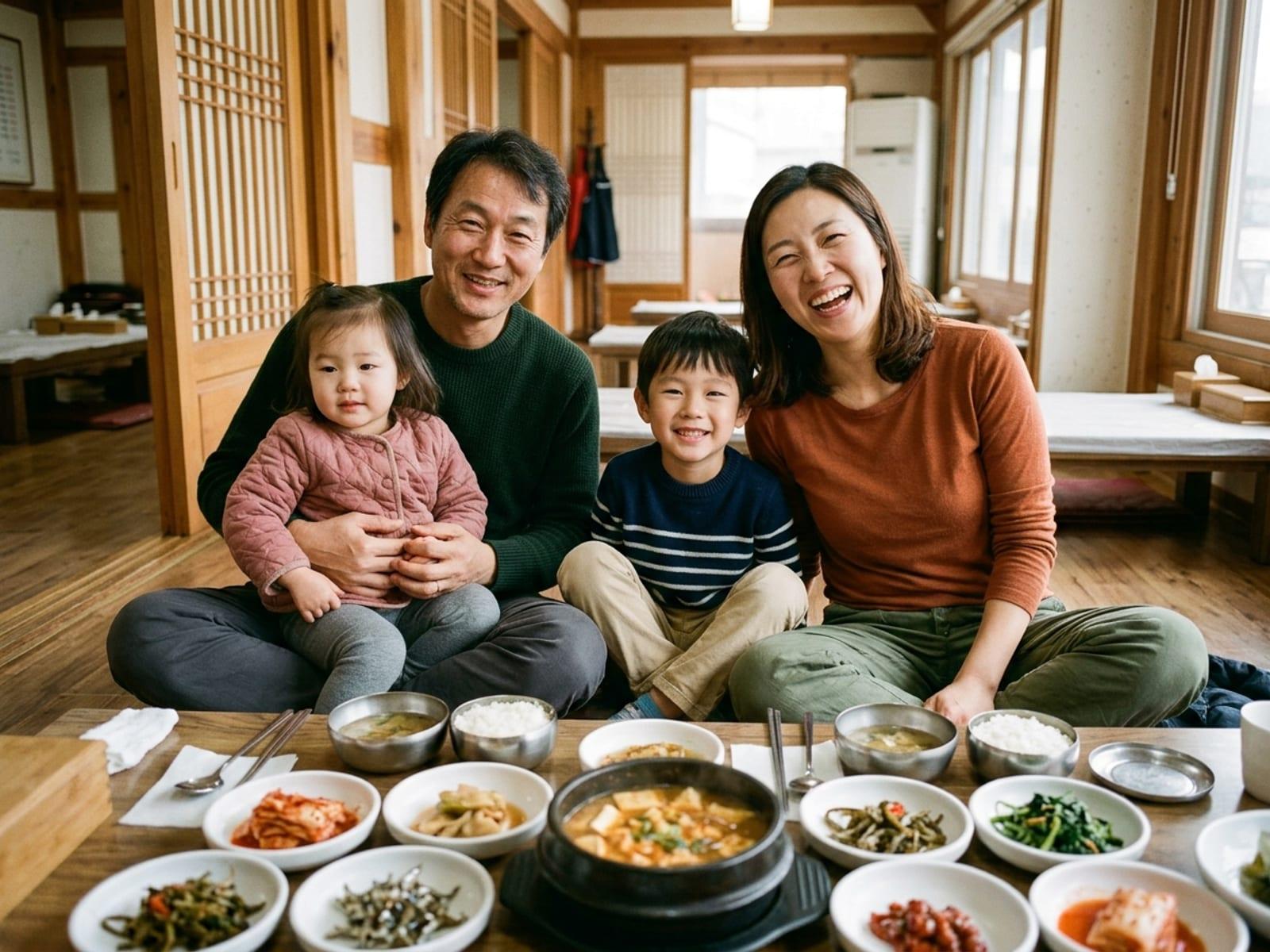
At a Korean sikdang, the everyday neighborhood restaurant, you call the staff with the button on your table or a quick "jeogiyo" (excuse me), share the small side dishes (banchan) that arrive without being ordered, and pay at the counter with your bill when you're done. There's no tipping: menu prices already include tax and service. With children, check the door for a "No Kids Zone" sign and ask whether dishes must be ordered for two or more before you sit down.
You ordered a single bowl of soup, and the table fills up with little dishes. You wonder why no one is coming to take your order, until you notice a button on the edge of the table. These customs can puzzle first-timers, but once you know how they work, each one makes sense, and they add up to a style of eating out that is actually relaxed for families.
Call the staff with a button or "jeogiyo"
Many restaurants in Korea have a small call button on each table, often on a corner or under the tabletop, so look for it as soon as you sit down. Press it when you're ready to order and someone will come over. If you can't find one, raise your hand and call out "jeogiyo" ("Excuse me"). If you just wait quietly, staff may not notice you for a long time at busy hours.
More and more places now take orders through a tablet on the table or a kiosk by the entrance. Some machines only display Korean; in that case, go by the food photos, and if you're stuck, call a staff member over and point to the screen.
Some restaurants keep water, small plates and wet towels in a corner for customers to fetch themselves. Glance around and watch what other diners are doing, and you'll pick up how that particular place works.
Banchan, the little side dishes, are for sharing
The first surprise at a Korean meal is banchan, the small side dishes that arrive without your ordering them. Along with kimchi you might see namul (seasoned vegetables), stir-fries, sweet-savory braised dishes, jeon (savory pancakes) and rolled omelet, all set in the middle of the table for everyone to share. Traditional table settings were even named by the number of banchan, such as "three dishes" or "five dishes," and royal court meals are said to have had twelve.
Banchan are meant to be finished during the meal and topped up if they run out. If you'd like more of something, staff will often bring a refill when asked, and some restaurants have a self-service corner where you can help yourself. If your child loves a particular dish, don't hesitate to ask. Just avoid taking more than you can eat; that's the considerate way to do it, for you and for the restaurant.
Using a spoon and chopsticks (sujeo)
At a Korean table you use a long-handled flat spoon and metal chopsticks as a pair, known together as sujeo. The thin stainless steel chopsticks are slippery and hard for children who aren't used to them. For small kids, bringing their usual child-size spoon and fork, or training chopsticks, makes meals much easier.
Two points of etiquette are worth remembering. Don't stand your chopsticks upright in a bowl of rice; it recalls the offering table set out for ancestral rites and is considered bad luck. And don't hold your spoon and chopsticks together in one hand, which is thought rude, especially when eating with elders. It's fine to rest the spoon you aren't using on top of your rice or soup bowl.
At restaurants with floor seating, take your shoes off before stepping up. Shoes that slip on and off easily make it much simpler with kids going in and out. The ondol (heated) floor stays warm even in winter and is comfortable for small children to sit on.
No tipping; pay at the counter
Tipping isn't a custom at Korean restaurants. Menu prices are supposed to include tax and service, and a 2013 amendment to the Food Sanitation Act made this "final price display" a requirement. As a result, adding a mandatory service charge or tip is considered to break the rules. In 2025 it was reported that a restaurant with a tip jar at its checkout counter was widely criticized on social media, a sign of how firmly diners share the expectation that tips aren't asked for. If you want to show thanks, a "gamsahamnida" ("Thank you") on your way out is plenty.
When you've finished, the usual practice is to take your bill to the counter and pay there. Say "gyesanhalgeyo" ("I'd like to pay") and you'll be understood. Many restaurants are said to let customers charge their phones, so if your battery is running low, it's worth asking.
Places that don't admit kids, and places that welcome them
Korea has No Kids Zones, restaurants and cafes that turn away children. They have spread since the early 2010s and are common among cafes and restaurants. The most common reason given is avoiding liability if a child gets hurt on the premises. In 2017 the National Human Rights Commission of Korea found the practice discriminatory, but it isn't prohibited by law. Jeju Island is said to have an especially large number. Some places post a notice at the entrance, so checking before you walk in can save an awkward moment.
On the other hand, there's also a system for registering child-friendly places as Kids OK Zones, and Seoul has more than 500 registered, most of them restaurants. Whether a place has high chairs or children's tableware varies, so if it matters to you, ask before you book or arrive.
A few Korean phrases go a long way when eating out with children. To ask for a high chair: "agi uija isseoyo?" ("Do you have a child's chair?"). For small plates: "apjeopsi juseyo." To ask for no spice: "an maepge hae juseyo." Barbecue and hot-pot restaurants sometimes require a minimum of two portions, so before sitting down, ask how to order for a small child.
Watch the spice too. The kimchi and many seasoned banchan contain chili, so start children on the ones that aren't red, like rolled omelet, namul and sweet-savory braised dishes. To see what your family around a table full of little dishes might look like, you can try pokesta's AI-generated photos ($1 per photo, and your first one is free).
Where to start
For your first meal out in Korea, a restaurant that specializes in one dish is the easy way in. In midsummer, for example, a samgyetang restaurant with a single signature dish leaves nothing to agonize over. In a port city, the restaurants at Jagalchi Market, which cook the fish you pick out at the market on the spot, are another very Korean way to eat out. To graze on a little of everything, the food stalls of Seoul's Gwangjang Market let you order mung bean bindaetteok or mini gimbap just by pointing. Seoul's main gateway is Incheon International Airport (ICN). Prices, opening hours and whether children are admitted vary by restaurant and can change, so check each place's own information before you go. Entry requirements for South Korea depend on your nationality, so check your own government's official information before you travel.
References