Gyeongju, in southeastern South Korea, was the capital of the ancient kingdom of Silla, and its royal tombs, observatory and palace pond still sit in the middle of town; in 2000 they were inscribed on the UNESCO World Heritage List as the Gyeongju Historic Areas. Most sights are clustered on flat ground, so it's easy to explore on foot with children. Spring and autumn are the most comfortable seasons, and a day that puts Gyeongju National Museum in the hot midday hours and the illuminated Donggung Palace and Wolji Pond after dark keeps kids from tiring out.
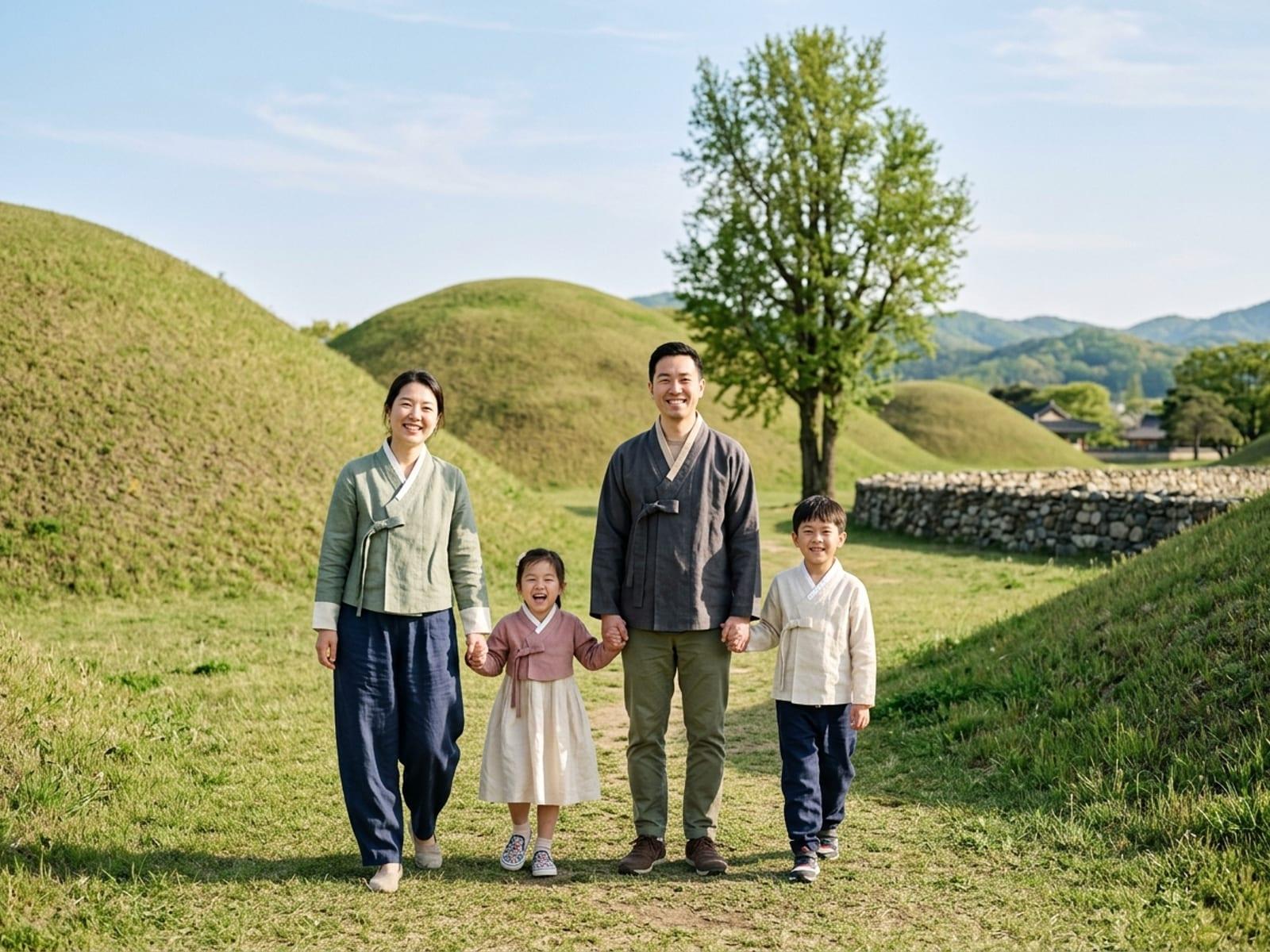
In the middle of town, round grassy hills rise one after another. Look closer and you realize they aren't natural hills at all but the tombs of kings and nobles from about 1,500 years ago.
Silla's capital survives in five separate belts
Silla ruled the southeast of the Korean Peninsula from 57 BC to AD 935, with Gyeongju as its capital. In the 7th century it unified most of the peninsula, and Buddhist culture flourished. From 57 BC to 935 comes to roughly 992 years by the traditional count. A single dynasty kept its capital in the same place for that long, which is why ruins lie layered across the whole city. Tell children that "for almost a thousand years, this town was the center of the country," and the sheer number of tombs starts to make sense.
The Gyeongju Historic Areas are not one site but five belts, grouped by their remains and covering 2,880 hectares in all. Families will spend most of their time in three of them. The Wolseong Belt holds the royal palace site of Wolseong, Cheomseongdae, the Gyerim woods and Wolji Pond. The Tumuli Park Belt is the royal burial ground around Daereungwon, made up of three groups of tombs; those that have been excavated yielded grave goods of gold, glass and ceramics. The Hwangnyongsa Belt has Bunhwangsa Temple and the site of Hwangnyongsa, once Korea's largest temple, whose foundation stones show it covered about 72,500 square meters.
The other two call for a separate plan from a walk around town. The Namsan Belt is a mountain often described as an open-air museum, with the ruins of 122 temples, 53 stone statues, 64 stone pagodas and 16 stone lanterns on record. Namsansinseong fortress, built in 591, and the Poseokjeong site, with its abalone-shaped stone watercourse, are here too. The Sanseong (mountain fortress) Belt centers on Myeonghwalseong, and nobody is certain when it was first built. It was repaired in 473, King Jabi moved into it in 475, and records show it was rebuilt in 551, 554 and 593. It was likely abandoned after 647, when Bidam's rebels captured it.
Seokguram Grotto and Bulguksa Temple, on Tohamsan east of the city, aren't part of these five. They were inscribed in 1995 as one of Korea's very first World Heritage Sites, separately from the Gyeongju Historic Areas.
Daereungwon and Cheonmachong: inside a royal tomb
Start with Daereungwon, where many of the large tombs are gathered. Walking paths wind between the grassy mounds, so you can feel their size up close. One of them, Cheonmachong, was excavated starting in 1973. It is 47 meters across and 12.7 meters high, dates from around the 5th to 6th century, and the name of the king buried there is unknown.
About 11,500 objects were found in Cheonmachong, including a gold crown, a gold belt and rings. The tomb is named for a painting of a flying "heavenly horse" (cheonma) on birch bark that was used as a mudguard on a saddle. The painting of a horse with wings on its legs is designated a National Treasure of South Korea, as is the gold crown. Part of the tomb's interior is open to visitors, and you can step inside to see how it was built: a wooden burial chamber covered over with earth and stones. Walking into a mound they've only seen from outside tends to stick with children. It's dim inside, so tell nervous kids beforehand that you're going to look inside a king's tomb.
Daereungwon's main gate is open from 9:00 to 22:00 (last entry 21:30), and Cheonmachong until 21:30, according to the Korea Tourism Organization as of March 2025. Admission fees and hours can change, so check the official information.
Cheomseongdae, and Donggung Palace and Wolji Pond at night
A short walk from Daereungwon, a stone tower shaped like a bottle stands in a grassy field. Cheomseongdae is an observatory built in the 7th century, during the reign of Queen Seondeok of Silla, and is said to be the oldest surviving observatory in Asia. It stands about 9.17 meters tall. Tradition says it is built of 365 stones, one for each day of the year, so try counting them with your children. A 1962 survey counted 366, and the number changes depending on whether you include the stones inside.
On the way from Cheomseongdae to the Wolseong palace site is an old wood called Gyerim, whose shaded paths make a welcome rest stop on a summer walk.
After dark, go to Donggung Palace and Wolji Pond. The pond belonged to a royal palace garden built in 674 on the orders of King Munmu, and it was once known as Anapji. Three small islands sit in the pond, which measures about 200 meters east to west and 180 meters north to south, and at night the reconstructed pavilions are lit up and reflected in the water. Excavations from 1975 to 1986 turned up nearly 33,000 objects, including roof tiles, pottery and gilt-bronze Buddha statues.
According to the Gyeongju city tourism site, Donggung Palace and Wolji Pond is open from 9:00 to 22:00, with ticket sales ending at 21:30. The lights come on after sunset and stay on until 22:00, and the same goes for Cheomseongdae.
Hwangnyongsa is only stones now, so see the model first
Work on Hwangnyongsa began in 553 under King Jinheung, and the temple wasn't fully completed until 644. Its nine-story wooden pagoda is said to have stood 68 or 80 meters tall, and it was burned in the Mongol invasions of 1238. Only the massive foundation stones remain. Trace the history of Seoul's Lotus Lantern Festival back far enough and you reach this temple.
Stones alone don't convey the scale, so before you walk the site, stop at the Hwangnyongsa History and Culture Museum. On the first floor is an 8-meter model of the pagoda at one-tenth of its actual size, and a three-dimensional theater tells the story from the temple's founding to its loss in the Mongol invasions. It opens from 9:00 to 18:00, until 19:00 on weekends from April to October. Admission is 3,000 won for adults, 2,000 won for teenagers and 1,500 won for children, and free for ages 6 and under and 65 and over. It closes on January 1 and on the days of Seollal and Chuseok (Korea Tourism Organization, as of March 2025).
Tombs in the morning, the museum at midday, the pond at night
Daereungwon, Cheomseongdae, the Wolseong palace site and Donggung Palace and Wolji Pond are close together near the city center, within walking distance of one another. The paths between the sites, though, are mostly open lawn with little shade, so hats and drinks are essential in summer. Visiting Daereungwon and Cheomseongdae in the morning, the indoor Gyeongju National Museum in the midday heat, and Donggung Palace and Wolji Pond from late afternoon on keeps children from tiring out. If your kids can ride, bikes are rented by the hour near Daereungwon, and prices vary by shop.
Gyeongju National Museum is free. It opens from 10:00 to 18:00 (last entry 17:30), with an extra hour on Saturdays and public holidays, and closes on January 1 and on the days of Seollal and Chuseok (Korea Tourism Organization, as of March 2025). It has a dedicated hall showing about 730 of the finds from Wolji Pond, and it's also the place to see with your own eyes what came out of the tomb mounds you just walked between. The National Museum of Korea in Seoul also displays Silla gold crowns, so you can compare the two before or after your trip. If you're using a stroller, some grass and dirt paths are hard to push on, so bring a baby carrier as well.
If your children are older, around the upper grades of elementary school, and can handle a hike, you can venture into the Namsan Belt. Even a short climb from the base brings you to figures of the Buddha carved into rock. Some trails are steep, so with small children, a plan centered on the sites in the city is the sensible choice.
For a souvenir, pick up Gyeongju's famous Hwangnam-ppang, a small baked pastry packed with sweet red bean paste, said to have been first made in 1939 and sweet in a way children usually like. You can also preview your family walking between the ancient tomb mounds with pokesta's AI-generated photos ($1 per photo, and your first one is free).
Short days for the night lights, and two ways in
Spring and autumn are the most comfortable seasons for walking. Summers are very hot and winter winds are cold. The lights at Wolji Pond come on after sunset, so in summer you'll be waiting until close to your children's bedtime.
The nearest international gateway is Gimhae International Airport (PUS) in Busan. If you stay a night there, Jagalchi Market on the harbor pairs well with this trip. By rail, KTX trains stop at Gyeongju Station (formerly Singyeongju Station), with direct service from the Seoul and Busan directions. Gyeongju Station is in Geoncheon-eup, well west of the city center, so take a bus or taxi into town from there. Plenty of direct express buses also run to Gyeongju from around the country. Entry requirements for South Korea depend on your nationality, so check your own government's official information before you travel.
References
- Wikipedia, "Gyeongju Historic Areas" https://en.wikipedia.org/wiki/Gyeongju_Historic_Areas
- Wikipedia, "Hwangnyongsa" https://en.wikipedia.org/wiki/Hwangnyongsa
- Wikipedia, "Myeonghwalseong" https://en.wikipedia.org/wiki/Myeonghwalseong
- Wikipedia, "Cheonmachong" https://en.wikipedia.org/wiki/Cheonmachong
- Wikipedia, "Cheomseongdae" https://en.wikipedia.org/wiki/Cheomseongdae
- Wikipedia, "Donggung Palace and Wolji Pond" https://en.wikipedia.org/wiki/Donggung_Palace_and_Wolji_Pond
- Wikipedia, "Gyeongju station" https://en.wikipedia.org/wiki/Gyeongju_station
- VISITKOREA, "Pedaling Through Time: A Bike Tour Guide to Gyeongju" https://english.visitkorea.or.kr/svc/contents/contentsView.do?vcontsId=221789
- Gyeongju City Tourism, "경주야경10Pick" https://www.gyeongju.go.kr/tour/page.do?mnu_uid=4859
- The Kyunghyang Shinmun, "No worries even if it rains, a 'Museum Vacation'···Three flagship indoor destinations in North Gyeongsang selected" https://www.khan.co.kr/en/article/202607101317017