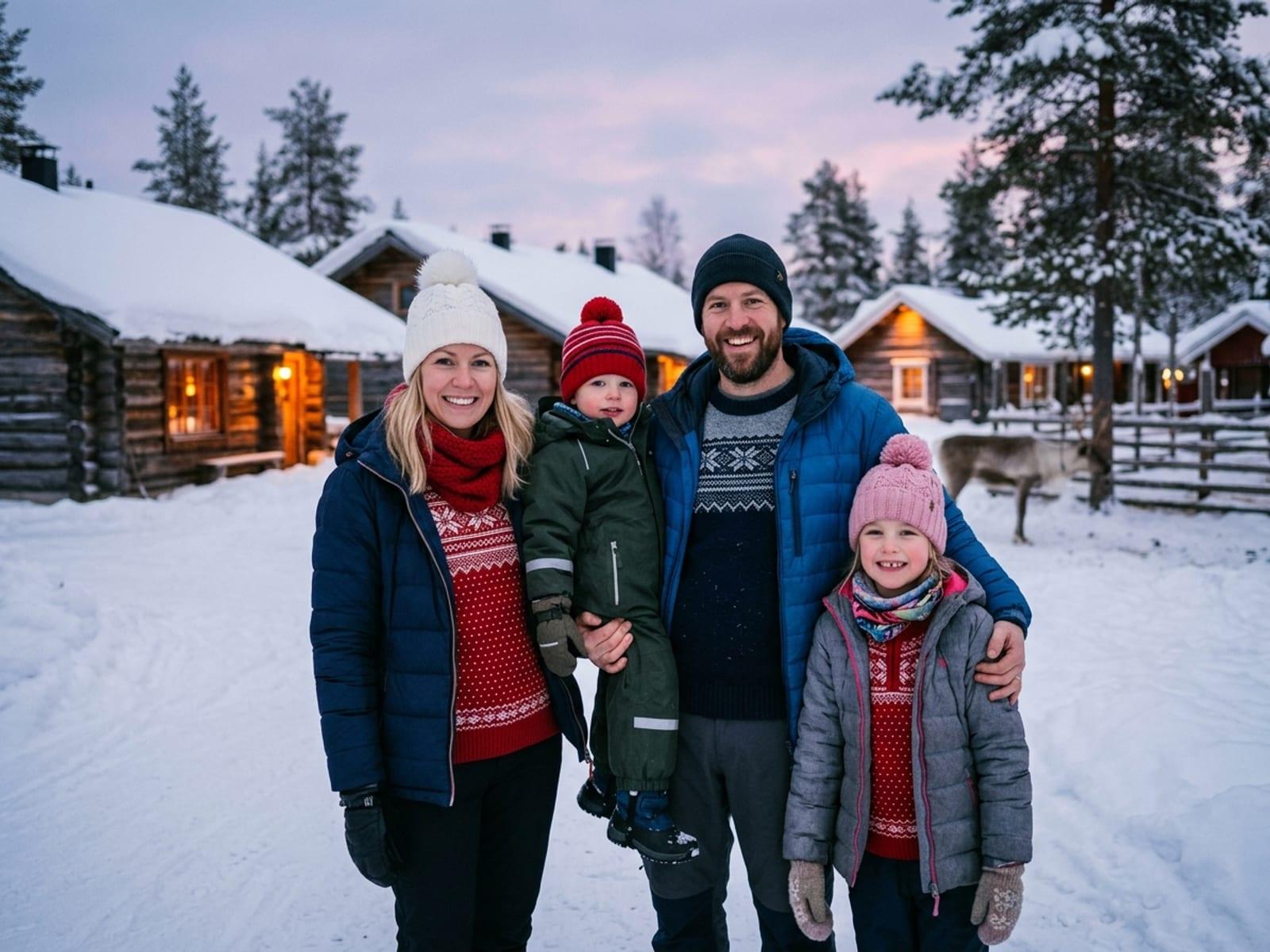
About 8 kilometers north of central Rovaniemi, the main city of Finnish Lapland, Santa Claus Village sits right on the Arctic Circle. You can meet Santa Claus here on any day of the year, and neither getting into the village nor chatting with Santa costs anything. A few things are particular to this place, though: you can't use your own camera during the meeting, and around the winter solstice there are only a little over two hours between sunrise and sunset. Knowing that in advance changes how you plan the day.
The line in the square: 66°33′ north
The Arctic Circle is clearly marked across the village's central square. According to the village's official site, it runs at 66°33′45.9″ north. Walk over it, hop over it, cartwheel over it if you like: once you're across, you're officially in the Arctic. A child stepping over that line is the obvious family photo of the day, and you can also get an Arctic Circle crossing certificate to mark the moment. It's sold in the village's Christmas House shop.
The village started with a single log cabin. In October 1944 the retreating German army burned Rovaniemi, and in the summer of 1950 former US First Lady Eleanor Roosevelt came to see the city's reconstruction for herself and to cross the Arctic Circle while she was there. Logs were taken from the Ounasjoki river eight days before she arrived, the cabin went up in less than two weeks, and it was finished on June 11, 1950. The Roosevelt Cottage was the first building at the Arctic Circle and still stands in the village, with an information board beside it telling its story. Since then, Santa's office, a post office, restaurants, souvenir shops and places to stay have grown up around it, and the village now welcomes more than 500,000 visitors a year.
Meeting Santa is free; an elf takes the pictures
The main destination is the Santa Claus Office. Santa greets visitors there every day of the year, and both entry and the meeting itself are free. You can't book a time slot in advance. If there's a queue, everyone waits their turn, and during the busiest stretch, from late November to early January, the official site recommends arriving earlier in the day to make sure you get in. A Christmas Express Pass that lets families skip the queue can be booked through the office's website.
The photo policy is worth knowing before you go. Guests are asked not to use their own cameras during the meeting. Instead, a Photographer Elf captures photos and video, and afterwards you can buy them, either as a digital photo and video package or as a printed A4 photo. The digital files stay available for download for 400 days after the visit, so there's no need to decide everything on the spot. If you don't buy anything, the visit costs nothing.
Opening hours shift a lot with the seasons. For winter 2026–27, the office is open daily from 8:00 to 20:00 between November 30 and January 3, then 9:00 to 18:00 from January 4 to the end of March. Hours and prices change from year to year, so check the official website before you go. It also helps to decide with your child beforehand what they'd like to say or ask; the words come out more easily when nerves kick in.
Santa is in the village all year, but in Finnish homes Joulupukki, the Finnish Santa, knocks on the door on Christmas Eve. For how families spend that evening and how to photograph it, see our guide to Finnish Christmas Eve family photos at home.
A red mailbox that holds your letters until Christmas
The other big stop is Santa Claus Main Post Office. Santa receives around half a million letters a year from children and adults all over the world, and some of them are on display inside. Anything you send from here gets the special Arctic Circle postmark.
What makes this post office different is its red mailbox. Letters dropped into it aren't sent right away; they're held and sent out for Christmas. So even on a summer or autumn trip, a postcard your child writes to themselves can turn up at home months later, around the holidays. Ask at the counter or check the official site for the latest posting date that still makes it in time for Christmas. The post office is also open every day of the year, with hours that change by season.
Two hours of daylight at the solstice, minus 10 in January
The village looks most like itself under snow. In winter, husky rides run inside the village every day, and reindeer sleigh rides and snowmobiling can be booked in and around it. All of them cost extra, and what's on offer and the prices vary by season and operator. With small children, a short ride is an easy first step. For a taste of Lapland, order poronkäristys, sautéed reindeer with mash and lingonberries, at a restaurant in Rovaniemi.
Plan around how short the winter days are. Around the winter solstice, only about 2 hours and 15 minutes pass between sunrise and sunset in Rovaniemi. The city center lies about 6 kilometers south of the Arctic Circle, so the sun does rise, but it barely clears the horizon. It never gets pitch dark, either: for a few hours around midday the snow is washed in soft blue and pink light. Use that window for outdoor activities and photos, and save the dark hours for indoors. When conditions are right, the northern lights may appear at night.
The cold is easier to prepare for when you know the numbers. Based on 1991–2020 averages at Rovaniemi Airport, the mean temperature is −7.7°C in December and −10.3°C in January and February. The average January low is −13.5°C, and −38.1°C was recorded in January 1999. Snow stays on the ground for about 175 days in an average year. Dress in three layers: a base layer, a fleece or sweater, and a waterproof, windproof outer jacket, plus a hat, gloves, thick socks and insulated, non-slip boots. Children feel the cold first in their hands and feet, so pack a spare pair of gloves. Some tour operators rent out winter clothing and boots, which is worth asking about if hauling heavy gear from home sounds like a hassle. Indoors it's well heated, so wear layers that come off easily. Strollers struggle on snowy paths; a sled-style stroller or a baby carrier makes getting around easier.
To see how your family would look in matching Nordic knits, scarves and hats in the snowy village, you can try it before the trip with pokesta's AI photos ($1 per photo).
Three kilometers from the airport, bus 8 from town
The usual route from abroad is to connect to a domestic flight at Helsinki Airport (HEL). The flight to Rovaniemi takes about 1 hour 15 minutes; leave yourself two hours or more for the connection. There are also more than 40 direct routes from cities across Europe to Rovaniemi, and which ones operate changes with the season. Several trains a day run from Helsinki, including the Santa Claus Express night train. Entry requirements depend on your nationality, so check your own government's official travel information.
Rovaniemi Airport (RVN) is only about 3 kilometers from the village, which itself lies about 8 kilometers north of the city center. Local bus 8 runs between the center and the village all year round. From November to March, the private Santa's & Airport Express also links the village, the center and the airport, and in autumn and winter the Apukka Shuttle Bus runs between the center, the village and Apukka. Taxis are available too. Routes and timetables change from year to year, so check the official website before you travel.
December, January to March, or a season without snow
The same Santa Claus Village offers a very different trip depending on when you go. If you want to spend Christmas there, December is the month, but it's also when accommodation and flights are hardest to get and most expensive, and when the lines at the Santa Claus Office are longest. If you're set on December, book early. If snowy scenery and sledding are what you're after, January through March is easier on children: the days are getting longer, so there's more daylight for being outdoors.
If meeting Santa matters more than snow, summer or autumn works too. From around June 7 to July 6 the sun doesn't set at all, and you can walk through forests and along rivers that stay light in the middle of the night. From mid-September, the fells of Ylläs and Pallas in western Lapland turn red underfoot during ruska, the Lapland autumn colors. When it's quieter, your time with Santa feels more relaxed, and a postcard dropped into the red mailbox will still arrive in winter. In the end it comes down to your children's ages and what they're most looking forward to.
References
- Santa Claus Village (official site), "Arctic Circle" https://santaclausvillage.info/experiences/arctic-circle/
- Santa Claus Village (official site), "History of Roosevelt Cottage" https://santaclausvillage.info/info-and-tips/roosevelt-cottage/
- Santa Claus Village (official site), "Santa Claus Office" https://santaclausvillage.info/santa-claus-office/
- Santa Claus Village (official site), "Santa Claus Main Post Office" https://santaclausvillage.info/santa-claus-main-post-office/
- Santa Claus Village (official site), "Getting here and moving around" https://santaclausvillage.info/info-and-tips/getting-here-and-moving-around/
- Visit Rovaniemi (Rovaniemi's official tourism site), "Santa Claus Village At The Arctic Circle" https://www.visitrovaniemi.fi/santa-claus-village-at-the-arctic-circle/
- Visit Rovaniemi, "Getting here" https://www.visitrovaniemi.fi/plan-your-trip/getting-here/
- Visit Rovaniemi, "Polar Night" https://www.visitrovaniemi.fi/love/polar-night/
- Wikipedia, "Rovaniemi" (climate normals, midnight sun dates) https://en.wikipedia.org/wiki/Rovaniemi
- Yle News, "Finland marks winter solstice, longer days on the horizon" (December 22, 2018) https://yle.fi/a/3-10569812