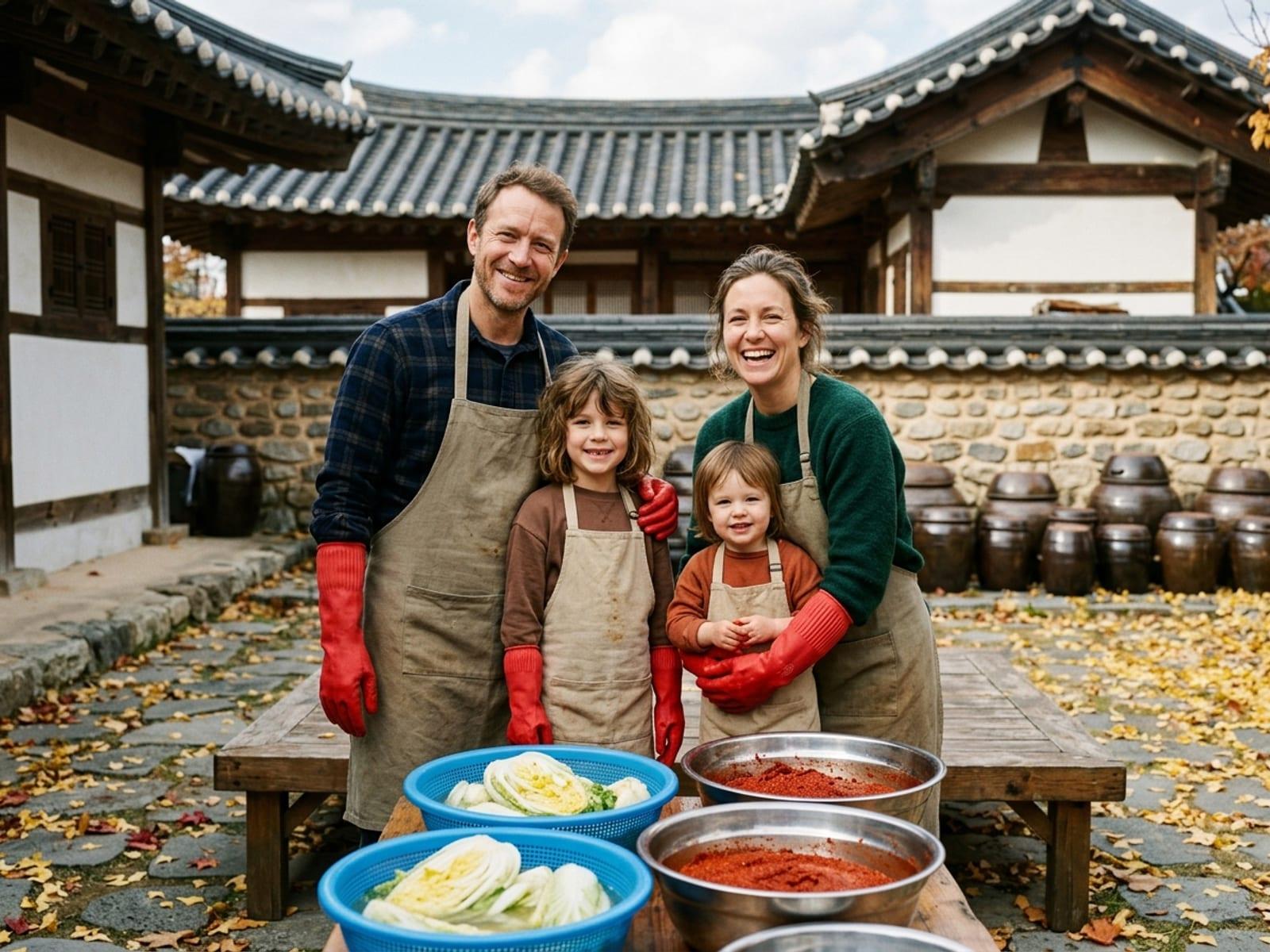
Kimjang is the Korean custom of families and neighbors gathering in late autumn (traditionally November to December) to make the whole winter's supply of kimchi in one go, and it was added to UNESCO's Intangible Cultural Heritage list in 2013. It happens at home, so travelers rarely get to join in, but at Museum Kimchikan in Seoul's Insadong you can book a kimchi-making session. With children, bring rubber gloves and dark clothes, and start tasting with mild white kimchi or dongchimi.
Winter work that takes a year to prepare
Read UNESCO's description and it's clear that kimjang isn't a single day's work but a year-round part of life. In spring, households buy shrimp, anchovies and other seafood to salt and ferment. In summer they buy sea salt for the brine. In late summer, red chili peppers are dried and ground into powder. Then, in late autumn, kimjang season finally begins. Each household watches the weather forecast and picks a day when the temperature is just right.
Kimjang also comes with a custom of sharing. As families swap their kimchi, tips and ideas about how to make it travel along with it. Methods and ingredients differ by region and by family, and most have been passed down from mother-in-law to daughter-in-law. In 2015, North Korea's kimchi-making tradition was also inscribed by UNESCO as a separate listing. Kimchi became the second tradition listed from both North and South Korea, after the folk song "Arirang."
Keeping winter kimchi neither too cold nor too warm mattered too. In the past, families buried brown earthenware jars called onggi in the ground so they wouldn't freeze, or lined them up on a jangdokdae, a platform for storage jars. Today many households use dedicated kimchi refrigerators that let them fine-tune the temperature. Winter kimchi is eaten a little at a time until early spring, and batches that have turned very sour go into stews and stir-fries. The same jar of kimchi turns into different dishes as the season moves on.
Chili peppers arrived only after the 17th century
Kimchi's red color wasn't always there. Chili peppers are native to the Americas and reached the Korean Peninsula around the early 17th century. They didn't come into wide use until the 19th century, and before that, kimchi contained no chili at all. The practice of fermenting vegetables to preserve them is far older, though; jars for pickling vegetables appear in records from the Three Kingdoms period.
Kimjang centers on baechu kimchi, made with whole napa cabbages, but there are many other kinds. Kkakdugi uses cubed radish, and chonggak kimchi uses small radishes with their leaves still attached. Baek kimchi (white kimchi), made without chili, and dongchimi (water kimchi), radish steeped in a light brine, aren't spicy, which makes them easy for children to eat.
Where to try making kimchi in Seoul
One of the easiest places for travelers to try kimchi-making is Museum Kimchikan, a museum devoted to kimchi in Insadong. It occupies the fourth to sixth floors of the main building of Insadong Maru, on Insadong's main street. Go into the building with the convenience store and take the elevator on the left up to the fourth floor. From Exit 6 of Anguk Station on subway Line 3, walk about 300 meters down Insadong's main street and it's on the right. It's also about a ten-minute walk from Exit 3 of Jonggak Station on Line 1.
The museum is open Tuesday to Sunday, 10 a.m. to 6 p.m. (last entry 5:30 p.m.). It's closed on Mondays, January 1, the Seollal (Lunar New Year) and Chuseok holidays, and December 25. Its hands-on programs are divided into sessions for foreign visitors, children, individuals and groups, and you book through the official website. Content, prices and language support change depending on the time of year, so confirm them on the booking page or by phone.
After the museum, stroll a little further along Insadong and stop at a restaurant to taste seasonal kimchi, which arrives among the banchan, the small shared side dishes at a Korean meal. Freshly made kimchi is lightly fermented and tastes clean, with little sourness; the tang grows stronger with time. Try a few side by side and you'll notice how the same kimchi changes.
With children, start with the mild kinds
The basic method for baechu kimchi is to peel back the leaves of salted, softened cabbage one at a time and rub seasoning paste between them. It's a simple, repetitive task, so a primary-school child can help alongside an adult right to the end. In a class you'll be handling chili paste with your hands. Put rubber gloves on your kids so chili doesn't get on their hands or into their eyes, and keep reminding them not to rub their eyes while they work. Chili stains are hard to wash out, so skip white clothes and choose dark colors like navy or brown, with an apron on top.
When it's time to eat, begin with mild kinds like baek kimchi or dongchimi. If a child wants to try red kimchi, rinsing it lightly in water and eating it with rice tones down the heat. There's no need to push it on a child who isn't used to it. Just watching the cabbage being salted shows how much work went into getting ready for winter.
If you're taking home kimchi you made or bought, think about how you'll carry it. Juicy kimchi usually runs into liquid limits in carry-on bags, so it normally goes in checked luggage. As it ferments, the bag can swell and leak, so double-bag it in resealable bags and pack it apart from your clothes to keep the smell from spreading. Whether you can bring it in at all also depends on the quarantine rules of the country you're flying to, so check the rules for your destination.
If you'd like a picture of your family in red rubber gloves and aprons gathered around the cabbage, you can try one with pokesta's AI photos ($1 per photo, and the first one is free).
When to go and how to get there
Kimjang is traditionally done from November into December. Walk around Seoul as Korean households start getting ready for winter, and kimchi feels closer than usual. The museum's classes run all year, so if the season doesn't matter to you, you can fit one into a trip at any time.
Flights arrive at Incheon International Airport (ICN), and the AREX airport railroad reaches Seoul Station in about an hour. Insadong is in the city center, close to old palaces such as Gyeongbokgung and Changdeokgung, so it's easy to fold into a half-day walk. Entry requirements for Korea depend on your nationality, so check your own government's official information.
For more Korean food, see our articles on bibimbap in Jeonju and Busan's Jagalchi Market.
For a traveler, kimjang is less about making kimchi than about understanding the season. If you're there in November, make kimchi at the museum first and then taste freshly made kimchi at a restaurant. For children, that order makes the most sense.
References