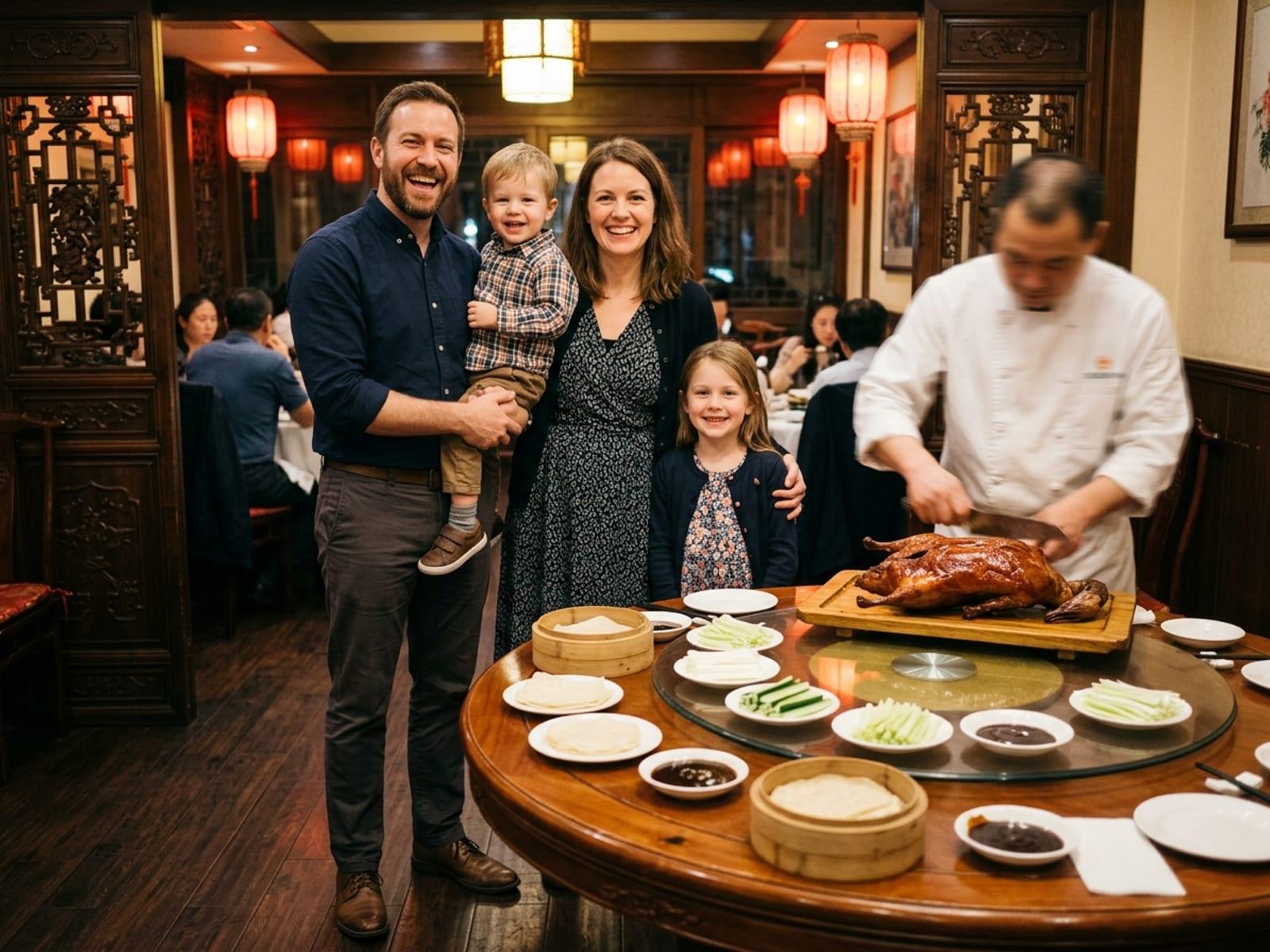
The two old names for Peking duck (Beijing kaoya) in Beijing are Bianyifang and Quanjude, and they roast it differently. Bianyifang's best-known restaurant is at Xianyukou, a lane of old-name eateries just east of Qianmen Street, where the shop that today's Bianyifang grew from opened in 1855; it still uses the closed oven, where the duck cooks in stored heat with no flame. Quanjude, which also started on Qianmen Street, roasts its ducks over open fruitwood fires. Peking duck was named part of China's national intangible cultural heritage in 2008. Knowing the two roasting styles, and that the duck is eaten in three stages from skin to meat to bones, makes choosing a restaurant and ordering much easier.
From a Yuan court cookbook to Ming-era restaurants
Roast duck is said to have been eaten in China since the Northern and Southern Dynasties. A dish called shao yazi, seen as the ancestor of Peking duck, appears in Yinshan Zhengyao, a book written in 1330, during the Yuan dynasty, by Hu Sihui, who supervised the imperial kitchens. The dish took something close to its present form in the late Ming dynasty.
The first restaurant on record to specialize in roast duck is Bianyifang, said to have been founded in 1416, the 14th year of the Ming Yongle emperor. Strictly speaking, what opened in 1416 was the shop in Mishi Hutong known as "Old Bianyifang"; today's Bianyifang grew out of a shop that a merchant named Wang opened at Xianyukou near Qianmen in 1855, with a chef hired away from the old one. Later, in 1864, the third year of the Qing Tongzhi emperor, Yang Quanren opened Quanjude on Qianmen Street and made hung-oven roast duck its specialty. You'll still see both names all over the city.
After the public-private joint ownership reforms of the 1950s, the Xianyukou Bianyifang became the only authentic closed-oven duck restaurant in Beijing. Today it is run by the Beijing Bianyifang Roast Duck Group. The name is read biàn yí fāng; the first two characters are the same ones that mean "cheap" when read pián yi, but not here. There are several stories about where the name came from, and in 1958 Premier Zhou Enlai explained it as "convenient for the people, good for the home."
A white duck, and a dish served to diplomats
The duck traditionally used is the all-white Beijing stuffed duck. It was raised free-range for about 45 days, then hand-fed for the last 15 to 20 days to fatten it up, and could reach 5 to 7 kg.
That has changed in recent years. Leaner breeds that grow in about 40 days without force-feeding have spread, and by 2021, more than 95 percent of the ducks sold in Beijing were reportedly breeds that don't need it.
Peking duck has also had its moments on the diplomatic stage. When the US national security adviser Henry Kissinger made his secret trip to Beijing in 1971, Peking duck was served at his lunch with Premier Zhou Enlai, a scene often told as part of the dish's history.
Two ways to roast: hung oven and closed oven
There are two main schools of roasting.
The first is the hung oven (gualu), associated with Quanjude. The duck hangs inside an oven with no door and is roasted over wood from fruit trees such as peach and pear, at about 270°C for 30 to 40 minutes. The direct heat and fruitwood smoke give the skin a crisp, fragrant finish.
The second is the closed oven (menlu), associated with Bianyifang. The oven is heated thoroughly by burning things like sorghum stalks, then the fire is put out and the duck roasts in the stored heat. With no flame touching it, the fat under the skin stays wrapped around the meat, and the result is moist and tender. At Bianyifang, broth is poured into the duck's cavity as it roasts, so it is baked outside and simmered inside. The ovens at the Xianyukou restaurant are each about one square meter, six of them built as a single unit, and each holds ten ducks at a time. The restaurant also serves versions in which the duck is soaked in vegetable juice or jasmine tea before roasting, sold as "vegetable-fragrance" and "flower-fragrance" duck; ask which are on that day.
So which restaurant you walk into makes a real difference to the texture. If you have time, try both; even children can usually tell them apart.
The preparation before roasting takes work too. Air is pumped between the skin and the fat to lift the skin away, the duck is scalded in boiling water, hung to dry, glazed with maltose syrup or something similar and left to rest again. That's what gives the skin its glossy reddish-brown color in the oven.
Skin, meat, bones: the duck in three courses
Once roasted, the duck is carved near the table. In Beijing this is called pian ya, and a skilled chef can take a whole bird apart in no time. For kids, watching the knife work up close may be the best part of the meal.
The first course is crisp skin on its own, dipped in sugar or in tianmianjiang, a sweet bean sauce. Next comes meat and skin wrapped in thin wheat pancakes with the sauce, slivered scallions and cucumber. Dipping the skin in sugar and eating it with cucumber is said to have been started by Mei Lanfang, the famous Peking opera performer.
There's a small knack to wrapping. Spread a pancake on your palm or plate, smear a thin layer of sauce on it with your chopsticks, then add two or three slices of meat and skin and a few strips of scallion and cucumber. Fold the bottom up once, tuck in the sides, then roll it up, and the filling won't fall out halfway through. Pile on too much and the pancake tears. Roll the first one for your child to show them how, then let them make the second; that alone gets the whole table involved.
Finally, the carcass comes back as soup with napa cabbage and tofu, or stir-fried with sweet bean sauce, or with salt and pepper. What it turns into depends on the restaurant, so ask when you order. A cabbage and tofu soup is mild, and makes a gentle last dish for children.
Sharing a round table with kids
Most Peking duck restaurants seat you at the classic big round table with a lazy Susan, and the more of you there are, the more fun it is. How many people one duck feeds depends on the restaurant and what else you order, so tell the staff how many you are and how old the children are, and let them help you decide how much to order. Reading up on how sharing works at a Chinese round table, from turning the lazy Susan to using serving chopsticks, lets you explain it to the kids before you go.
For small children, go easy on the sauce and cucumber when you roll their pancakes. The skin is very rich, and too much of it can sit heavily in a small stomach. Some kids also don't like the bite of scallion or the grassy smell of cucumber, so make their wraps separately.
The flagship branches of the famous old restaurants get busy at dinnertime. Book if you can; if they don't take bookings, arrive right at opening or a little early, so the children aren't kept waiting long. If you want Bianyifang and a walk around Qianmen on the same evening, go to Xianyukou. If you're staying farther out, Bianyifang has plenty of other branches in the city (31 directly run and chain restaurants as of 2018), so a nearer one may suit tired kids better. Hours and booking methods differ by branch, so check the official listings before you go. There's no dress code, but if you want a souvenir photo in a private room at one of the old houses, a collared shirt or a simple dress suits the red lanterns and carved wooden screens nicely.
A family photo around a duck restaurant's round table can be made ahead of time with pokesta's AI photos ($1 per photo). If you're visiting Beijing for the Lunar New Year, see our guide to Spring Festival and temple fairs in Beijing.
When to go and getting there: it's on the menu all year
Peking duck is served year-round. Beijing summers are hot and winters are dry and cold, so if you're combining it with sightseeing, spring and autumn are the most comfortable seasons with children.
Beijing has two airports, Beijing Capital International (PEK) and Beijing Daxing International (PKX), and both have rail links into the city. Qianmen Street, where Quanjude began, runs south from Tiananmen Square, and Bianyifang's Xianyukou restaurant is just off its east side, which makes both easy to combine with a visit to the Forbidden City or the Temple of Heaven. It also makes a good dinner after a day at the Mutianyu Great Wall, up by cable car and down by toboggan. Entry requirements for China depend on your nationality, so check your own government's official information before you leave.
References