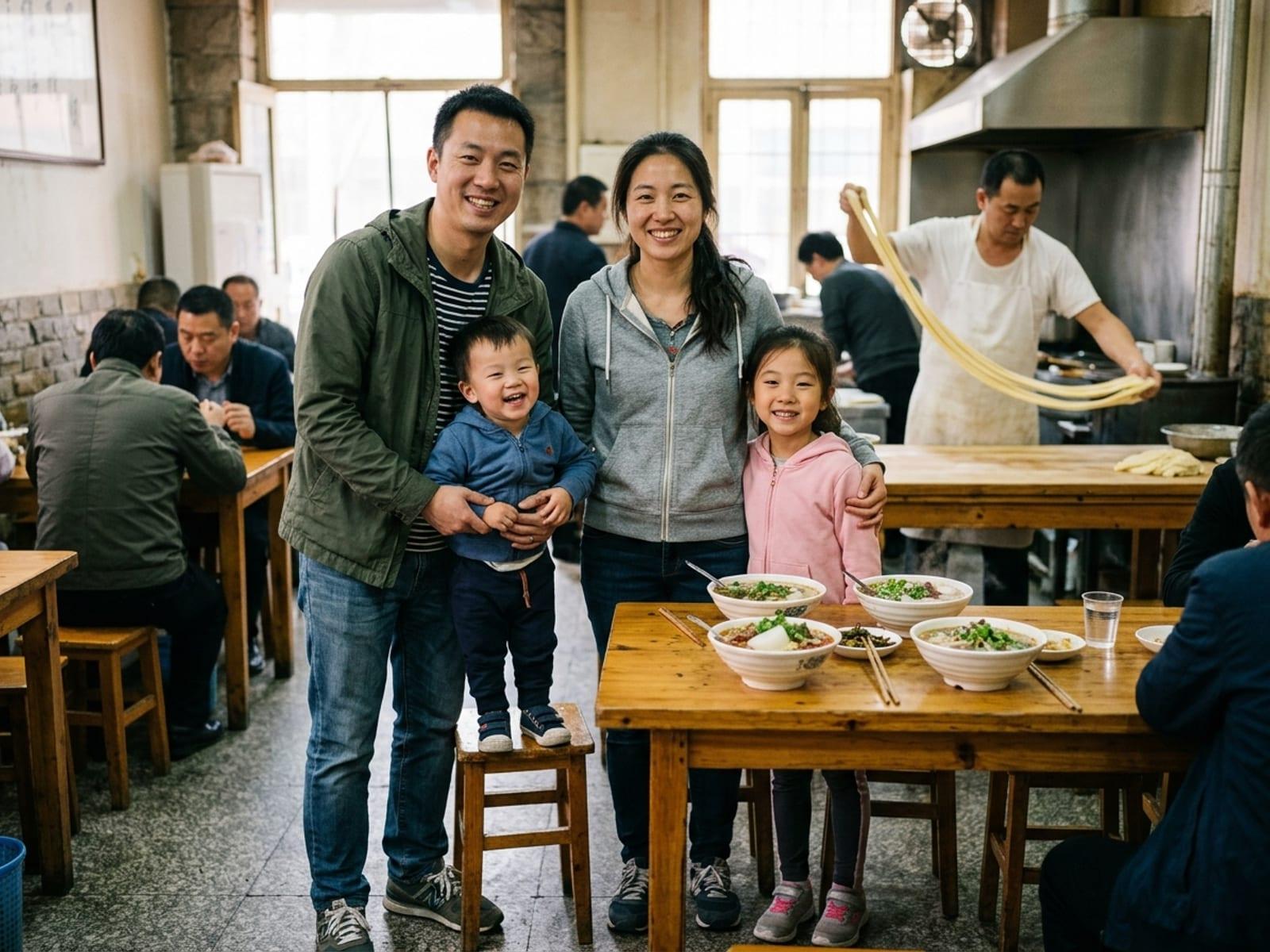
A clear beef broth, yellow noodles pulled by hand a moment ago, white radish, red chili oil, and a scatter of green coriander and garlic shoots. Lanzhou beef noodles (Lanzhou niurou mian) are what people in Lanzhou, the capital of Gansu Province on the banks of the Yellow River, have long eaten first thing in the morning. In 2021 the way they are made was added to China's list of national intangible cultural heritage. At a local noodle shop you choose the thickness of your noodles when you order. With children, the safest way to start is thin noodles and only a little chili oil.
The five-color rule
A bowl of Lanzhou beef noodles is supposed to look a certain way, summed up in a local phrase: "one clear, two white, three red, four green, five yellow." The broth is clear, the radish is white, the chili oil is red, the coriander and garlic shoots are green, and the noodles are a glossy yellow. No soy sauce goes in, so the broth stays clear and tastes clean, seasoned with salt and spices.
There are several stories about where the dish came from. One says the Hui, China's Chinese-speaking Muslims, created a beef noodle soup during the Tang dynasty that fit their dietary rules. Another says the first beef noodle shop in Lanzhou opened in the early Qing dynasty. The person most often credited with giving the dish its modern form is Ma Baozi, a Hui man who is said to have started selling beef noodles around 1915 and set down the five-color standard.
The noodles get their springy texture and yellow color from penghui, an alkaline ash made by burning a grass from the Gobi that has traditionally been added to the dough. Many shops now use a commercial noodle additive instead. The dough is prepared the day before, then pulled by the cook when you order and boiled straight away. A bowl arrives about two minutes after you order, which is part of why it became a breakfast dish.
You decide how thick your noodles are
What throws most first-timers in Lanzhou is the number of noodle shapes. Round noodles alone come in grades: the hair-thin maoxi, then xi, sanxi, erxi, and the thick cu. Flat noodles include jiuye, about as wide as a garlic chive leaf, then bokuan, kuan, and dakuan, which is as wide as a belt. There are also shapes that test a cook's skill, such as qiaomaileng, with a triangular cross-section. The most popular choices tend to be xi, erxi, sanxi and jiuye.
Lanzhou noodle shops traditionally had no waiters: you paid first and collected your bowl yourself when it was ready. How ordering works today varies from shop to shop, so it helps to watch what others are doing for a minute before you join the line. Decide on everyone's noodle width while you wait, so you are not stuck at the counter. Some shops also sell braised beef shank and cold side dishes on separate plates.
Eating at a qingzhen (halal) shop
Lanzhou beef noodles are closely tied to Hui food culture, and many shops are qingzhen, meaning halal, run according to Islamic dietary law. It is basic courtesy not to bring pork or alcohol inside. If you have pork buns or sausages packed as snacks, put them away before you walk in.
It is also worth knowing that most of the shops around China with "Lanzhou lamian" on the sign are not serving the dish you get in Lanzhou. Those are generally described as halal hand-pulled noodle shops spread largely by people from places like Hualong in Qinghai Province, trading on the Lanzhou name. A bowl in Lanzhou itself differs in how clear the broth is and how you choose the noodles.
With kids, go thin and easy on the chili
The best noodles for children are round ones that are easy to slurp, around xi or sanxi. Maoxi is so thin it goes soft quickly, and the wide dakuan is chewy enough that you will be tearing it into pieces for a small child.
Ask for less spice when you order. The chili oil is made by pouring hot oil over ground chili and sesame, and a proper bowl is not meant to be flooded red with it, but even a little can taste hot to a child. Say "lazi shao yidian" (less chili oil) or "bu yao la" (no chili oil) at the counter, and "bu yao xiangcai" if your child doesn't like coriander. Portions are big, so a small child will be fine sharing from a parent's bowl. Ladle hot broth into a small dish or a separate bowl and let it cool first.
Wheat is the whole point of this dish, so if anyone has a wheat allergy, it is one to skip. For other allergies, a note written in Chinese is the clearest way to check with the shop.
Plan around morning noodle hours
Most Lanzhou noodle shops open around 6:30 a.m. and are busiest around 10 a.m. Many qingzhen shops run by Hui families close at about 2 p.m. If you arrive in the evening hoping for a bowl, your choices may be limited, so plan your days around "one bowl at breakfast or lunch." To avoid the crowds, go right at opening or in the quieter stretch just before noon.
After eating, walk down to the Yellow River. In the middle of the city it is crossed by the Zhongshan Bridge, completed in 1909 and considered the first permanent bridge over the Yellow River. The iron bridge is now closed to cars and open to pedestrians. Standing with your kids above the wide, muddy river, it is easy to see why this city was a stop on the Silk Road for so long.
Everyday travel clothes are fine. Lanzhou is a dry inland city, though, so bring a jacket for the cool mornings and evenings and something for dry skin. That morning around steaming bowls can also become a family photo with pokesta's AI photos ($1 per photo, first one free).
Getting there and fitting it into a trip
The main airport is Lanzhou Zhongchuan International Airport (LHW), about 70 km northwest of the city center. An intercity railway links the airport with the city, taking about 40 minutes to Lanzhou West Station. Lanzhou also sits on the rail route toward Xi'an and Dunhuang, so you can stop for a night on a Silk Road trip and have your bowl the next morning. For a noodle-tasting itinerary, pair it with Wuhan's hot dry noodles or with Xi'an's Muslim Quarter, where Hui food culture is also very much alive.
Opening hours and prices differ from shop to shop and can change. Entry requirements for China depend on your nationality, so check your own government's official information before you travel.
References