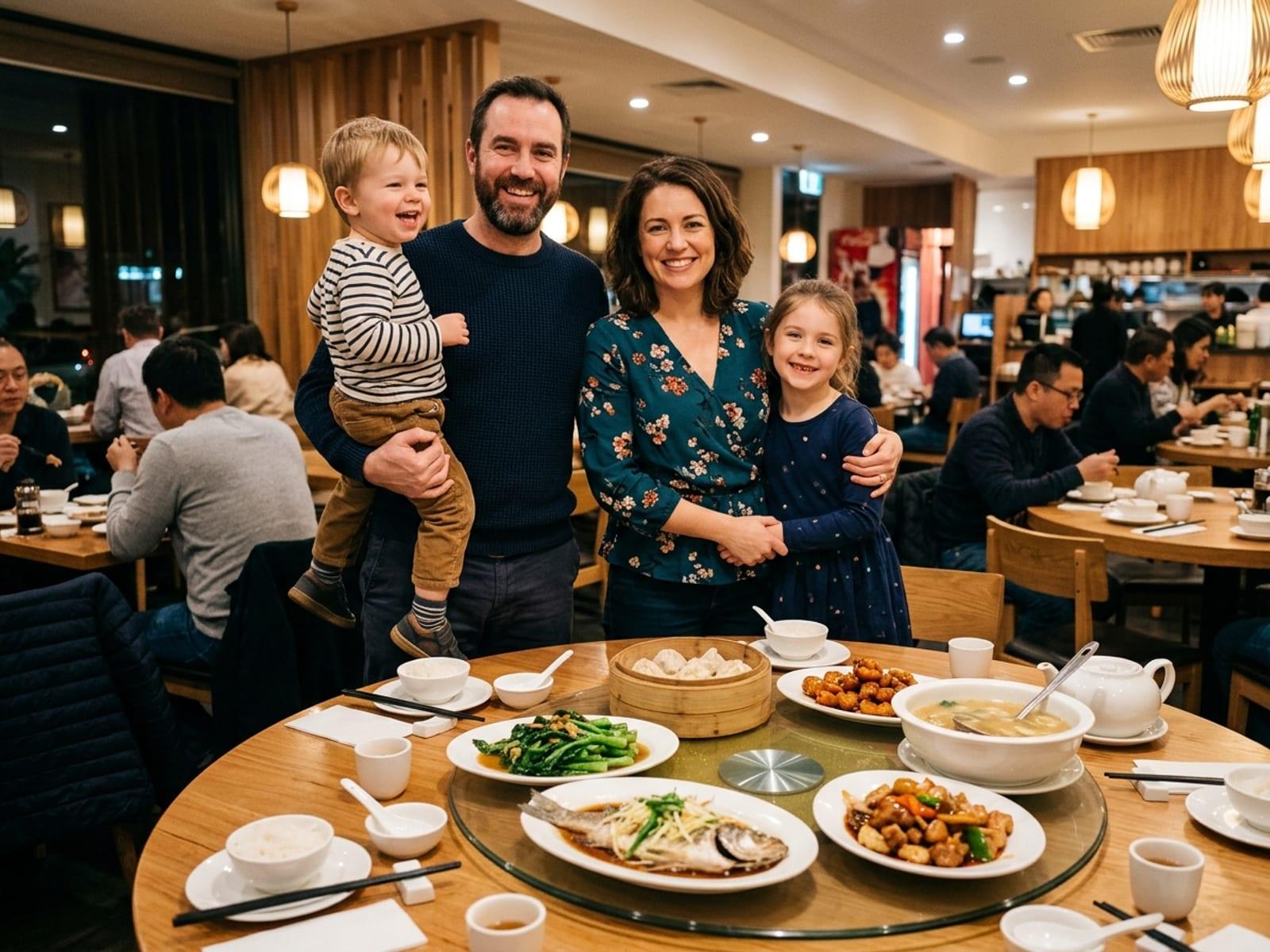
In a Chinese restaurant, people don't each order their own plate. The table orders several dishes, sets them in the middle of a round table and everyone shares. Tipping is generally not expected. Payment by QR code on a smartphone is everywhere, and you can link a card issued abroad. For a family trip, three habits make ordering far less confusing: roughly one dish per person, serving chopsticks, and taking leftovers home.
Order one dish per person, serve with serving chopsticks
A rough rule is one dish per person. For two adults and two children, that might be a stir-fried vegetable, a meat dish, a fish or tofu dish and a soup, chosen so that flavors and ingredients don't overlap. At celebrations ten or more dishes can come out, and the number is often said to be odd.
When taking food from a shared platter, use the longer serving chopsticks, gongkuai. Not every restaurant puts them out, but asking for them is not rude. "Qing gei wo gongkuai" (serving chopsticks, please) will do it. Take the piece closest to you rather than digging around the platter for the bit you want.
At a table with a lazy Susan, the custom is to let the guest of honor take from the first dish, then turn it clockwise. Don't spin it while someone is serving themselves. Children love to turn it, but a bowl of hot soup may be coming around, so make turning the table an adults-only job.
Where you sit also means something. The host or the eldest usually takes the seat in the middle facing the door (or facing east), with the most important guests seated nearby. The lowest seat is the one closest to the door used by the kitchen and the waiters. For a family meal on your own there is no need to worry too much, but if local people invite you, wait to be shown your seat. With a small child, it can also make sense for a parent to choose a seat near the entrance so you can step outside quickly if the child gets fussy.
At formal meals there are repeated toasts. With baijiu, the custom is to call "ganbei!" and drain the glass, and if there are no waiters, the youngest person at the table takes on the job of filling glasses. Children can join the toast perfectly well with juice or tea.
Chopsticks and tea: what to tell the kids
There are a few things to avoid with chopsticks. The most important is never to stand them upright in a bowl of rice. It looks like incense at a funeral and is considered bad luck. Also avoid pointing at people with chopsticks, tapping bowls with them, waving them around, or spearing food with them (unless something is too slippery to pick up any other way). At the very least, before the meal tell children two things: put chopsticks on the rest, and never stand them up.
In many restaurants, hot tea arrives as soon as you sit down, and you can drink it throughout the meal. When someone pours tea for you, say "xiexie" (thank you), or, if you are mid-conversation, tap the table lightly twice with two bent fingers as a thank-you. It is polite to pour for elders and seniors first.
No tipping, and the bill comes at the end
Tipping is generally not expected in Chinese restaurants. Unless there is a notice in the restaurant or a service charge is already on the bill, there is no custom of leaving one. You ask for the bill at the end of the meal: say "maidan" or "jiezhang."
In China the person who invited everyone usually pays, and it is common to see friends arguing over who gets to pay, because paying generously is a sign of goodwill. If a local acquaintance invites you, it is more natural to return the favor another time than to insist on splitting the bill.
Paying by phone, with a backup
Smartphone payment through WeChat Pay (Weixin Zhifu) and Alipay (Zhifubao) is used everywhere in China. According to the Beijing municipal government's foreign affairs office, bank cards issued overseas can be linked to these apps: WeChat Pay accepts Visa, Diners Club, Mastercard and JCB, and Alipay accepts Visa, Diners Club, Mastercard and Discover. Besides meals, you can pay for transport, hotels and supermarkets by scanning QR codes.
The accepted cards, sign-up steps and spending limits can change, so check each app's official guidance and your card issuer's information before you leave. Small eateries and street stalls may not take cards, so it is wise to carry a little cash and another payment method as backup.
With kids, order light and "dabao" the rest
At a family round table, the safest approach is to order on the light side and add more if needed. In China it is perfectly normal to take home food you couldn't finish. Say "dabao" and staff will pack it into containers. Taking plenty home can even be seen as a compliment to the cook. Think about whether you can actually eat it in your hotel room the next morning before you choose what to take.
If you are worried about spice, say "bu yao la" (not spicy) when ordering, or "wei la" (a little spicy). Many Sichuan and Hunan dishes are spicy by design, so for children it helps to also order dishes that are naturally mild, such as steamed fish, tomato and egg stir-fry, dumplings and plain rice. If you need a high chair, ask "you ertong yi ma?" before you sit down. Allergies are hard to explain out loud, so the reliable way is to show staff a note with the problem ingredients written in Chinese.
There is no dress code for eating out, but sauces tend to splash at a shared round table, so darker colors that hide stains are the relaxed choice. A family photo around a round table covered in platters is also something pokesta can make with AI ($1 per photo, first one free).
When you can't decide where to eat
Part of the pleasure of eating out in China is how much the food changes from region to region. Pick one local specialty per city (Peking duck in Beijing, the old yum cha teahouses in Guangzhou, hotpot in Chongqing) and for the rest of your meals order home-style dishes at a neighborhood restaurant. That keeps things manageable for both the kids' energy and your budget. Entry requirements for China depend on your nationality, so check your own government's official information before you travel.
References