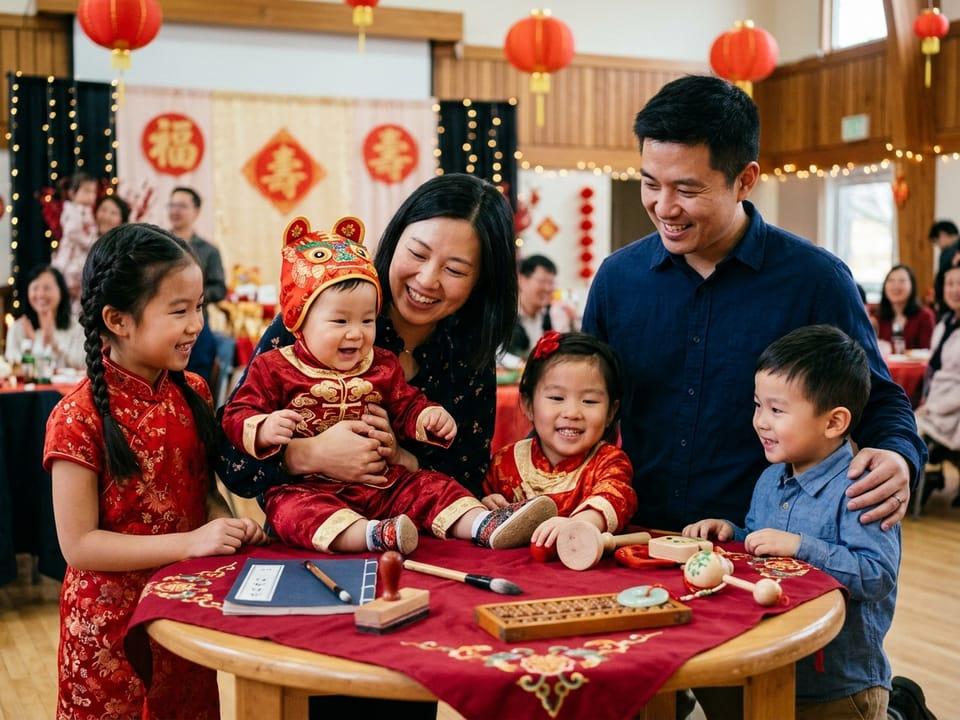
Zhuazhou (抓周) is the Chinese custom of laying out a book, a brush, an abacus and other objects in front of a child on their first birthday and seeing which one they grab first, as a playful hint of what they might become. Nobody actually plans a child's future around it these days. It's a moment for the whole family to crowd around, watch those small hands, and laugh. The essentials are simple: keep the first birthday grab items to somewhere between six and twelve, put a card by each one explaining what it stands for, leave out real coins and anything with a battery, and have two people on camera duty.
From shi'er to shizui to zhuazhou
The best-known early record is in Yanshi Jiaxun, the family instructions written by the sixth-century Northern Qi scholar Yan Zhitui. He describes a custom from the Jiangnan region: when a child turned one, the family made new clothes, gave the baby a bath, and set out bows and arrows, paper and brushes for a boy, or scissors, a ruler, needle and thread for a girl, along with food, treasures and toys. Which one the child reached for was taken as a sign of greed or integrity, cleverness or dullness. Back then it was called shi'er, "testing the child."
By the Song dynasty the records get more detailed. Meng Yuanlao's Dongjing Meng Hua Lu, a portrait of life in the Northern Song capital Kaifeng, calls the first birthday zhouzui. Families set plates and cups out on the floor holding fruit, food, an official's letter of appointment, brush and inkstone, sutras, needle and thread, and took whatever the child picked up first as an omen. That was shizui. A Song-era miscellany, Airizhai Congchao, retells how the general Cao Bin, as a one-year-old, grabbed a weapon in his left hand and a ritual vessel in his right, then took a seal and ignored everything else, and adds that "these days people call it shizhou." So the name has shifted over the centuries, from shi'er to shizui and shizhou. Today zhuazhou is the usual word, though shizhou and nazhou are still heard.
The most famous zhuazhou in literature belongs to Jia Baoyu, hero of Dream of the Red Chamber, told in Chapter 2. His father laid out countless objects to test his ambitions, and the baby ignored all of them and grabbed only rouge, powder and hairpins, which made his father furious. Even then, it seems, the fun lay partly in things not going to plan.
Neighboring cultures have their own first-birthday grab. Korea's doljabi is covered in our guide to Korean dol photos, and the object-choosing at Vietnam's first-birthday celebration in our thôi nôi article.
Zhuazhou items and what each one means
The traditional set is a book, a writing brush, ink, paper, an inkstone, an abacus and money. Families are told to make the total a multiple of six, such as 12 or 18, because it echoes the lucky phrase liu liu da shun, "everything goes smoothly." These days many add objects that stand for modern jobs and hobbies, and some use picture cards in place of the real things.
| Item |
What it's said to mean |
| Book |
Scholarship, a life of learning |
| Brush, ink, paper, inkstone |
Writing (author, journalist), teaching |
| Name seal |
Government or politics |
| Abacus or calculator |
Business, accounting |
| Money (toy gold coins, a red envelope) |
Wealth |
| Ruler |
Design or architecture (some lists say law) |
| Spring onion |
Intelligence: cong (葱) sounds like "clever" (聪) |
| Garlic |
A head for numbers: suan (蒜) sounds like "calculate" (算) |
| Rice or straw |
Farming |
| Toy stethoscope |
Doctor or nurse |
| Computer mouse, mobile phone |
IT and engineering |
| Ball |
Sports |
| Lipstick |
Modeling, makeup artistry |
| Bank card, passbook |
Finance |
You don't need all of them. Too many items confuse the baby and clutter the photo, so six or twelve is plenty. Put a small card next to each one saying what it stands for ("doctor," "teacher"), and anyone looking at the photos later will get the joke. The cards double as captions when you make the album. If lipstick makes the cut, a note about Baoyu on its card is a nice touch.
Nothing small, nothing sharp, nothing with a battery
One-year-olds put whatever they grab straight into their mouths. The American Academy of Pediatrics' parenting site lists coins, marbles, small balls and toys with small parts among the things to keep out of young children's reach. If you want "money" on the cloth, use an oversized toy coin or a red envelope (hongbao) instead of real coins. Skip the knives, scissors and needles from the old lists and use a cloth tape measure or a toy sewing kit.
The modern items bring a newer risk: button batteries in calculators and toy phones. The same site warns that button and lithium coin batteries can cause internal burns if swallowed. If the battery cover isn't held shut with a screw, take the battery out before the item goes on the cloth, or use a picture card instead.
Watch the balloon decorations as well. Pieces of burst or deflated balloons are a choking risk for children up to about age eight. Keep balloons away from the zhuazhou area and clear up any that pop.
A half-circle on a red cloth, shot from the front and the side
The floor is the safest place. Spread out a red cloth and arrange the items in a half-circle about a meter from where the baby starts. Leave a little space between objects so the photo makes it obvious which one was picked. You may be tempted to put your own favorite a little closer. Resist. If everything is the same distance away, the whole family can be genuinely delighted with whatever the baby chooses.
The grab is over in a second, so assign two people. One crouches behind the row of items at the baby's eye level and shoots bursts from the front. The other films from the side. Start the video before the baby is even set down on the cloth; you can pull your favorite frame out later.
Window light is best. Skip the flash, which can startle a baby. Pick a time after a nap and a feed, while the mood is good. Everyone who isn't shooting should stay behind the baby's starting point and avoid calling the baby toward anything. Their faces will show up behind the baby, so the grandparents' reactions end up in the shot too.
If the baby grabs nothing and bursts into tears, or grabs two things at once, that's fine. Take a break and try again, or keep the outcome as it is. Like Baoyu's, the surprising choices are the ones the family still talks about years later.
Studio, banquet, or home?
Classic outfits are a red tangzhuang for a boy and a red-and-gold qipao-style dress for a girl, and some babies wear a tiger-face hat. Once the grab is done, put the chosen item in the baby's hand and take one family portrait with the baby on a grandparent's lap. It's a photo that tells you at a glance what happened that day. If you also want costume portraits at home, our guide to first-birthday photos at home explains why to take them before the grab.
Some children's photo studios offer first-birthday packages with a zhuazhou set and costumes. You get proper lighting, props and several outfit changes. On the other hand, some babies get shy in unfamiliar places, and session time is limited. Prices, how many files you receive and whether the family can join in all vary, so ask before you book. At a first-birthday banquet (zhousuiyan) in a restaurant, the host may lead the zhuazhou on stage. A hired photographer should know in advance that the grab and the photos with the grandparents are must-haves.
If you want a framed costume portrait, go to a studio; if you want the grab with everyone's faces around it, do it at home. And when the grandparents live back in your hometown and can't come, pokesta can use AI to create a family photo from each person's phone snapshots, with everyone in tangzhuang around the zhuazhou table. Your first image after signing up is free, and after that it's $1 per photo.
Write down what they picked
Finally, note the item, the date and who was there on the back of a print or in the album. Cao Bin's seal and Baoyu's rouge have been retold for centuries. Your child's story only needs to last until they're old enough to hear you say, "This is what you chose."
References
- Shi'er, with the Yanshi Jiaxun quotation (Moedict / Ministry of Education Revised Mandarin Chinese Dictionary, in Chinese)
- Shizhou, with quotations from Airizhai Congchao and Youxue Qionglin (Moedict, in Chinese)
- Dongjing Meng Hua Lu, Volume 5, "Raising Children" (Wikisource, in Chinese)
- Dream of the Red Chamber, Chapter 2 (Wikisource, in Chinese)
- Zhuazhou (Chinese Wikipedia)
- Zhuazhou (Wikipedia)
- Choking Prevention (HealthyChildren.org, American Academy of Pediatrics)