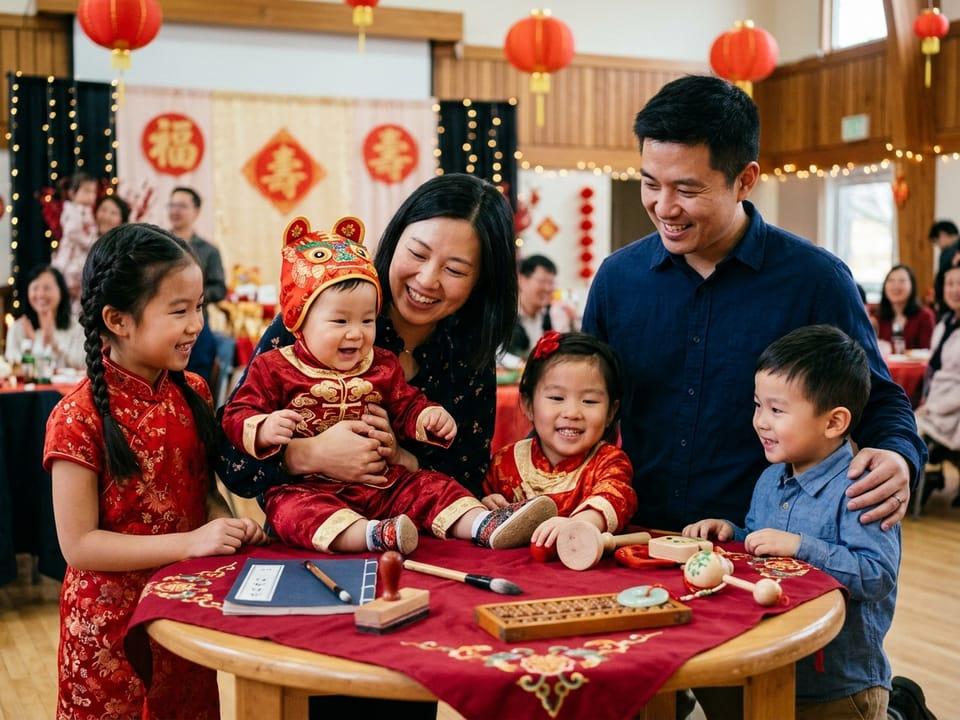
A one-year-old who cries in a crowd or turns shy with strangers is behaving normally for the age: the CDC lists being "shy, clingy, or fearful around strangers" among the milestones around nine months. So don't stage the zhuazhou, the first-birthday custom of laying out objects to see which one the baby grabs, at the noisiest moment of the banquet. Do it before the meal, in a corner of the hall or a private room, with only parents, grandparents and whoever is taking photos, outside nap time, and finish in about ten minutes.
Shyness and tears are normal at this age
At a zhousui banquet a baby walks into a room of dozens of unfamiliar faces, gets passed from one relative to the next, and hears music and clinking glasses. For a child who has only recently started telling familiar people from strangers, that can be far too much. The CDC's checklists put shyness or fear around strangers at about nine months, and at about one year a baby pulls up to stand, walks holding on to furniture and picks things up between thumb and pointer finger. In other words, the baby is easily overwhelmed by a crowd and can already pinch small objects off a table and put them in the mouth.
So don't treat crying as the baby "losing face" for the family. Before the zhuazhou, keep the baby from being handed around; let parents carry them to greet people. Bring a familiar comforter or small toy to hold, but keep it off the zhuazhou cloth, or the baby will head straight for it.
Move the zhuazhou before the meal, after a nap
A lunchtime banquet often lands right on the baby's nap. The easy fix is to plan around the baby's day rather than make the baby fit the banquet. For example, if your baby usually naps at about noon, let them sleep earlier that morning at home or in the car, arrive around eleven, change and have a snack in a private room, do the zhuazhou at quarter past, take the family portrait straight after, and start the meal once guests have arrived. An evening banquet is simpler: go out after a good afternoon nap.
Keep the room small. Parents sit opposite the baby beyond the objects, grandparents to one side, photographers in front and at the side. Other relatives can watch from the door or see the photos and video later. If you've hired an MC, they can announce what the baby picked when the meal begins, with no need to re-stage the ritual.
If the baby has a fever, a rash or is clearly unwell on the day, don't push it. Hold the banquet as planned and do the zhuazhou at home a few days later with a red cloth and a few objects; the pictures are often more natural that way. The custom is about family gathering to watch a child, and a few days' delay doesn't change that.
If the baby won't grab, mouths things or cries
Won't grab anything: wait. Don't put objects into the baby's hand or nudge the one you're hoping for closer. Let the baby crawl around on the cloth while parents call softly from the far side. If interest runs out, pick the baby up for a few minutes' break and try again; nothing says it can only happen once.
Puts things in the mouth: at this age everything gets tasted, so choose the objects in advance. The American Academy of Pediatrics advises keeping coins, marbles, small balls and toys with small or detachable parts out of reach, warns that button batteries can cause internal burns if swallowed, and notes that balloons are a choking risk for children up to 8. Use a large toy gold coin or a red envelope instead of real coins, and take the batteries out of calculators and toy phones. The China Consumers Association also advises buying toys with the CCC compulsory certification mark and checking the age range and safety warnings.
Cries: pick the baby up and comfort them; don't press on. A photo of the baby in a parent's arms reaching for an object is still a zhuazhou photo.
Relatives will comment, and a light reply keeps the mood up. These lines aren't rules, just something cheerful to say:
- Grabs nothing: "No rush, no grabbing; this one knows their own mind."
- Takes one in each hand: "Wants to learn everything."
- Puts it in the mouth first: "Born to enjoy good food."
- Cries loudly: "What a strong voice."
Photos work best with two people: a burst from the front, video from the side
The grab is over fast, so decide who shoots beforehand. One person kneels opposite the objects at the baby's eye level and shoots bursts; another films from the side, starting before the baby is set on the cloth, so frames can be pulled from the video later. Skip the flash, which can startle the baby, and if the hall is dim, move the zhuazhou near a window or under a light.
A studio can stage the zhuazhou on another day with proper lights and props, though an unfamiliar studio can unsettle a shy baby further. A photographer at the banquet records the moment with the whole family there, but you can't choose the baby's mood. A first run at home finds the baby most relaxed, and the banquet version can then be short. When there are many guests and parents are stretched, paying one photographer to cover these minutes is money well spent; see hiring a photographer for a zhousui banquet. For the objects and their meanings, see the zhuazhou guide, and for a home shoot, first birthday photos at home.
Tears in every photo are fine, and you can still have a smiling family picture
On the day, your baby may cry from start to finish, and the sharpest picture may be a scrunched-up little face. Years later that may well be the one everyone asks to see. If you'd also like a picture of everyone smiling, pokesta can turn your family's phone photos into an AI-made scene of you all in first-birthday clothes around the zhuazhou table, at $1 per photo with the first photo free. It's a created image, not a record of the day. Before or after the party, make your first one free with a recent photo of your baby smiling.
References