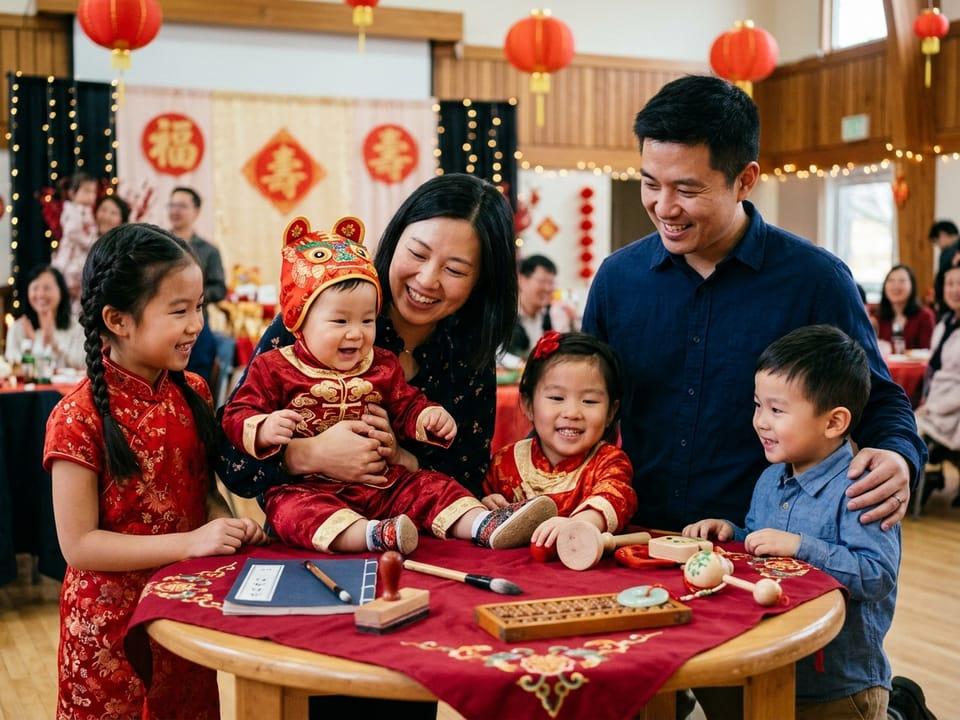
Chinese First-Birthday Photos at Home (周岁照) Without a Studio
pokesta Editorial Team · Updated October 12, 2026
A zhousui portrait (周岁照, written 週歲照 in Taiwan), the photo that marks a child's first birthday, can be made at home with a red cloth on the wall, a gold "1", a bowl of longevity noodles and a phone held at toddler height. Building the set takes about an hour. The real work is the subject: at twelve months most children are crawling, pulling up on furniture or taking first steps, and very few will sit on a cushion and smile on cue, so build a set that still works when the child moves.
Red and gold say "celebration" before anyone reads a caption
Red is the traditional color of Chinese New Year and other celebrations, and the red of a hongbao envelope stands for good luck. White is traditionally the color of mourning, so while a pale wall is fine to shoot against, a set that is white from edge to edge can look wrong to grandparents. Let red carry the frame, with gold or yellow as the accent.
You don't need a printed backdrop. A red tablecloth or two meters of red cotton hung from a curtain rod or tension pole covers the wall behind a seated child. Choose matte fabric over satin, which throws the window back at the camera as bright streaks, and hang it the night before so the folds drop out. A red or cream blanket over a play mat carries the color onto the floor and spares small knees.
Then add one strong prop, usually a large gold "1". Foil number balloons are everywhere, but the American Academy of Pediatrics warns that balloons are a choking risk for children up to eight years old. A cardboard or wooden "1" painted gold and leaned against the wall photographs just as well and can't pop. A paper-cut 福 character or a hand-lettered banner with the child's name is the other cheap option.
Before you start, check the edges of the frame from camera height and move the laundry rack, the blinking router and the diapers further away than seems necessary.
Put the birthday on the table with longevity noodles
Food tells the story of a birthday more clearly than any banner. Longevity noodles (长寿面) are eaten on birthdays as a wish for long life, and tradition says the cook shouldn't cut them, so each strand is eaten whole. The shot to aim for is a grandparent lifting one long strand out of the bowl with chopsticks while the birthday child watches from a lap.
Longevity peach buns (寿桃) are white steamed buns shaped like a peach, sometimes filled with lotus or red bean paste, with the tip tinted red. They are most closely tied to the birthdays of elderly relatives, so on a first-birthday table they're a wish rather than a rule. If your family keeps them for the older generation, leave them off.
In Taiwan the first birthday is tōo-tsè (度晬) in Taiwanese Hokkien. The Ministry of Education's Taiwanese dictionary lists red turtle cakes (紅龜), sticky rice cakes dyed red and stamped with a turtle pattern, both among the offerings to the gods and ancestors that day and in the gift the mother's family sends. A plate of them beside the noodles marks the day the Taiwanese way, and suits a family with roots on both sides of the strait. The offerings and the gift make photographs of their own, covered in Taiwanese first-birthday traditions.
Keep the props and the birthday child's own food separate. The AAP lists chunks of meat, raw fruit and raw vegetable pieces among the foods to avoid or modify for young children, advises cutting food into pieces no bigger than half an inch, and says children shouldn't walk or play with food in their mouths. Feed the baby a small, cut-up portion before or after the photos, sitting down; the decorated bowl is for the adults.
Shoot from the floor, in the hour after a nap
Get down to the child's eye level: kneel, or lie on your stomach with your elbows on the floor. From adult height you look down on the top of a small head and the backdrop turns into floor. Use the 1x or 2x lens and step back rather than switching to the ultra-wide, which stretches anything near the edges, round cheeks included.
Light the set from a window to one side, not behind the child. Switch off the ceiling light, which can tint the window light yellow, and leave the flash off. Shoot in bursts and pick the frame where the eyes are open and the hand isn't in the mouth. For a first step, film it and take a screenshot of the best moment.
Timing matters more than any setting. The hour after a nap and a snack is when a one-year-old is most likely to go along with you. Shoot for a few minutes, take a break with toys away from the backdrop, then go again; two or three short sets beat one long one that ends in tears.
A toddler on the move needs a set that moves with them
Plan for what the child can do now, not for the portrait you saw online.
A child who sits steadily needs only a low, firm cushion in red or gold. Never put a one-year-old on a table, a stool or the back of the sofa for a better angle; bring the camera lower instead.
A child who is pulling up needs something to pull up on: a sturdy low stool, a toy box, or the sofa with the seat cushions taken off. A parent kneels just out of frame with a hand ready. A child gripping the edge and glancing back at the camera often makes the best picture of the day.
A child who is walking won't stay put, so don't try. Have a grandparent kneel with open arms at the far side of the backdrop and shoot low from beside the child as they toddle across, then swap ends so they walk toward a parent crouched behind the phone.
Give small hands something safe to hold; a child holding something stays still for a second or two. The wooden "1" works, and so does an empty red envelope. Hats and anything else they'll pull off go first. For outfits, from a red tang suit to a small hanfu, see baby hanfu and tang suits for milestone photos.
Take the portraits before the grab
If the day includes a zhuazhou, the grab in which the baby picks one object from a spread laid out in front of them, take the portraits first. Once the objects are scattered and the cake is out, the clean set is gone and so is the child's patience. Portraits in the morning and the grab after lunch is an easy split. If your family counts the birthday by the lunar calendar, or it falls midweek, the portraits needn't be taken on the day itself. What the objects mean is in our zhuazhou guide, and running the grab at home covers the layout and where the two cameras go.
When a studio is still the better choice
If your apartment is dark, if you want several costume changes in one morning, or if you want a large, evenly lit print of three generations to frame, a children's photo studio does that well, with outfits in every size and staff who coax smiles for a living. Packages are priced in renminbi on the mainland and in New Taiwan dollars in Taiwan, and what they include varies by city, season and plan, so compare what's in each package rather than the headline price. Before paying, read what to ask a studio about extra charges.
When grandparents live in another city or abroad and can't be in the room, pokesta can use AI to create a family photo of everyone in first-birthday outfits from each person's own phone photos ($1 per photo, the first one free).
The picture you'll come back to is rarely the perfect sitting portrait. It's the one where the child is halfway across the red cloth, reaching for someone who's laughing.