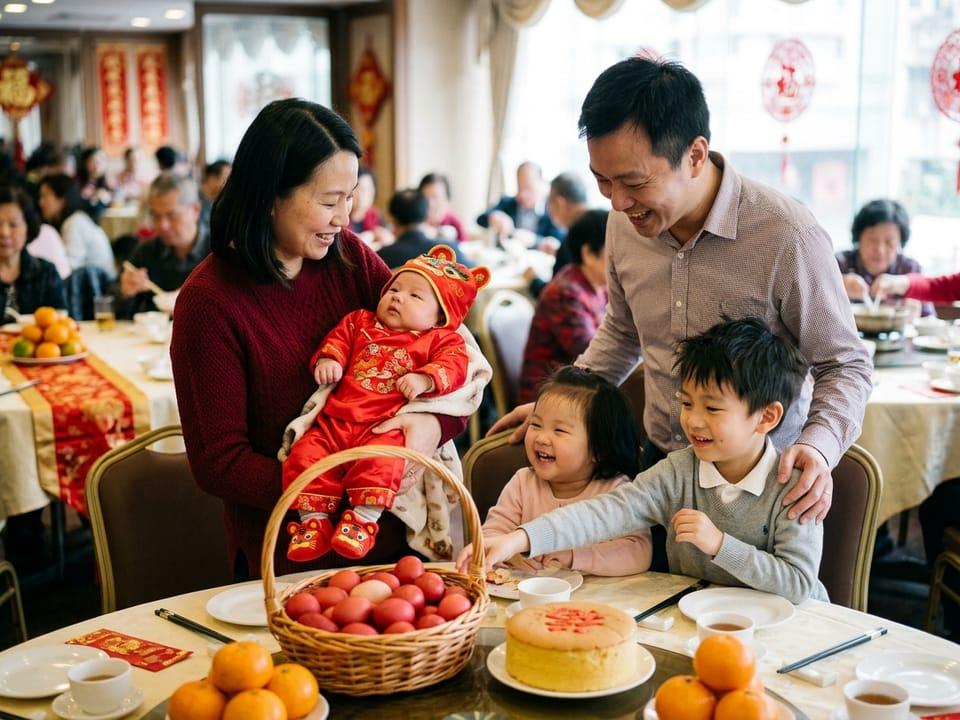
A Chinese full-month celebration (满月 man yue, also called 弥月 mi yue) marks the baby's thirtieth day and the end of the mother's month of postpartum rest. Traditionally the family hosts a banquet called 满月酒, hands out red-dyed eggs to relatives and friends, and may give the baby a first haircut. The mother's family has a part too: in north China her mother took her and the baby home for a stay; in Minnan communities her family sent a head-to-toe set of baby clothes. Customs vary by region and family, so each example below names its source; then come tips for banquet photos that spare mother and baby.
The thirtieth day ends a month indoors
The month after birth is 坐月子 (zuo yuezi), a month of rest and recovery for the mother. In the account of north Chinese birth customs by Liu Xinyu, an associate researcher at the China Intangible Cultural Heritage Protection Center, the thirtieth day meant the baby had passed another dangerous threshold and could leave the birth room and meet people. The family put on a 满月酒 to celebrate the baby "moving out of the nest" (移窠). Wealthy families hung lanterns, invited crowds and booked performers; ordinary families at least asked relatives and neighbors round to a table of food. The baby was dressed with care for the many paternal relatives meeting them for the first time.
Celebrations have shrunk since then. Liu cites observations from 1980s Beijing in which the full month still brought a small gathering, at the very least a bowl of noodles as a wish for long life, but the guests were mostly the grandparents. The full month was still when the baby's name was settled, by then the registered name rather than a nickname. Today a 满月酒 ranges from a restaurant banquet of several tables to lunch at home, on a date and scale that suit the mother.
Red eggs announce that the baby is here and thriving
Taiwan's Ministry of Education dictionary defines 紅蛋 (红蛋) as eggs dyed red, noting the old custom of a family with a new baby giving them to relatives and friends at the full month. Red stands for luck and happiness. In Flavor and Fortune, Stella Fong describes a father handing out red eggs to relatives, neighbors and friends to announce a birth, and a one-month feast that most often opened with red eggs and pickled ginger. In Liu's account the father's family carried red eggs and peanuts when they went to share the news. Some families have rules on how many eggs to give, which differ by place; ask whoever is cooking.
In Taiwan the full month is also the time for oil rice (油飯), glutinous rice cooked with dried shrimp, pork, shiitake and fried shallots. The gazetteer of Luzhou, now a district of New Taipei City, lists it with chicken in rice wine, red eggs and red round rice cakes (紅圓) among the full-month offerings to the ancestors and gods. The gift boxes sent to friends are covered in Taiwan's full-month gifts.
Dyeing the eggs the night before makes a better picture than the finished pile: a grandmother's red-stained fingers, eggs drying on newspaper, a child helping. On the day, a bowl of eggs on a red cloth at the end of the table can sit behind the baby in the family group.
The first haircut, and a brush made from baby hair
The full month is a traditional time for a first haircut, though families differ: some shave the head, some snip a single lock, some wait. Many parts of mainland China shave the whole head, the "full-month head" (满月头), believing repeated shaving makes hair grow back better. Specialists quoted by 39 Health (republished on 人民政协网) say hair depends on genes, nutrition and health, not shaving, and that a baby's thin scalp, especially with eczema, is easily cut and infected, so scissors are safer than a razor.
The Minnan customs of Taiwan and Kinmen differ. The Luzhou gazetteer says some families shave the head on the full-month day and others on the 24th day; an experienced barber shaves the baby, then rolls a hen's egg over the face and a duck egg over the body while saying "chicken-egg face, duck-egg body", a wish for a pretty face and a sturdy build. In the Kinmen Daily News, Lin Wenlian (林文鍊) says the haircut usually falls on the 24th day, a nod to the Twenty-Four Filial Exemplars, and that the baby's head is washed from a basin of hot water holding round stones, twelve copper coins, a hen's egg, a red-dyed duck egg and a little scallion: the scallion for cleverness, the stones for strength, the coins for wealth. Taiwan's first-year milestones follows the Luzhou record through the year.
Some families keep the hair for a 胎毛笔 (taimao bi), a calligraphy brush made from it. Winnie Chui, one of the few makers still working in Hong Kong, told Goldthread that only the first growth is used, because it's the only time human hair tapers naturally at the tip. The same article says the locks usually come from a first haircut before age three, and that Chui traces the tradition to northern China in the Tang dynasty. The brushes were expensive and long made mostly for wealthy families; they carry the hope that the child will grow up wise and filial. The Luzhou gazetteer notes that parents there now often pay to have one made.
If you want a brush, ask the maker how much hair is needed before anyone cuts, since one ceremonial snip may not be enough; keep the hair dry in a labeled envelope. Choose a time when the baby is fed and drowsy, keep the room warm, and have one calm adult cradle the head while another cuts with the blades pointing away from the baby. For a full shave, a barber used to babies is worth paying for. The photos to take are small ones: the hands at work, the lock of hair on red paper beside the baby's fist, a before-and-after from the same angle.
After the full month, the baby visits the mother's family
In most northern families, Liu writes, the full month was followed by a custom called 挪骚窝 (nuo sao wo; 窝 means nest, as in 移窠). The new mother's own mother came to take her and the baby home for five days to half a month. It was the baby's first trip away, to get to know the mother's family. Before leaving, the baby wore cotton threads around the neck: white for a long, healthy life, blue to block misfortune. In the 1980s Beijing that Liu cites, few still believed in it, but the form survived: the mother cut the baby's hair at the full month, as arranged, then took the baby to her parents for a few days.
Her family appears earlier, too: on the twelfth day they were expected to come with meat, eggs and other nourishing food, the amount showing how much they valued the occasion.
In Kinmen, Lin writes, the mother's brothers bring the 頭尾 (thâu-bué, "head and tail") at the full month: everything the baby wears from head to foot, typically a hat, clothes, shoes and socks, bracelets, a chest ornament and anklets. Timing varies. The Taiwan Folk Arts Museum describes its "bowl hat" (碗帽), a cap shaped like an upturned bowl with a copper lion against evil, as an essential part of the 頭尾 the maternal grandmother's family gives at four months.
If the 頭尾 arrives at the full month, photograph the baby wearing it in the maternal grandparents' arms, so gift and givers stay together. On the trip to her family, catch the threads at the neck or the grandmother carrying the baby out the door.
Plan the banquet photos around the mother and baby
Full-month photos are nothing new: in Liu's 1980s Beijing, city families introduced the baby with a photographer's picture at the full month or after the hundredth day.
Whoever takes the photos, a relative with a good phone or a photographer hired for a couple of hours, give them a short list: three generations together, the mother with the baby, each set of grandparents with the baby, the egg table, and one wide shot of the room. Take the formal group as guests arrive, while the baby is fed and before the food comes out. Once the dishes land, hands are busy and the baby is usually tired.
The mother has just come out of a month of rest, so she sets the pace. Put a chair for her where the group photo will be taken, so she isn't standing with the baby while everyone gathers, and arrange a quiet side room for feeding and naps. Ask the restaurant for a table near a window or under even light, so nobody needs a flash in the baby's face.
Event photographers usually charge by the hour or by a half or full day, in yuan on the mainland and New Taiwan dollars in Taiwan, and prices vary by city and season. Ask how many edited photos are included and when you'll get them. Hiring someone makes sense for a banquet of several tables, when every relative wants a picture and the parents are busy greeting guests. For lunch at home with the grandparents, a phone on a tripod is plenty, and full-month baby photos at home covers that quieter version. If relatives overseas can't make the trip, pokesta can create a family photo at a red-and-gold full-month banquet from each person's own phone snapshots, at $1 per photo with the first one free.
Photograph the baby first and the banquet second
Banquet dishes look much the same in every photo; a thirty-day-old baby changes by the week. Get the close-ups and the family group early, then put the phone down and eat. The hundredth day is only a couple of months away, and its customs bring a new set of pictures.
References
- 文化遗产的人伦维续:传统诞生礼的构造与消解 (Liu Xinyu, Chinese Social Sciences Net, in Chinese)
- 紅蛋 (Moedict / Ministry of Education Revised Mandarin Chinese Dictionary, in Chinese)
- 蘆洲市志 第十二篇 禮俗 (Luzhou City Gazetteer, Luzhou District Office, New Taipei City, PDF in Chinese)
- Why parents are buying calligraphy brushes made with baby hair (Goldthread)
- Celebrating Baby Beginnings (Stella Fong, Flavor and Fortune)
- 《地方傳說》談閩南人生禮俗及歲時節俗 (Lin Wenlian, Kinmen Daily News, 2004, in Chinese)
- 碗帽 Bowl hat (Taiwan Folk Arts Museum collection, Taiwan Digital Archives Union Catalog, in Chinese)
- 剃光头能防痱子?专家:夏天最好别给宝宝剃光头 (39 Health via 人民政协网, 2015, in Chinese)