
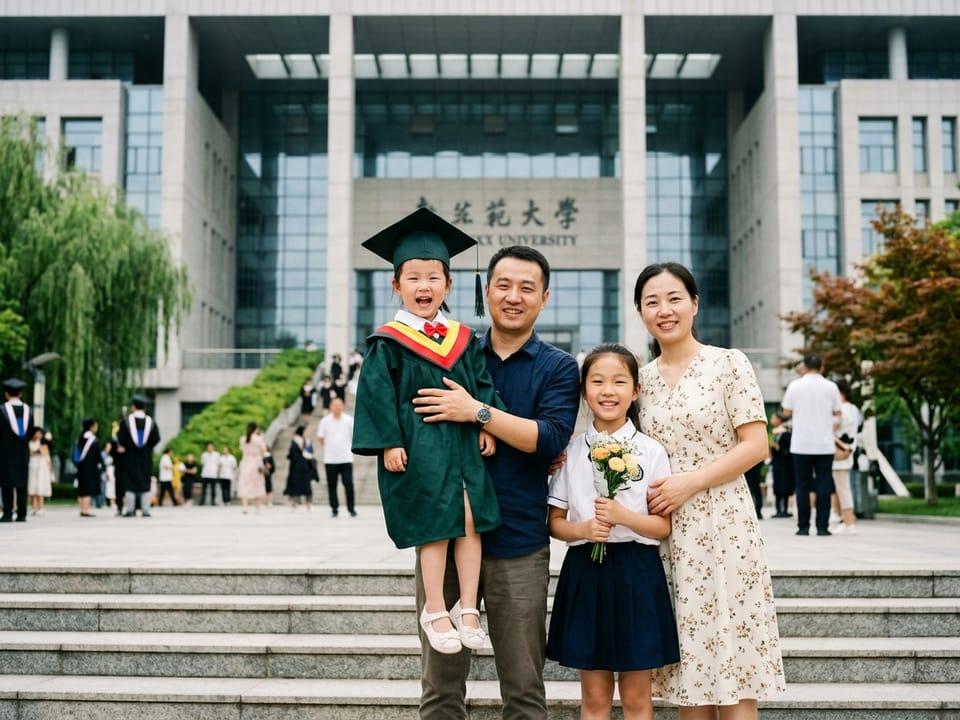
Families are welcome at most Chinese university graduation ceremonies (毕业典礼), but many universities ration places. A common approach is to give family tickets to each school in proportion to its number of graduates, one ticket per person and non-transferable, and relatives without one watch a livestream in an overflow room. How you get onto campus varies by university and changes from year to year. Plan the family photo for before the ceremony, or for the gap between the end of the ceremony and handing the gown back, not for the ceremony itself.
Family tickets come through the graduate, so ask early
Take three universities' 2025 notices. Beijing Normal University gave each school a share of family tickets in proportion to its graduates and let the schools hand them out, with a strict one-person-one-ticket rule and no entry without one. The ceremony began at 7:00 a.m., and families had to assemble by 6:30 to have tickets checked before being led in. The degree-conferral ceremony that followed was explicitly closed to family. Xiamen University said it had limited the number of family members admitted after guaranteeing places for graduates, and relatives without tickets could watch a simultaneous broadcast at their graduate's school. At the University of Shanghai for Science and Technology, parents swiped their ID cards at the gate on the day.
Three practical points follow. Tickets flow from the university to schools and then to classes, so the graduate should report how many family members are coming as soon as the school's notice appears. Many universities hold the graduation ceremony and the degree-conferral ceremony (学位授予仪式) separately, and families may only be allowed into the first, so check before booking flights and hotels. Whether grandparents and toddlers each need a ticket, or whether strollers are allowed, is often not in the notice, so have the graduate ask their counselor (辅导员). These were the 2025 arrangements; go by the notice your university issues this year.
June ceremonies in the Yangtze region often fall in the plum rains
The National Climate Center's review of China's 2023 rainy seasons put the start of the plum rains (梅雨) in the middle and lower Yangtze region on June 16, two days later than normal, and the end on July 24, eight days late. In a typical year, then, the rains arrive around mid-June and leave around mid-July. Many universities hold graduation in the second half of June, so if your graduate studies in that region, plan for rain and sticky heat on the day. Elsewhere, outdoor ceremonies often start early, which means strong sun by the time they finish.
Xiamen University's 2025 notice also banned bags, food, drinks and umbrellas from the venue, along with anyone in slippers or shorts. If your university has similar rules, have one family member stay outside with the bags, water and umbrellas, and make sure grandparents and children drink and use the toilet before going in. If you'd rather bring a disposable raincoat, check it's allowed.
An early ceremony also means leaving in the dark. With a two- or three-year-old, consider having one adult watch the livestream with the child in an overflow room or outside, free to leave when hunger or sleep strikes. If a grandparent feels dizzy or their heart is racing, get them into the shade at once and ask staff for help.