
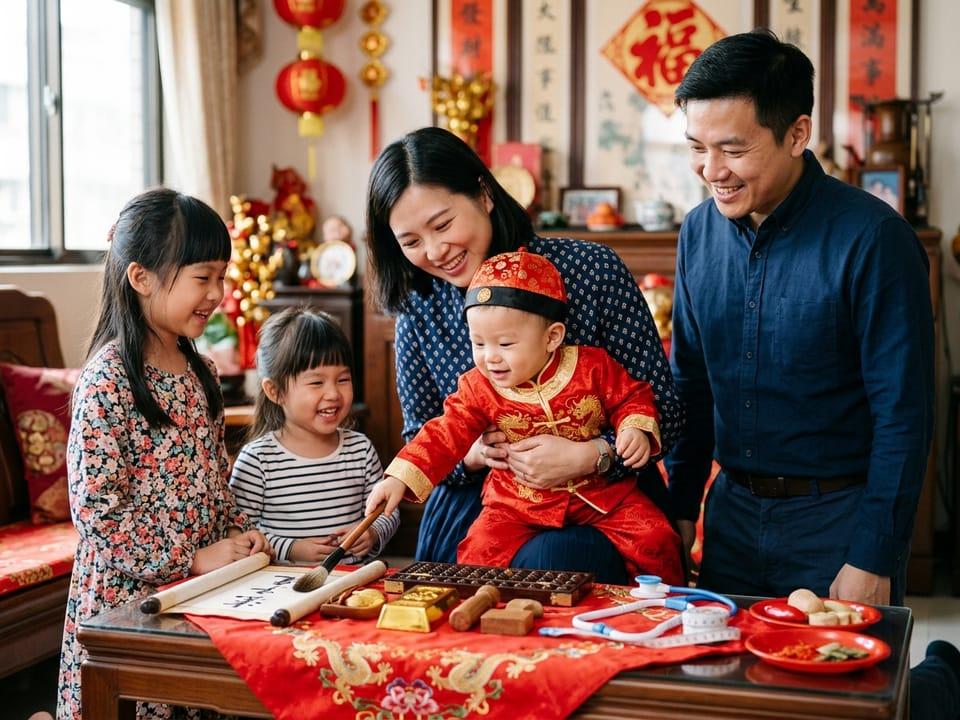
You can run a zhuazhou, the first-birthday grab in which a baby picks from a spread of objects, entirely at home, and the photos can feel warmer than at a venue because the faces around the mat belong to your own family. You need a rented kit or a dozen things from around the house, a rice sieve or a red cloth on the floor, one person to say the blessings and two people with phones who know their jobs before the baby is set down. The layout decides the photos far more than the camera does.
Rent a kit, or gather a dozen things from the house
In Taiwan the grab belongs to tōo-tsè (度晬), the Taiwanese Hokkien name for the first-birthday celebration, whose other customs are covered in Taiwanese first-birthday traditions. The Ministry of Education's Taiwanese dictionary describes twelve objects linked to different occupations set out in a bamboo sieve for the baby to choose from. In mainland China the same custom is usually written 抓周 and held around the first birthday (周岁). Whichever side of the strait you're on, the household logistics are the same.
A rental kit makes the job quick. 小淘氣親子遊戲館, a parent-and-child play studio in Tainan, lists a zhuazhou rental on its LINE official account that includes a traditional outfit, a red tortoise cake, a "wisdom gong" and celery, 18 props, a red cloth, a rice sieve, a guide and a certificate, with a "clever gate" and a tiger doll as optional extras. No price is listed, so ask. With any rental, also ask how long you can keep it, whether there's a deposit, who pays for return shipping and what happens if a prop comes back chewed. In mainland China or anywhere else the shop will be a different one, but the questions are the same.
The house will supply most of it anyway: a children's book, a calligraphy brush or a pen, a calculator, a cloth tape measure, a toy stethoscope, a karaoke microphone, and a red envelope in place of money. Food adds wordplay that reads well on camera. When the Wufeng District Household Registration Office in Taichung held a zhuazhou for 20 babies at the Lin Family Mansion in 2022, it used puffed rice (mixiang), scallion for a quick mind, celery for diligence and garlic for being careful with money, according to a report in Great News (大成報). The history and meaning of the traditional objects are in our zhuazhou guide, so this piece sticks to running the day.
Lay it out on the floor, with the camera in mind
Do it on the floor, never on a table or a bed. A rice sieve gives you a natural round frame and looks especially good from above, but it holds only a handful of flat objects before things spill over the rim. A red cloth on a play mat gives you more room and softer knees. Whichever you use, leave a gap between objects so that anyone looking at the photo later can tell which one was chosen.
Turn every object so its recognisable side faces the camera rather than the baby: the cover of the book, the keypad of the calculator, the round end of the stethoscope. Put small, low things at the front and taller ones, such as the book or the gong, at the back, so nothing hides anything else. Then look at what's behind the mat from where the cameras will stand, and move the laundry rack.
Decide where the baby starts and where the parents sit. One parent sitting in the middle behind the objects gives the baby a reason to move forward without steering them toward any single item. Everyone else stays behind the baby's starting point, where their faces will end up in the background of the wide shot.