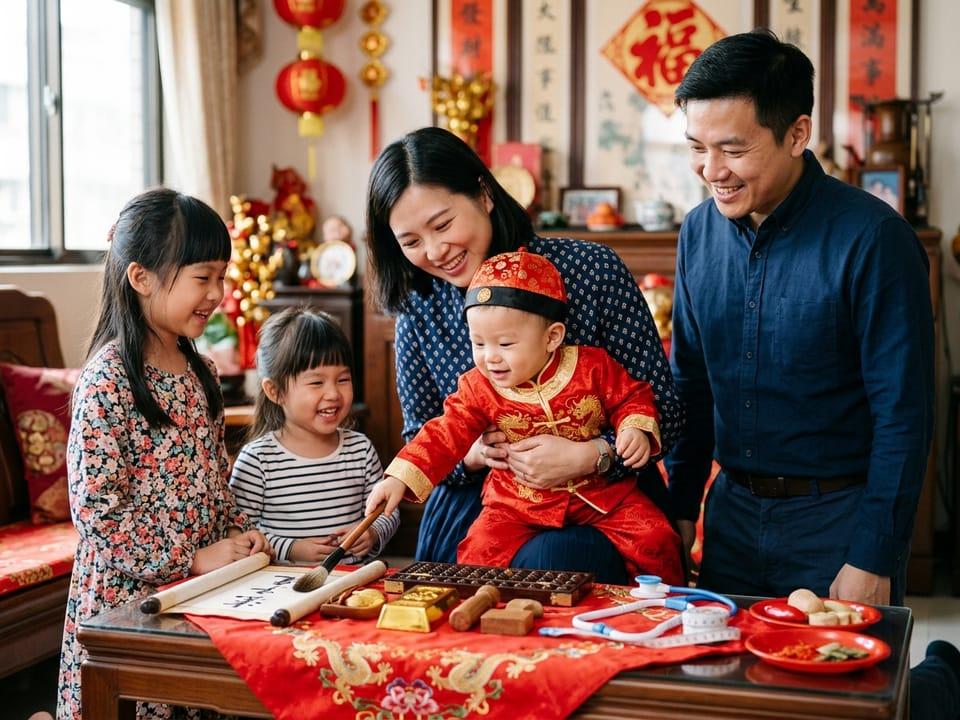
For a zhuazhou, the first-birthday grab, the classic Taiwanese outfit turns the baby into a small tiger: a tiger hat, tiger shoes and sometimes a whole tiger suit, all meant to keep the child safe. Some families add or swap in a miniature scholar's robe as a wish for success in study. Before renting anything, check whether your venue already supplies an outfit and whether a grandmother on the mother's side is planning to give one, because that was the traditional source. Either way, the costume only needs to stay on for the grab and a handful of photos.
The tiger is there to guard the child
Dressing a small child as a tiger for protection is a custom found well beyond Taiwan. The Pitt Rivers Museum at the University of Oxford, describing an embroidered Hmong (Miao) child's hat from Guizhou in its collection, explains that such a hat "scares away evil spirits or fools them into thinking that the child is a fearsome animal," and that worn on birthdays or other special occasions it was supposed to bring luck and peace. The Textile Research Centre in Leiden adds that tigers stand for bravery, strength and good fortune in Chinese tradition, that the hats could be worn with embroidered tiger-shaped shoes, and that they carry a mark resembling 王, the character for "king."
The idea is very much alive in Taiwan. When the household registration office in Wufeng, Taichung, held a first-birthday ceremony at the Lin Family Mansion in 2022, the twenty one-year-olds taking part wore tiger suits (虎服), described in the local press as a way to draw good luck and keep misfortune off. Hotel banquet packages can include a tiger outfit, which is worth knowing before you pay for one separately; our guide to zhuazhou venues looks at what those packages contain.
A scholar's robe carries a different wish
The scholar robe, rented and sold as 狀元服, takes its name from the zhuangyuan (狀元), the candidate who placed first in the imperial palace examination. In everyday Mandarin the word still means whoever comes top in any exam. Putting a one-year-old in that robe is a cheerful, unsubtle wish for success in school, and it sits nicely beside the book and the writing brush among the items on the mat.
None of this is compulsory. The Ministry of Education's definition of the Taiwanese first birthday lists offerings, gifts and the grab, and says nothing about tigers or scholar's robes. Tiger pieces and a scholar's robe can be combined, and some families prefer a red tangzhuang jacket or a qipao-style dress, which our zhuazhou guide touches on. Pick whichever wish you would like the photos to tell.
Ask the grandparents before you rent anything
In the old custom, the first-birthday gift came from the mother's side of the family. The Ministry of Education's Taiwanese Hokkien dictionary, defining 度晬 (tōo-tsè, the Taiwanese word for a baby's first birthday), says the mother's family brings a "head-and-tail" gift (頭尾禮) together with red turtle cakes. The dictionary doesn't list what the gift contains, but a short piece on Hakka birth customs, published with the ministry's Hakka dictionary, describes the Hakka version (做頭尾). Writing about the four-month celebration, it says the maternal grandmother prepares the set just as she does for the full-month celebration and the first birthday: clothing from head to toe, including a top, trousers, a hat, shoes, an embroidered belly apron (肚兜) and a bib. It adds that the 卍 symbol, a Buddhist sign read as wan (萬) and standing for continuity, was stitched in red silk thread on the collar and on the back of the hat, as a prayer for the child to grow up safely.
So the cheapest outfit may already be on its way. Ask whether a grandmother intends to give clothes, or has kept a set from an older cousin, before you pay for a rental. If she has stitched or chosen something specially, its collar and the back of the hat deserve a close-up of their own; there are more ideas for the rest of the day in Taiwanese first-birthday traditions.
Rent for one day, buy for a second child
Shops in Taiwan rent zhuazhou outfits, often together with the items for the grab. For a single day, renting is usually the sensible choice: a one-year-old wears the set for well under an hour, and storage space is short. Before you book, find out exactly what is in the set (suit, hat, shoes, robe, belly apron), how sizes are given, how hand-embroidered hats and shoes are cleaned between rentals, and what the deposit and late-return rules are. Arrange delivery a few days early so you can try everything on at home and swap sizes if needed. If the party is at a hotel or a studio, ask what they provide first; you may end up renting only the scholar's robe.
Buying makes more sense if a younger sibling or cousin will wear it, if you want to keep the hat and shoes with the photos, or if a grandparent would like to give the outfit in the old way. Prices depend on the shop, the material and whether the embroidery is handmade, so compare a few sets and look at photos of the stitching rather than relying on a product name.
Dress for the grab, not for the whole party
Embroidered satin is warm, and a padded tiger suit over everyday clothes can overheat a toddler fast in a warm room. Put a thin cotton bodysuit underneath instead of a full outfit, and choose a suit with enough room at the neck and arms for a child who is used to moving freely.
Shoes matter most for a baby who is pulling up or taking first steps. Measure the foot while your child stands, compare it with the inner length the shop lists, and leave a little room. Check that the sole doesn't slip on the floor where the grab will happen. With hats, look for one that sits on the head without a tight chin strap; if it ties, use a bow that comes undone with one pull, and take the hat off before any nap or car journey.
Tug every pompom, bell, bead and sequin before the day. Anything that comes away in your fingers can come away in a one-year-old's, and from there it goes straight into the mouth. If something feels loose, snip it off or sew it down, and do the same check on rented pieces, which have already been handled by other children.
Timing is the other half of comfort. Dress your child just before the ceremony, put the hat on last and take the hat photos first, because a one-year-old will pull it off within minutes. Once the grab and the family portrait are done, change back into soft clothes for the cake and the meal.
Borrow the tiger, keep the pictures
Photograph the outfit while you have it: the hat's forehead from the front, the tiger shoes side by side before they go on, a sleeve of the scholar's robe as a small hand closes around a brush. If the set goes back to the shop the next day and a grandparent abroad missed the moment, pokesta can create a family photo of everyone in festive dress around a zhuazhou table with AI from each person's own phone photos, at $1 per photo with the first one free. For setting up the grab itself at home, see zhuazhou photos you take yourself, and browse other families' zhuazhou posts.
References