
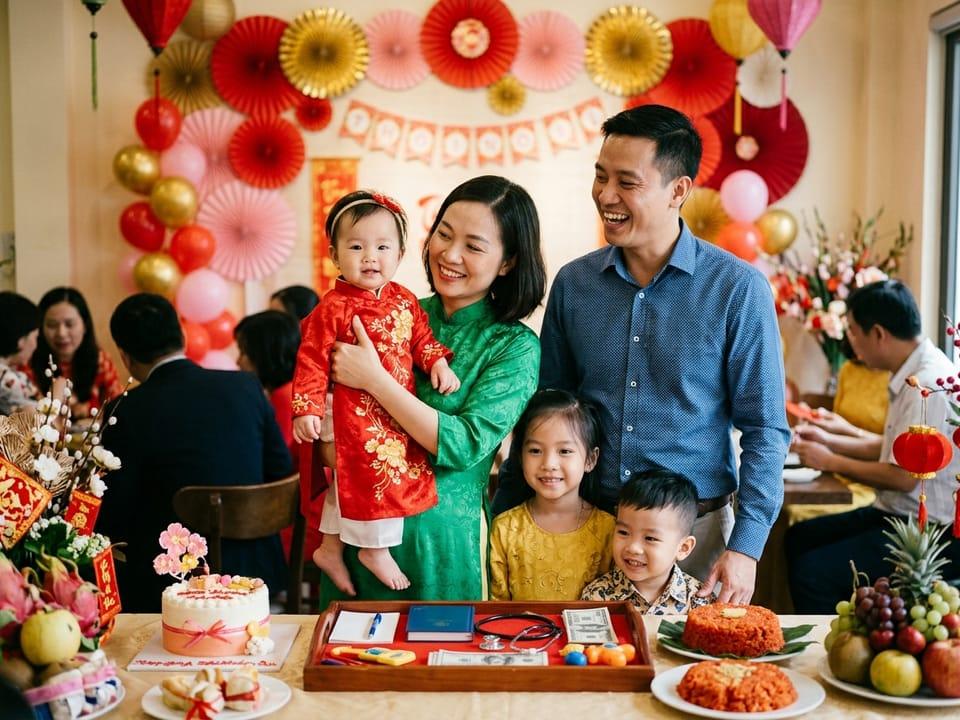
Thôi nôi, also called đầy năm, is the long-standing Vietnamese custom of celebrating a baby's first year. The name means the child will "no longer sleep in the cradle" (nôi). It's a thank-you to the Bà Mụ, the midwife deities believed to have watched over the baby, and a blessing for the child's health and happiness in the years ahead. The date is counted from the baby's lunar birthday, and the day opens with offerings to the Bà Mụ before the part everyone waits for: the baby picking an object.
It only happens once, so most families want good photos of it, and a studio session and photos of the celebration at home produce very different pictures. Which one suits you depends on what you most want to keep: a polished first-birthday portrait, or the object-picking with the relatives crowded round.
A day or two before the lunar birthday, starting with offerings
By custom, the date is counted from the baby's birthday on the lunar calendar (âm lịch). Because lunar dates fall on a different solar date each year, thôi nôi usually won't land on the first birthday on the regular calendar, so convert the lunar date before you tell the studio and the relatives. From there, the celebration is held one day before a boy's birthday and two days before a girl's, usually around noon (giờ Ngọ). Some parenting sites give the reverse, though: "trai kém 2, gái kém 1," two days early for boys and one for girls. Practice varies by family and region, so settle the date as a family with the relatives' schedules in mind, and check with whichever elder lights the incense at home. If the noon ceremony collides with nap time, see our timetable for the day.
The celebration begins with offerings to the midwife deities (cúng Mụ). Then comes the highlight: the object-picking game (chọn đồ vật). On a board, tray or table, parents lay out things like a mirror, a comb, a pen, books, a handful of sticky rice (xôi), money, scissors and a little soil, and whatever the baby grabs first is said to hint at their future career. It's more fun than fortune-telling, and everyone leans in to watch. Afterwards, grandparents, relatives from both sides of the family and other guests come forward with blessings and gifts, including lucky money in red envelopes (lì xì). To close, once the incense has burned down, the paper money from the tray is burned (hóa vàng), wine and tea are poured around the ashes, and salt and rice are scattered outside the house. There's fire and smoke at this point, so hold the baby somewhere well away from it.
There are roughly three moments you'll want: the baby and parents in front of the offerings, the object-picking moment, and a group shot that includes both sets of grandparents. The last two can only be taken on the day of the party.
Twelve of everything on the tray, and twelve objects to pick from
Families set out two or three offering trays, depending on custom. The main one is for the 12 Bà Mụ and Đức Ông. In the example given by VOH, the Ho Chi Minh City broadcaster, it holds a boiled chicken, roast pork with bánh hỏi (fine woven rice vermicelli), a plate of fruit, 12 small plates of sticky rice and one large, 12 small bowls of rice porridge and one large, and 12 small bowls of chè, a sweet soup. For a girl the chè is chè trôi nước, glutinous rice balls; for a boy it's chè đậu trắng, made with white beans. There's also betel leaf folded into the shape of a phoenix's wing (trầu têm cánh phượng), fresh flowers, 12 cups of wine or water, 12 candles with incense, and paper money. A separate tray goes to the god of wealth and the earth god (Thần Tài and Thổ Địa) and the kitchen god (Ông Táo), with fruit, sticky rice, chè, and egg, meat and shrimp. The numbers vary by region and household; the parenting site Hello Bacsi, for example, lists 13 plates of sticky rice and 13 bowls of chè.
Photograph the tray before the incense is lit, once from directly above and once from the front at an angle, and you'll be able to see later exactly what was offered. Twelve small plates in rows read best from above.
VOH says parents lay out 12 objects for the picking. Alongside the traditional ones, families add things from modern life. Typical readings: a mirror or comb points to beauty or fashion, a pen to writing or journalism, books to teaching or research, a calculator to business, a medicine bag or toy stethoscope to healthcare, a microphone to entertainment or public speaking, a toy kitchen set to cooking, a paintbrush to art or design, money to banking or accounting, a camera to photography, and a toy car or plane to transport or aviation. Hello Bacsi adds that it's all in fun, and parents shouldn't steer a child's future by what they happened to grab.
Letting a one-year-old pick an object is much like the Chinese zhuazhou. The difference is that thôi nôi begins with offerings to the Bà Mụ, and the date is set from the lunar birthday, moved a day or two earlier depending on whether the baby is a boy or a girl.