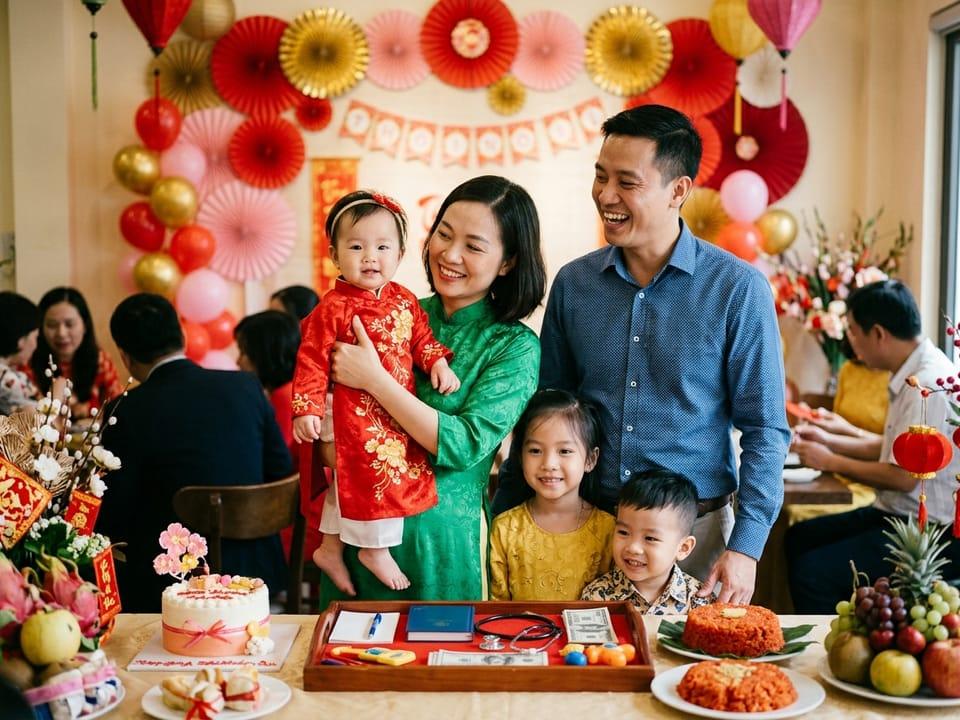
Thôi Nôi at Noon, Nap at Noon: Planning the Ceremony and Photos Around Sleep and Heat
pokesta Editorial Team · Updated October 29, 2026
If your family holds the thôi nôi offering at giờ Ngọ, around noon, keep it there and move the baby's sleep instead. Finish the morning nap by about 11, feed the baby before the guests arrive, and fit the group photo and the object-picking into the half hour right after the cúng. Then let the baby sleep while the adults eat. The NHS says children sleep around 12 to 15 hours in total after their first birthday, so a skipped nap shows quickly at a party.
Noon is common, but not universal
Vietnamese Wikipedia says the ceremony is usually held at giờ Ngọ, 12 noon, with the offering to the Bà Mụ (the midwife deities) first and the object-picking after it. Hello Bacsi's guide to the offerings says the cúng is usually done in the morning. Both describe customs that change from region to region and family to family. So before planning anything around noon, ask the grandparents, or whoever leads the offering, whether the time is fixed. If a morning cúng is fine with them, the clash with nap time disappears.
If it has to be noon, plan the morning backwards from 12.
Fix the sleep the day before, not on the morning
A one-year-old who went to bed late the night before starts the day behind. Keep that evening quiet: no late visitors, the usual bath, the usual bedtime, even if relatives have arrived from out of town. In the morning, wake at the normal time.
If your baby still takes a morning nap, put them down a little earlier than usual so they wake by around 11. A short nap that ends in time beats a long one that runs into the cúng. Feed them before the guests arrive. HealthyChildren.org, the American Academy of Pediatrics' site for parents, notes that at 8 to 12 months even familiar relatives can make a baby hide or cry, especially if they come close too fast.
When you invite people, give a time rather than a meal. "Come at 11:30, the offering starts at 12" gets guests there before the cúng, so you aren't taking the group photo while half the family is still parking. Ask relatives to let the baby come to them instead of passing them around before the picking.
A sample timetable for a noon cúng
This one assumes a baby who wakes around 7 and still naps twice. Shift it to fit your own child.
9:30 to 11:00: morning nap in a dark, cool room
11:00: feed and change; the áo dài goes on last, around 11:45
11:30: guests arrive and settle; the baby stays with a parent
12:00: the cúng, for as long as the elders need
Straight after: the group photo with both sets of grandparents, then the object-picking, all within about 30 minutes
From about 12:45: back into light clothes and a nap in a quiet room while the meal goes on
The order matters. The group photo goes first because everyone is already standing by the trays and the baby is still fresh. The object-picking can take seconds or several minutes, so keep one person shooting in burst mode and another on the floor at the baby's eye level.
Heat: hold the cúng in the coolest room
The south is warm all year. Ho Chi Minh City averages about 26°C in December and January and peaks around 29°C in April, with the rainy season running from May to November. Hanoi averages close to 29°C in June and July and about 16°C in January. A noon cúng in the south, or in a northern summer, means a warm room full of people, candles and incense.
Set the trays out in the coolest room you have, with the fan or air conditioning running before the guests arrive and aimed away from the candles. Keep the baby an arm's length from the incense, and put the áo dài on for the photos only. A northern winter brings the opposite problem: a vest under the áo dài, and socks until the picking starts.
Studio, photographer or family: which suits a noon cúng
A studio session can be booked on another day at whatever hour your baby is at their best, which takes the nap problem off the party day entirely, and you get controlled light and a proper portrait in a baby áo dài. What you won't get there is the real cúng, or the object-picking with the family around.
A photographer at home captures exactly that, and is worth paying for when both families come and nobody wants to spend the half hour after the cúng holding a phone. The catch is that they work to your noon, nap or no nap. Shooting it yourselves costs nothing and can stop the moment the baby fades, but someone in the family watches the picking through a screen. One way to split it is a studio portrait a week or two before, and the family's own photos at home on the day. Our piece on Thôi Nôi photos: studio or home covers the trade-off in more detail.
Keep the noon, move the nap
The cúng belongs to the elders and the Bà Mụ; the timetable around it is yours to set. Guard the morning nap, hold the photos to 30 minutes, and let the baby sleep through the meal. If the tears come anyway, our guide to a crying baby at the thôi nôi studio has more on calming a one-year-old in front of a camera.
If the day ends with more napping than posing, there is still a way to get a dressed-up picture afterwards. pokesta turns phone photos you already have into a thôi nôi family portrait with AI, with your baby in a red áo dài in front of a first-birthday backdrop, at $1 per photo with the first one free. It is a generated image, not a record of the ceremony. Pick a photo from a good-mood moment and make the free one to see how it looks.