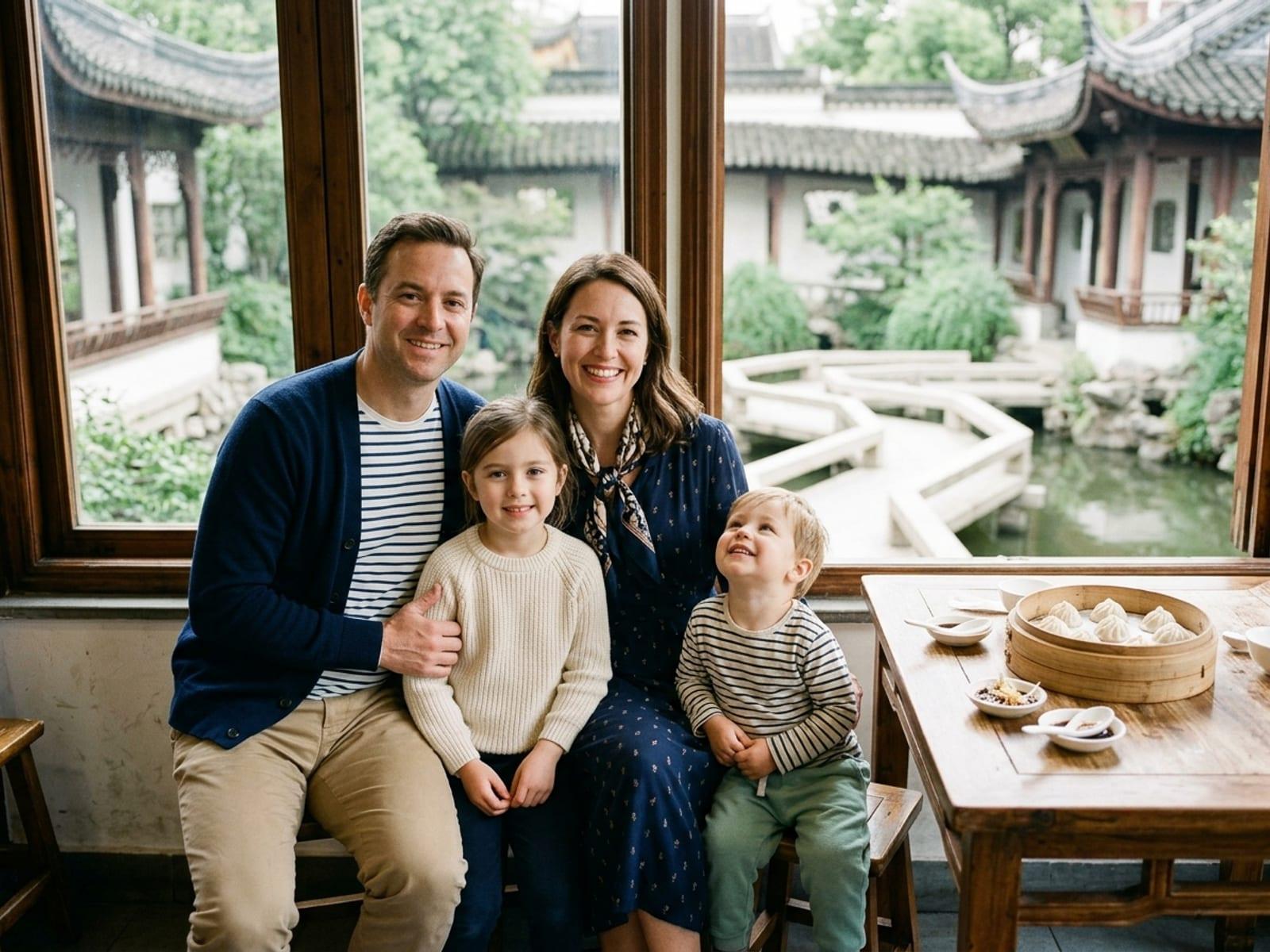
Thin dough gathered into a ring of pleats on top, and a soup that wobbles inside when you lift it. Shanghai's xiaolongbao began in Nanxiang, a town northwest of the city, and spread from there to central Shanghai. If you want a basket at the source, the old restaurant beside Yu Garden in the old city is the place to aim for. The thing to watch most with children is how hot the soup inside is. Practice as a family before you start: put the dumpling on a spoon, make a small hole in the skin, and let it cool before it goes in your mouth.
Nanxiang's "thin skin, plenty of filling"
The ancestor of xiaolongbao is thought to be guantangbao, a soup-filled bun from Kaifeng in Henan, the capital of the Northern Song dynasty. The Shanghai-style xiaolongbao started in Nanxiang, a town now part of Jiading District in Shanghai. During the Tongzhi reign of the Qing dynasty, in the late 19th century, a Nanxiang shop called Rihuaxuan is said to have served these buns, and a local record, the supplementary gazetteer of Jiading County, describes Nanxiang's buns as a specialty with "thin skin and plenty of filling." In Shanghai xiaolongbao are also called xiaolong mantou, which is why many restaurant names still include the word mantou.
The soup is really aspic wrapped up with the filling. Pork skin and similar ingredients are simmered and set into a jelly, mixed into the filling and sealed inside. When the dumplings are steamed, the jelly melts and fills the skin with broth. Nanxiang-style dough is barely leavened, so the skin is thin and there is room for more filling. Shanghai xiaolongbao are mostly filled with pork; crab and shrimp versions are in the minority.
Xiaolongbao look a little different from one city to the next. In Suzhou and Wuxi they are larger with a sweeter filling, in Nanjing they are small with skins thin enough to see through, and Changzhou is known for crab versions. If you are traveling by train through the lower Yangtze, ordering a basket in each city and comparing them is a good way to eat your way along. Some restaurants now also make vegetable-only versions and sweet dessert versions, so there are more options for children who don't like meat.
Nanxiang Mantou Dian by the Nine-Turn Bridge
The restaurant that brought Nanxiang's xiaolongbao into central Shanghai is Nanxiang Mantou Dian at Yu Garden. In 1900 the brother-in-law of Rihuaxuan's owner opened a shop called Changxinglou beside the Nine-Turn Bridge at the City God Temple in Shanghai's old town (the temple honors the city's guardian deity). It was later renamed Nanxiang Mantou Dian, and it now operates as part of the Shanghai Old City God Temple catering group.
At the main restaurant, the ground floor is a takeaway window selling pork xiaolongbao, with no seating. Dining rooms and private rooms are on the second floor and above, where pricier items are served, such as xiefen xiaolong, filled with crab meat and roe. The takeaway window is convenient, but eating scalding dumplings on your feet is not ideal for small children. With a family, it is calmer to sit down upstairs.
Yu Garden itself was begun in 1559, during the Ming dynasty, by Pan Yunduan for his father, and covers about 2 hectares. The highlights are the Nine-Turn Bridge zigzagging across the pond, the Huxinting teahouse built on the pond in 1855, and the Exquisite Jade Rock (Yulinglong), a stone riddled with holes. It stands about 3.3 meters tall and weighs around 5 tonnes, and legend says it was on its way to the garden of the Northern Song emperor Huizong when the boat sank, and was later pulled out of the Huangpu River. Telling that story while the kids peer through the holes keeps them interested in the garden a bit longer. Next door are the City God Temple and Yuyuan Bazaar, with hundreds of shops selling snacks and souvenirs. Weekends and public holidays are very crowded; early on a weekday morning the lines and crowds are more manageable. The Nine-Turn Bridge really does turn again and again, and when it is busy there is little room to stop. With a small child, either leave the stroller before the bridge and switch to a carrier, or use a carrier from the start. Hold hands on the bridge, and take your pond photos when there is a gap in the crowd.
How to eat them without spilling or getting burned
Xiaolongbao come to the table piping hot, still in their bamboo steamer. The basic method:
- Gently pick one up with chopsticks just below the pleats and set it on a spoon
- Poke a small hole in the skin or take a little bite, and sip the soup first
- Add a few shreds of ginger, dab on a little black vinegar, and eat the rest
In Shanghai the standard dip is Zhenjiang black vinegar with shredded ginger. The skin is thin, so if you squeeze too hard with your chopsticks it tears and the soup runs out. For small children, an adult should put each dumpling on a spoon, open a hole to let the steam escape, and then hand it over. The soup is far hotter than it looks, and popping one in whole will burn the inside of your mouth. Kids find them easier once they have cooled a little.
As for quantity, one basket shared by the family plus a few small orders of other dim sum or noodles is about right. Ordering several dishes to share works the same way as morning yum cha in Guangzhou, and the etiquette for sharing food at a Chinese restaurant, such as using serving chopsticks, applies here too. Xiefen xiaolongbao contain crab (a shellfish) and shrimp versions contain shrimp, so if anyone has a shellfish allergy, stick to the basic pork ones and confirm with a note in Chinese when you order. The skin is made from wheat flour.
If you have time for Nanxiang itself
With a spare half day, you can visit Nanxiang, the home of xiaolongbao. It is in Jiading District, a little over 20 km northwest of the city center, and has Guyi Garden, a garden begun during the Jiajing reign of the Ming dynasty. It counts among Shanghai's five great classical gardens, known for its bamboo groves, stone boat and lotus pond. It is quieter than Yu Garden in the center, and children can wander the paths through the bamboo, which is one of the pleasures of being out in the suburbs.
There is no particular dress code for eating dumplings, but darker clothes are a safe choice, since black vinegar and soup stains show less. If you want to see a family gathered around steamer baskets at a window seat overlooking the pond and the zigzag bridge, you can try it with pokesta's AI photos ($1 per photo, and your first one is free).
When to go and how to get there
Xiaolongbao are available all year. They were originally a breakfast food, so going in the morning or around lunch fits them naturally into the day. If crab xiaolongbao are what you are after, one idea is to come in autumn, when Yangcheng Lake hairy crabs are in season.
The main airport is Shanghai Pudong International Airport (PVG), and Shanghai Hongqiao International Airport (SHA), which handles mostly domestic flights, is another option. The nearest station to Yu Garden is Yuyuan Garden on Metro Lines 10 and 14. Restaurant hours, prices and menus can change, so check the latest information before you go. Entry requirements for China depend on your nationality, so check your own government's official information before you travel.
References