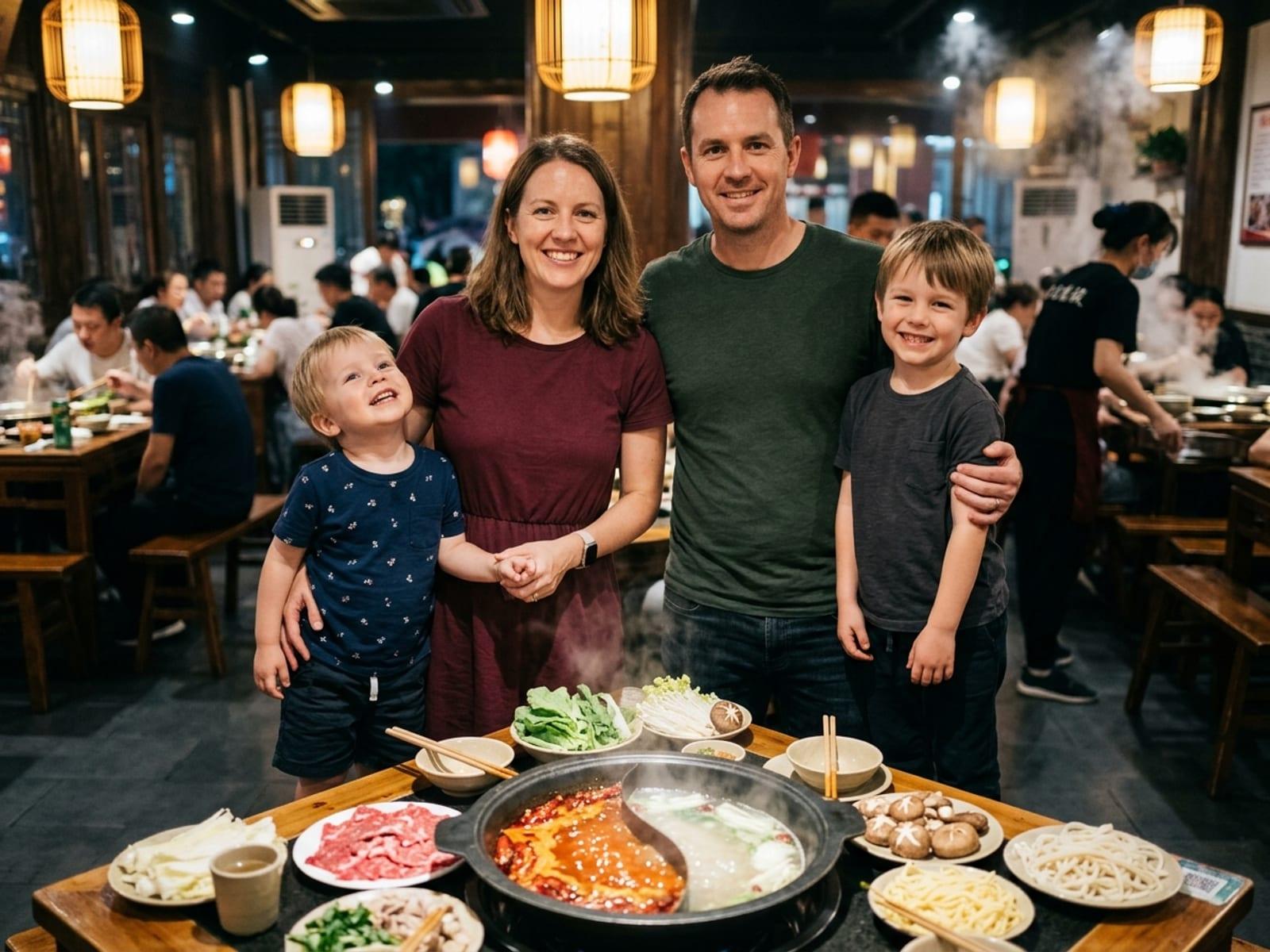
Under a thick layer of red oil, dried chilies and Sichuan peppercorns tumble in the boil. Hotpot from Chongqing, the big city in China's southwest, delivers two sensations at once, the tingling numbness called ma and the burning heat called la, and it is the dish most people think of when they think of Sichuan and Chongqing cooking. It's easy to assume it's off-limits for children who aren't used to spicy food, but with a split pot and a mild broth on one side, the whole family can eat from the same table. Know what goes in first and how to mix the dipping sauce, and even a first visit won't feel like guesswork.
A pot born on the Jialing River docks
Chongqing is a hilltop city where the Yangtze and the Jialing rivers meet. The origin story told locally centers on the people who worked the Chaotianmen docks on the Jialing. They bought beef fat and offal cheaply from a nearby slaughterhouse, fried chilies and Sichuan pepper in the tallow, then simmered tripe and vegetables in it.
Another account says a pot of beef tripe (maodu) was already being served at banquets in Chongqing during the Daoguang reign of the Qing dynasty. Even before that, there was reportedly a dockside street dish called shui ba kuai, in which raw beef offal such as tripe, liver and blood curd was sliced thin and dipped into broth simmering in a clay pot. You'll also see claims that hotpot dates back to the Song or Yuan dynasties, but chilies come from the Americas and only reached China in the Ming dynasty, so that's generally considered a stretch.
By around 1934, Chongqing restaurants were using small copper pots instead of big partitioned iron ones, and diners mixed their own dipping sauces. The iron pot divided by a grid into nine sections, the jiugongge, is still a familiar sight in Chongqing hotpot restaurants today.
Beef tallow and bean paste: what's in the red broth
The broth base of Chongqing hotpot is traditionally made with beef tallow. Pixian chili bean paste, fermented black beans from Yongchuan, several kinds of dried chili, Sichuan pepper, ginger, garlic, jiuniang (sweet fermented glutinous rice), rock sugar and salt are fried together in the tallow until fragrant, and that becomes the base of the red broth. More and more restaurants now also offer a clearer broth made with rapeseed oil instead of tallow.
In the old days, with dock customers coming and going all day, the broth was topped up and reused for a long time. The name lao huoguo, "old hotpot," is a leftover from that. Today, for hygiene, almost every restaurant starts each table on fresh broth.
The two characters in mala name two different sensations. La is the stinging heat of chili. Ma is the buzzing, tingling numbness on the tongue and lips that comes from Sichuan pepper. Plenty of first-timers are more surprised by the numbness than the heat. The peppercorns float loose in the pot, so when you serve your children, skim them aside with a slotted ladle so they don't end up on their plates.
Most restaurants let you choose a heat level, such as weila (mildly spicy), zhongla (medium) or tela (extra hot). With children, or if you're not used to spicy food, start with the mildest. Learning a few phrases such as bu yao la (no chili) from our notes on how to order in a Chinese restaurant makes it much easier to talk it through with the staff.
What goes in first, and the sesame-oil dip
Chongqing hotpot has something like a running order. Offal comes first: maodu (beef tripe), huanghou (beef aorta), yachang (duck intestine) and yaxue (set duck blood). Maodu and yachang are held in chopsticks and swished in the red broth for just a few seconds. Next come marinated beef, pork or lamb. Ingredients that soak up the broth, like vegetables, noodles and thin potato slices, go in last.
Being inland, Chongqing traditionally didn't put seafood in the pot. One of the few exceptions is a frozen filefish, known locally as haoeryu, which reached the markets in the 1970s and became a hotpot staple.
The standard dip is youdie: sesame oil with grated garlic and chopped scallion. Dipping a piping-hot morsel in sesame oil cools it a little and softens the heat. There's also a dry dip, gandie, made of chili powder and ground peanuts. Restaurants in Chengdu sometimes add oyster sauce, peanuts or ginger to the oil dip; Chongqing's is simpler by comparison.
Sharing one pot with children
As a family, order a divided pot. The usual kind is a ring of red mala broth around a center of mild clear broth (qingtang), and the children's food is cooked in the middle. Everyone eats from the same pot, adults from the outside, kids from the inside.
The bigger danger is heat rather than spice. Oily broth holds its temperature, and a splash when food drops in can burn even an adult. Seat small children away from the pot and serve their food for them. Steam from chili-laden broth can sting eyes and throats, so a table by the window or somewhere well ventilated helps.
Many kids aren't used to offal, so for them order thinly sliced beef or pork, napa cabbage, mushrooms, and noodles like glass noodles or thick wheat noodles. Spicy food can leave a red ring around a child's mouth, so bring plenty of wet wipes, and dress in dark colors that won't show splashes of red oil.
Adults' tongues get tired too if they go straight for the red side. Taste the vegetables and meat in the clear broth first, then move to the mala side. Make plenty of sesame-oil dip, and if the heat gets too much, give each bite a good dunk. Find your level this way and even adults who aren't big on spicy food can make it to the end of the meal.
A photo of the family laughing behind the hotpot steam can be made in advance with pokesta's AI photos ($1 per photo). For a famous dish with no chili at all, Beijing has Peking duck, eaten in three rounds of skin, meat and bones.
Chongqing by night, and getting there
Hotpot is on the menu all year. Chongqing summers are brutally hot, and the winters are foggy with a damp chill that gets into your bones. If you want to walk out to see the city lights after dinner, spring and autumn are the most comfortable times.
A favorite evening walk is Hongyadong, an 11-story complex in the style of traditional stilt houses built against the cliff on the south bank of the Jialing. It's near Jiefangbei, the downtown center. The fourth floor has a food market with stalls selling mala spices, and the top floor has a lookout over the Jialing. At night, seen from Qiansimen Bridge across the Jialing, the lit-up buildings seem to float layer on layer against the cliff.
The gateway airport is Chongqing Jiangbei International Airport (CKG), about 19 km north of the city center, linked to the city by Metro Lines 3 and 10. If you are combining the trip with neighboring Chengdu, a morning at the Chengdu panda base, best visited early gives the kids something of their own to look forward to. Entry requirements for China depend on your nationality, so check your own government's official information before you leave.
References