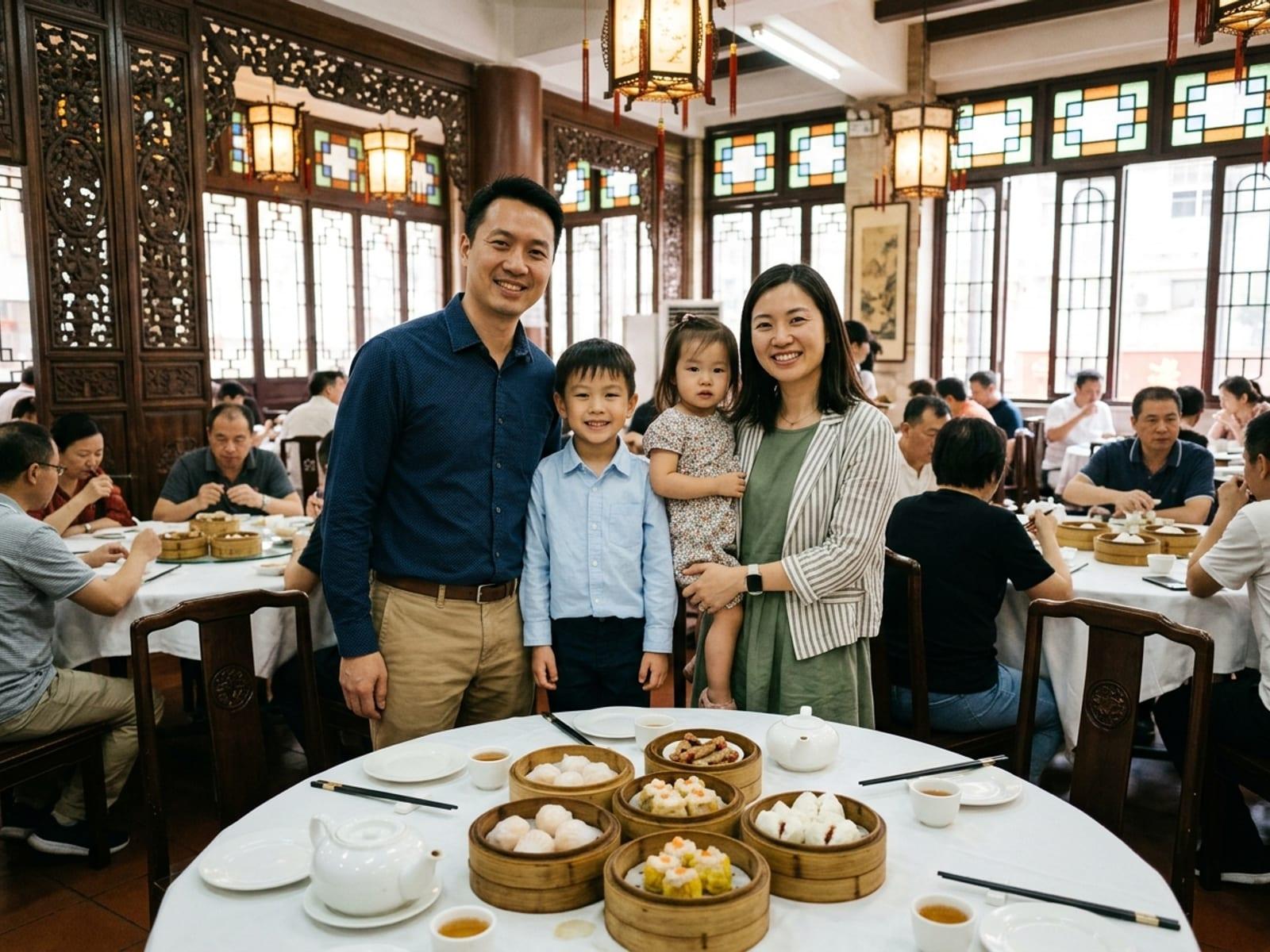
Walk into a teahouse in the morning and, all around the big round tables, families are gathered over teapots, lifting the lids off bamboo steamers. People in Guangzhou call this morning habit yum cha, "drinking tea," and in 2022 the yum cha customs of the Guangfu (Cantonese) region were added to Guangdong Province's list of intangible cultural heritage. For a traveling family, yum cha is an easy meal: you order small plates a few at a time, and it is simple to pick things children like. Learn a few customs and the busy hours, and even the oldest teahouses are nothing to be nervous about.
From two-li tea stalls to three-story teahouses
According to the Guangzhou municipal government's website, yum cha goes back to the "two-li houses" of the Xianfeng and Tongzhi reigns of the Qing dynasty, in the mid-19th century. These were places that served tea to dock and market workers for two li, a tiny sum, and over time they began serving dim sum too. A slightly more upmarket version was the chaju, or tea residence. Then came Sanyuanlou, a three-story building said to be Guangzhou's first teahouse of any real size, and the word chalou, "tea tower," still used for teahouses today, is said to come from tall buildings like it.
Yum cha is summed up in the phrase "yat jung leung gin" (yizhong liangjian): one pot of tea, two pieces of dim sum. Today's teahouses, of course, serve more kinds of dim sum than anyone could count. The city government's introduction names four staples as the "Four Heavenly Kings": har gow shrimp dumplings, steamed siu mai, char siu bao (barbecued pork buns) and egg tarts.
The old teahouses of Xiguan
Many of Guangzhou's oldest teahouses are in Xiguan, the area on the west side of the old city in Liwan District.
Lin Heung Lau began as a shop making pastries for weddings, was renamed Lianxianglou in 1889, and took its current name in 1910. It made its reputation with lotus seed paste pastries, and that lotus seed paste is said to have shaped the Cantonese mooncake as we know it. It is at 67 Dishifu Road in Liwan District and was recognized as a China Time-Honored Brand in 1993.
Panxi Restaurant opened in 1947. It sits beside Liwan Lake in a large garden layout of covered walkways, pavilions and a boat-shaped building on the water, and together with Beiyuan and Nanyuan it is known as one of Guangzhou's three great garden restaurants. Its specialties include water chestnut cake, a glassy cake made from water chestnut starch, and shrimp dumplings. You can look out over the garden while you eat, and when the kids get restless you can take a short walk around the pond. According to the city government, Luo Kun, known as Panxi's "top scholar of dim sum," created the dim sum banquet, a full menu made entirely of dim sum, and invented a dumpling shaped like a white rabbit on green grass. Dim sum in animal shapes always goes down well with children.
The city government also describes Taotaoju, founded in 1893, as a pioneer that in 1925 combined teahouse and restaurant under one roof, while Guangzhou Restaurant ran a newspaper advertisement in 1944 promising "new dim sum mornings and afternoons," which prompted the big restaurants to start offering yum cha. Taotaoju is also known for brewing its tea with water from Jiulong Spring on Baiyun Mountain and heating the water over charcoal made from olive pits; the diary of the writer Lu Xun lists some 25 teahouses and restaurants he visited in Guangzhou. By the 1980s there were said to be more than 4,000 kinds of dim sum, and around the same time evening yum cha took off and teahouses began putting on Cantonese opera. Since about 2012 more new places have served dim sum all day, so yum cha is no longer only a morning affair. Many of the old teahouses hold China Time-Honored Brand status, but that status is reviewed from time to time, and opening hours and locations can change. Check each restaurant's official information for the latest before you go.
Two taps on the table, a lid left ajar
A few teahouse customs are worth knowing.
The first is about pouring tea. When you pour from the pot, fill other people's cups before your own, starting with the eldest. The person being served taps the table lightly with their index and middle fingers as a thank-you. The custom is said to come from the Qianlong Emperor of the Qing dynasty, who traveled in disguise; to keep his identity secret, his attendants tapped the table instead of bowing. It is simple enough for children to copy at the table.
The second is about refills. When the teapot is empty, slide the lid a little off to one side, or with a metal pot leave the lid open, and staff will come to top it up with hot water.
Ordering used to mean pointing at dim sum wheeled past on carts, with the bill worked out from the number of steamers and plates left on the table. Today most places use an order sheet you mark, or a paper menu. If there is a menu with photos, let the kids point to what they want. For the rules that apply beyond teahouses, such as serving chopsticks, the lazy Susan and whether to tip, read up on Chinese restaurant etiquette and how to order before you sit down.
Kid-friendly dim sum and the busy hours
Easy picks for children include char siu bao filled with sweet barbecued pork, cheung fun (slippery rice noodle rolls wrapped around a filling), egg tarts, and water chestnut cake with its crunchy bits. Har gow and siu mai often contain shrimp, so skip them if your child has a shellfish allergy, and check with staff before you mark the order sheet. Plenty of dim sum also contain wheat or egg, so if there are allergies, carry a note in Chinese.
The tea may be quite strong. You can ask for plain hot water (baikaishui) for the kids instead. Steamers are hot, so lifting the lids is a job for the adults.
Yum cha is traditionally a morning-to-early-afternoon meal, and popular old teahouses fill up on weekend and holiday mornings. With children, go right at opening or on a weekday morning to cut down the wait for a table. With little ones, order two or three dishes at a time and add more once they are finished, which also means less goes to waste.
There is no dress code at the old teahouses, but slightly smarter clothes, such as collared shirts or simple dresses, suit rooms with stained glass and carved wooden screens. To see what a family photo around a round table, opening steamer baskets, might look like, you can try pokesta's AI photos ($1 per photo, and your first one is free).
When to go and how to get there
Yum cha is good all year. Guangdong summers are hot and humid, so with children, autumn through spring is more comfortable. The main airport is Guangzhou Baiyun International Airport (CAN). Liwan District, home to the old Xiguan teahouses, is on the west side of the city and easiest to get around by metro.
For something sweet afterward, Shunde's double-skin milk in neighboring Foshan is an easy side trip from Guangzhou. In June you could also combine your visit with Guangzhou's Dragon Boat Festival races. Entry requirements for China depend on your nationality, so check your own government's official information before you travel.
References