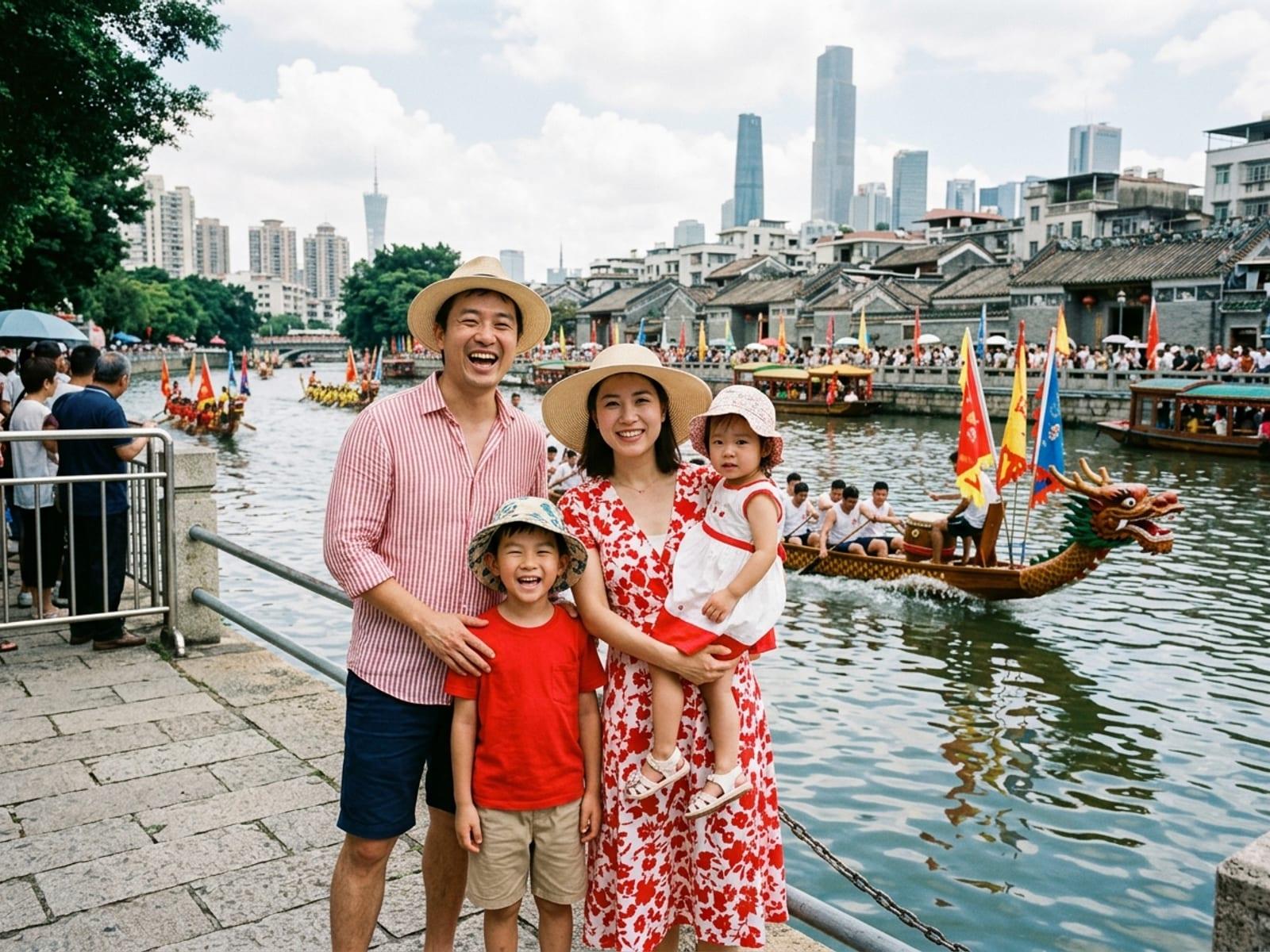
Duanwu, the Dragon Boat Festival, falls on the fifth day of the fifth lunar month. In Guangzhou, in Guangdong province, the weeks around it bring long, narrow boats with carved dragon heads (longzhou) out onto the canals of the city's villages, moving to the beat of drums. There are competitive races, but the real spectacle is the visiting: villages row over to see each other in rituals called zhaojing (inviting) and chenjing (paying a call). The dates follow the lunar calendar and shift every year, and the events are scattered across many villages, so checking that year's schedule before you go is essential.
Most of the year, the boats sleep in the mud
Duanwu is the Chinese festival on the fifth day of the fifth lunar month when people ward off bad luck and eat zongzi, sticky rice wrapped in leaves. In Guangzhou, dragon boat racing is the heart of the holiday, and in the month or so between taking the boats out of the water and Duanwu, each village practices at the oars and gets ready.
Guangzhou's dragon boats have a custom rarely seen elsewhere. When the festival is over, the dragon head and tail are removed and kept in the ancestral hall or a temple, while the hull is sunk to the bottom of the canal and covered in mud. This is called canglong, "hiding the dragon." Guangdong summers are long and the sun is fierce, and a boat built of kundian wood cracks if it sits out in it too long. Wrapped in wet mud and cut off from the air, a boat is said to last decades, even a century, without rotting.
Around the eighth day of the fourth lunar month the following year, the whole village turns out to dig away the mud and haul the boat out of the water. This is qilong, "raising the dragon." In 2026, Pantang village in Liwan district raised its dragon on May 24. Its boat is about 38 meters long and is said to be more than 400 years old. The crew scraped off the mud, washed the hull, rubbed it with pork fat to cut water resistance, and decorated it with flags and the dragon's head and tail. The work took at least three hours.
Next come ceremonies such as caiqing, then the boats visit each other's villages around Duanwu in chenjing, and finally they are sunk again in canglong. In 2023, for example, eight boats from Shipai village in Tianhe district went back under the water on the tenth day of the fifth lunar month. From qilong to canglong, the boats spend a little over a month above water.
Chebei and Liede, two villages that invite their neighbors
On a zhaojing day, a village hosts the villages it has ties with, and the invited villages row over in their own dragon boats. With drums and cheers from both banks, the narrow canals fill up with dragon boats, a sight that belongs to early summer in Guangzhou.
The best known is Chebei village in Tianhe district. Its zhaojing day is the third day of the fifth lunar month, two days before Duanwu. On that day in 2017, more than 100 dragon boats gathered on Chebei's canals. A few days earlier the village held its own race, with more than 900 rowers in 12 boats paddling there and back along a course of a little over 600 meters on the Chebei Chong canal, from Longxi Bridge to Shamei Bridge. Even from the bank you can clearly see the moment the oars fall into time with the drum.
Liede village, also in Tianhe, holds its zhaojing on canals surrounded by the towers of Zhujiang New Town, Guangzhou's central business district. More than 100 boats take part, and the event is listed as municipal intangible cultural heritage. Old wooden dragon boats beat their drums at the feet of glass skyscrapers, old and new in the same frame, and it shows clearly in photos.
On the Pearl River, which runs through the middle of the city, there's also an international invitational race with teams from China and abroad. In 2024 it was held on June 16, on a course from the north gate square of Sun Yat-sen University to Guangzhou Bridge. It's easier to find a viewing spot than at the village events, and you can see the line of boats from a distance.
Zongzi and dragon boat banquets
The food of Duanwu is zongzi, glutinous rice wrapped in leaves and steamed. As the festival approaches, shops across Guangzhou stack them up out front, and they make a handy snack between viewings. Filled zongzi are big, so splitting one with a child is usually about right. On viewing days you can also start the morning at a Xiguan teahouse with Guangzhou yum cha, ordering dim sum a few plates at a time, then head to the waterways.
Villages also put on longchuan fan, dragon boat banquets, for the rowers and the guests from invited villages. These meals are for the people who keep the festival going, so visitors shouldn't try to talk their way in. Enjoying the atmosphere from a distance is the polite thing to do.
Dress for the heat first
Around Duanwu, Guangzhou is in the middle of its humid rainy season. Wear breathable cotton or linen T-shirts and shirts with shorts or light dresses, and carry a folding umbrella or rain jacket for sudden downpours. You'll often wait on riverbanks with little shade, so hats and water are essential. When the heat gets to everyone, a chilled bowl of double-skin milk, the buffalo-milk pudding from neighboring Shunde, makes a gently sweet break for the kids.
If the family dresses in reds and whites, your clothes will sit nicely alongside the colorful flags and painted dragon heads, and your photos will look more pulled together.
Watching with children
Popular zhaojing days draw big crowds. Village canals are narrow, and the banks fill up. With small children, get there a little before the boats are at their thickest and look for a spot that's close enough to see but out of the main flow of people. Many banks have no railings, so hold your child's hand firmly and keep them back from the water's edge.
Some children are startled by firecrackers and the big drums. Bringing something to cover little ears helps them watch without fear.
Village events are, above all, local celebrations. Don't push to the water's edge for a shot or touch the boats, and stay out of the way of preparations and rituals.
You can try a Duanwu photo of your family in front of the dragon boats with pokesta's AI photos ($1 per photo), and see other families' Duanwu pictures in community posts.
When to go and getting there: check each year's schedule
Duanwu falls on the fifth day of the fifth lunar month, which is June 9 in 2027. Chebei's zhaojing is on the third day, so June 7 in 2027. Other villages' zhaojing and boat parades are spread over roughly two weeks either side of Duanwu, on different days each year. In 2024, for example, events ran on a rotating schedule from June 6 to June 29 in villages and parks in Tianhe, Baiyun, Liwan, Haizhu, Nansha and other districts. Check the schedule the Guangzhou government publishes each year for the villages you want to see before booking a hotel.
The gateway airport is Guangzhou Baiyun International Airport (CAN). Chebei and Liede are both in the built-up part of Tianhe district and easy to reach from the city center. Entry requirements for China depend on your nationality, so check your own government's official information before you leave.
References