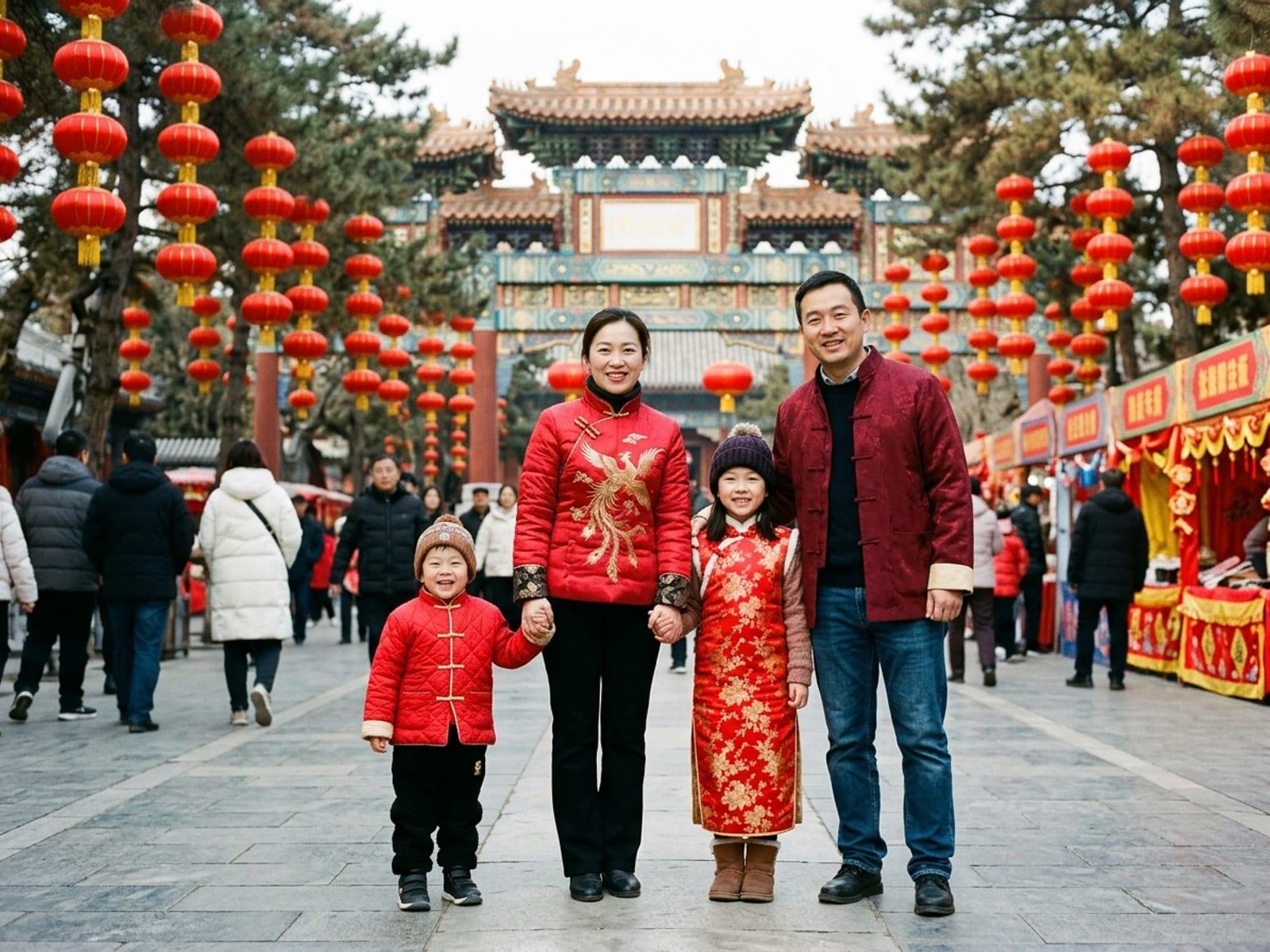
Spring Festival, better known abroad as Chinese New Year, is the biggest holiday of the year in China. It falls on the first day of the lunar year, somewhere between late January and mid-February (February 6 in 2027). In Beijing, red lanterns go up over the temple fairs (miaohui) held in the city's parks, and the whole city slips into holiday mode. It is also when much of the country travels home, so with kids the trick is to book trains, flights and Forbidden City tickets first and plan the rest around them.
It's the first day of the lunar year, so the date moves
Spring Festival falls on the first day of the first month of the traditional lunisolar calendar. Lunar months begin on the day of the new moon, so on the Gregorian calendar the holiday lands somewhere between late January and mid-February. In 2026 it fell on February 17; in 2027 it will be February 6. Because lunar dates can differ by a day depending on the time zone used for the calculation, go by the Chinese calendar when you check the date.
The night before is Chuxi, New Year's Eve, when families gather for a reunion dinner. In the north, Beijing included, many households make dumplings together, and children receive hongbao, red envelopes of money, from their elders. Doors are framed with chunlian, couplets written on red paper, and the character fu (good fortune) is often hung upside down. "Upside down" (dao) sounds like "arrived," so the pun means good fortune has arrived.
The festive mood lasts until the Lantern Festival on the 15th day of the first lunar month. In 2027 that's February 20, when people hang lanterns and eat yuanxiao, sweet glutinous rice balls.
In Beijing, the temple fairs are the highlight
The easiest way for visitors to soak up the New Year atmosphere is at a park temple fair. Ditan Park and Longtan Park host Beijing's best-known ones. In 2026 both ran from the first to the seventh day of the lunar year (February 17–23), 8:30 a.m. to 5 p.m., with admission at 30 yuan. Ditan's fair re-enacts the rite in which emperors once made offerings to the god of the earth, while Longtan Lake has parades and displays built around new technology.
Stalls sell tanghulu (candied fruit on a stick) and lamb skewers, and craftspeople demonstrate paper cutting and mianren, figures sculpted from colored dough. Much of it is fun for children just to watch. Themes, dates and ticketing are different every year, and Beijing's official announcements have the details for your visit.
Don't expect firecrackers in central Beijing, though. A city regulation bans fireworks and firecrackers inside the Fifth Ring Road. If you were picturing a New Year full of bangs, it may feel quiet, but with small children the lack of noise can make the fairs easier to enjoy.
Wear tangzhuang for the holiday; kids' sizes are easy to find
The classic New Year outfit is the tangzhuang, with its mandarin collar and knotted frog buttons (pankou). In China red stands for celebration and is believed to keep bad luck away, so at New Year you'll see red on adults and children alike. A padded red Chinese-style dress for girls and a red or navy tangzhuang jacket for boys are the usual choices.
Beijing winters are harsh, and in January and February it's not unusual for daytime temperatures to stay below freezing. Most tangzhuang are cut as outer jackets, so put thermal layers underneath, keep a coat on outdoors and take it off only for photos. Children's tangzhuang are easy to order online, and Beijing's markets and souvenir shops fill up with them in the weeks before the holiday.
Red is the festive color, but head-to-toe white can be associated with mourning in China. It's best avoided when visiting people at New Year or going to a temple fair.
With kids, plan around Chunyun and advance reservations
The roughly 40 days around Spring Festival are known as Chunyun, the season when the country travels home. For 2026, officials reported 9.4 billion inter-regional trips between February 2 and March 13. Domestic trains and flights sell out early, so if you plan to visit other cities as well, lock in that transport first. If the same winter trip includes the Harbin Ice and Snow Festival, with its ice castles lit up at night, book the high-speed train from Beijing at the same time.
From New Year's Eve, neighborhood restaurants and small shops may close for several days. Hotel restaurants and large shopping centers usually stay open, so make sure you can feed the kids close to where you're staying. For a festive round-table meal out, Peking duck at Quanjude or Bianyifang is a good candidate; check with the restaurant which days it opens over the holiday.
A growing number of sights require reservations. The Palace Museum (the Forbidden City) takes advance bookings under your real name only; foreign visitors book with their passport number. It's normally closed on Mondays but stays open over the Spring Festival public holiday. Tickets are released on the official website and official mini program at 8 p.m. seven days ahead. Admission is 60 yuan in peak season and 40 yuan in low season, and in winter the gates open at 8:30 a.m. with last entry at 3:30 p.m., earlier than in summer. Tickets go fast over the holiday, so once your dates are fixed, put the release day in your calendar.
Temple fairs are usually a little calmer in the morning. A stroller can get stuck in the crowds, so bring a baby carrier as well.
Beijing's two airports, visa-free entry and holiday fares
Spring Festival falls between late January and mid-February (February 6 in 2027), and the temple fairs usually run for about a week from the first day of the lunar year. Beijing has two international airports, Capital International (PEK) and Daxing International (PKX), and airport subway lines connect both to the city.
Visa and entry requirements depend on your nationality or region. China has widened visa-free entry to more countries and longer stays in recent years, but many of these measures are temporary and the details change often. If you're going for Spring Festival 2027, confirm the current rules through your own government's official information and the nearest Chinese embassy or consulate, and read your government's travel advice on safety before you leave.
Flights and hotels tend to cost more around Spring Festival. The dates are known years in advance, so booking as soon as your plans are firm leaves you more options. If you want a day out of the city during the holiday, the Great Wall at Mutianyu, with its cable car up and toboggan down, stays open in winter, but it closes early at 5:30 p.m. and snow or ice can shut parts of it.
A family photo under the red lanterns is one of the pleasures of New Year in Beijing, and pokesta's AI family photos ($1 per photo) let you try the tangzhuang look before the trip.
References