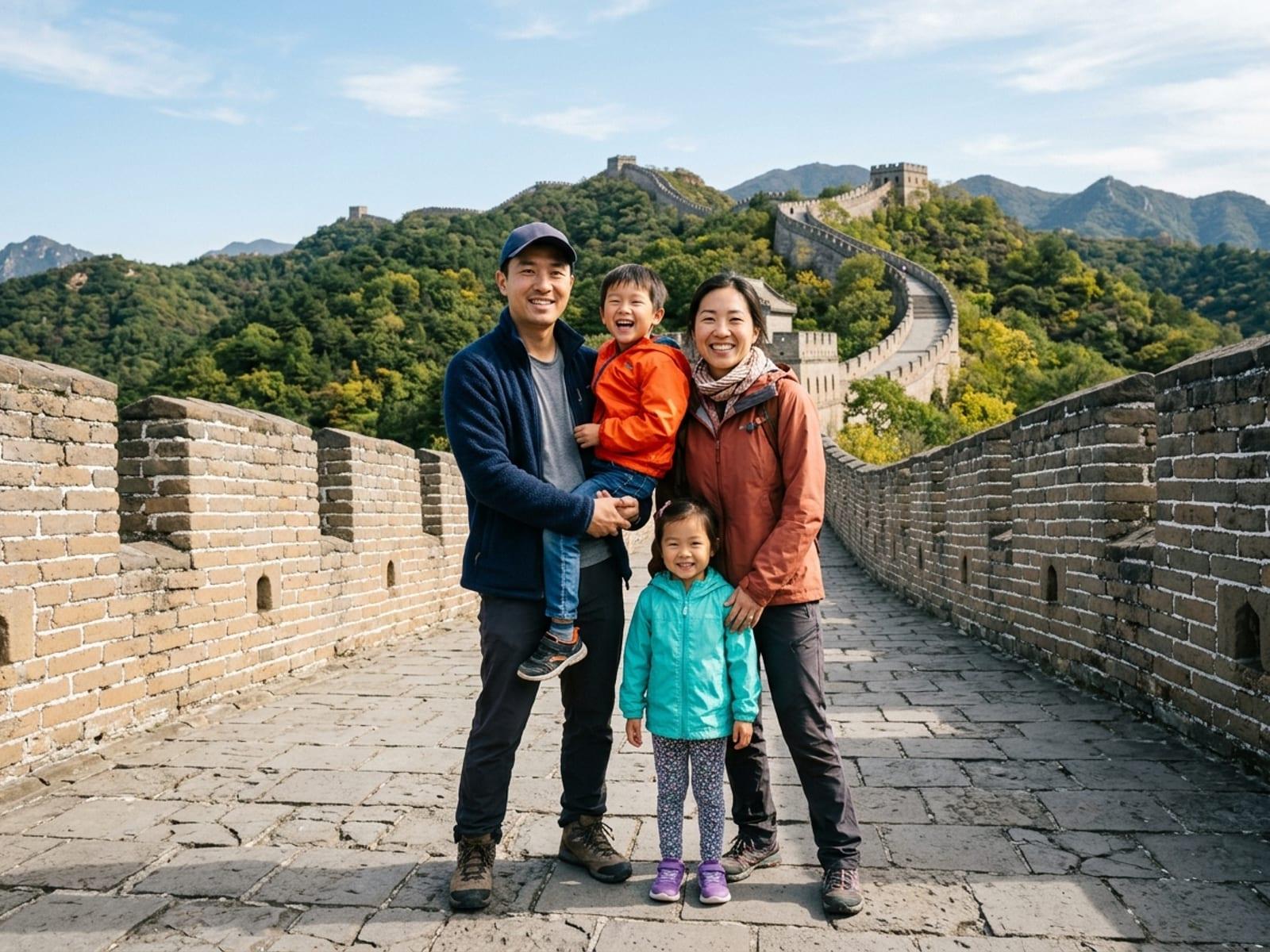
If you are visiting the Great Wall from Beijing with children, Mutianyu should be near the top of your list. It is in Huairou District, about 70 km northeast of the city center. Here a Ming-dynasty wall runs for 2.25 km along forested mountain ridges, with 22 watchtowers. You can ride a cable car or chairlift from the foot of the mountain up to the wall, and on the way back you have the option of sliding down a metal track on a toboggan. Tickets are booked in advance under your real name, so have your passport number ready and book before you set off.
A Ming wall built on top of a Northern Qi one
The first wall at Mutianyu was built in the mid-6th century, under the Northern Qi dynasty. What stands today was built on top of that older wall during the Ming dynasty: a pass was established here in 1404, and the wall was rebuilt in 1569. The year before, in 1568, the celebrated general Qi Jiguang had been sent to strengthen the defenses of the area, and he recommended adding buttress walls to the fortifications.
The wall at Mutianyu is built mainly of granite. It stands 7 to 8.5 meters high, and the walkway along the top is 4 to 5 meters wide. What sets it apart is that crenellated parapets with firing holes line both the inner and outer sides of the wall. That is unusual on other sections of the Great Wall and gives Mutianyu its distinctive look. More than 90 percent of the surrounding mountains are forested, so in spring green and in autumn color, the gray wall stands out sharply against the hillsides.
This section was restored with national approval in 1983 and has been open to all visitors since 1988. The Great Wall was inscribed as a UNESCO World Heritage Site in 1987.
Cable car, chairlift or toboggan
You can walk from the base up to the wall on roughly 4,000 steps, but with children, riding up is the realistic choice. There are two ways up: a four-person cable car (lanche in Chinese) and a two-person chairlift. According to the official website, the cable car's upper station is at 640 meters above sea level, near Tower 14 in the middle of the section.
For the way down, the single-rider toboggan on a metal track (huadao) is popular. However, the cable car and the chairlift-and-toboggan are run by different companies, and their tickets are not interchangeable. The official website says that visitors who book the chairlift and toboggan enter through the toboggan ticket gate. Decide which ride you'll take up and which down before you book, and there will be no confusion on the day. Check the age and height requirements for the toboggan on the official website or the booking page before you go. With small children, taking the cable car both ways is the easy option.
The official safety notes also point out that the cable car doors open and close automatically, so don't try to close them by hand once inside, and don't walk around in the cabin or put your head or arms out of the window.
Real-name tickets, and 1.2 meters is the price line
Admission tickets for Mutianyu are booked in advance under your real name, up to 30 days ahead. Foreign visitors book with their passport and show the original at the entrance on the day. Each ID can be used to book only one ticket per day.
There are set rules for children's prices. According to the official website, children 1.2 meters tall or under ride the shuttle bus at the base and the cable car for free. Over 1.2 meters, they pay the adult price. For admission, Chinese children aged 18 and under enter free, and foreign children aged 6 to 18 who are at least 1.2 meters tall pay a reduced price. Prices and the finer conditions can change, so check the booking page for the latest.
Opening hours in the peak season, from March 16 to November 15, are 7:30 a.m. to 6 p.m. on weekdays and until 6:30 p.m. on weekends. From November 16 to March 15, hours are 8 a.m. to 5:30 p.m. (as checked on the official website in October 2026). In the off-season, ticket sales stop one hour before closing and entry stops 30 minutes before, so leave plenty of time if you plan to arrive late. Part or all of the site may close temporarily in bad weather such as thunderstorms, rain or snow, thick fog or strong winds, so check the notices on the official website on the morning of your visit.
On the wall: no running, no climbing the parapets
The top of the wall is restored stone paving, but it still has steep slopes and stairs with uneven steps. The official safety notes ask visitors not to climb onto the parapets and not to run or horse around. Hold your children's hands, and when taking photos, don't sit or stand them on top of the parapets. Strollers are almost useless on the wall itself, so bring a baby carrier for little ones.
It is windier and cooler on the mountain than in the city. Whatever the season, bring a layer you can add, hats, water and light snacks, so breaks are easy when the kids get tired. There is little shade on the wall, so pack sunscreen in summer. If you limit your walk to a few towers in one direction from the cable car station and back, children up to primary-school age can manage it comfortably.
One way to keep kids going is to count the towers as you walk. Mutianyu has 22 in all and the cable car station is near Tower 14, so guessing "which number is next?" helps on the uphill stretches. The towers also shelter you from the wind, which makes them good places to rest and drink some water.
For the day as a whole, a plan that works well with children is to leave Beijing in the morning, walk the wall before noon, then come down for lunch at the base. The official website also has information on booking food and accommodation at the base. Head back to Beijing early in the afternoon and you'll reach your hotel before the evening traffic and before the kids run out of steam. Book a table for Peking duck, carved at the table in front of you, and the day on the wall ends with a feast.
For a family photo with the wall snaking along the forested ridges behind you, pokesta's AI photos ($1 per photo, first one free) can make one before the trip, which also gives kids a picture of where they're going.
Getting there and when to go
The main airport is Beijing Capital International Airport (PEK). Mutianyu is about 70 km from central Beijing, so with children the simplest option is a tour or a private car there and back. You can also go by public transport; check the transport information on the official website for current routes. The best way to avoid crowds is to set off so that you arrive first thing on a weekday morning.
The most comfortable seasons for walking are early summer, when the hills are deep green, and autumn, when the leaves turn. Winters are bitterly cold, and parts may close because of snow or ice. Around Chinese New Year you can fit Mutianyu into the same trip as Spring Festival in Beijing and its park temple fairs, as long as you allow for the earlier winter closing time. Entry requirements for China depend on your nationality, so check your own government's official information before you travel.
References