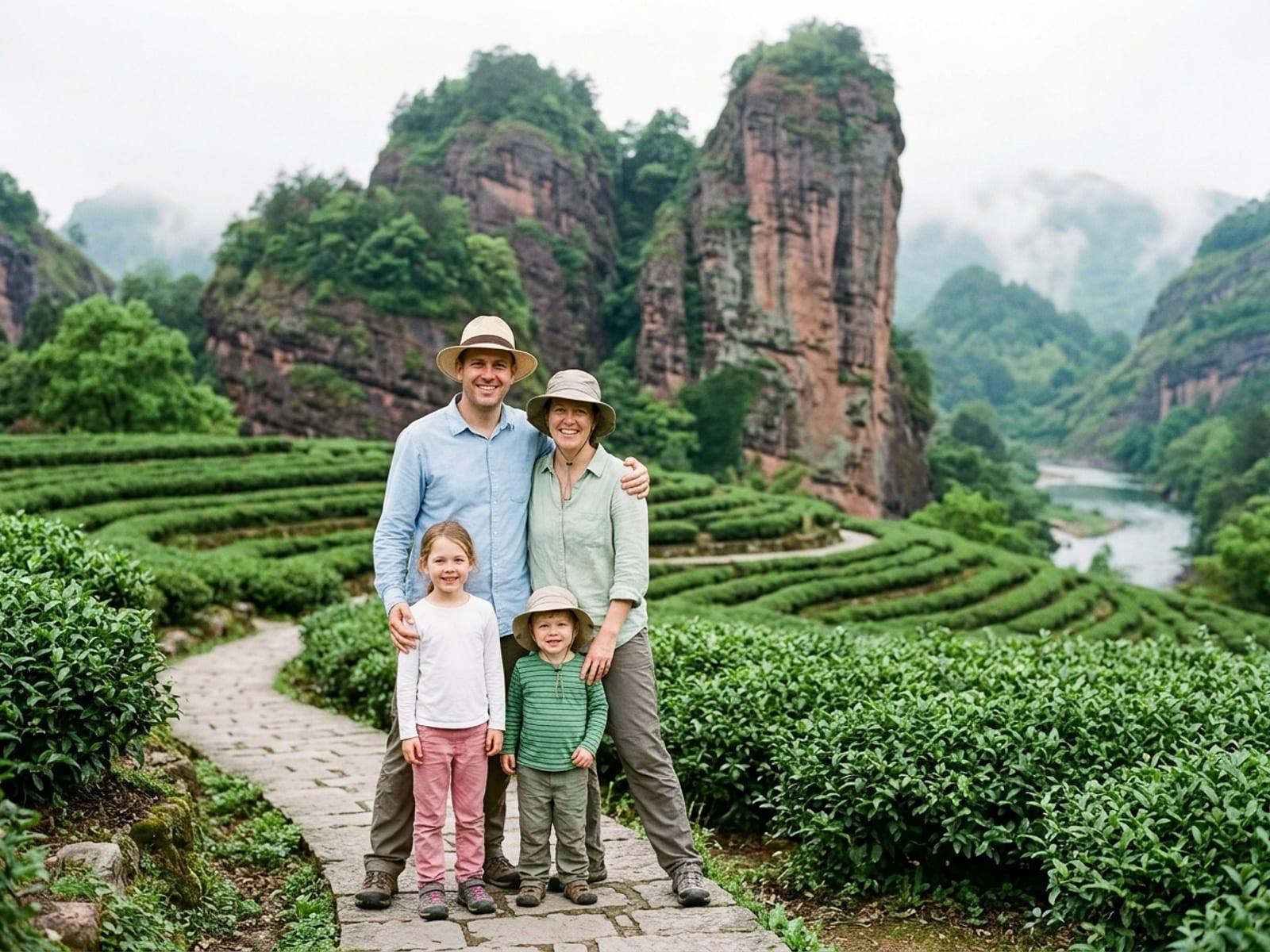
At the foot of sheer reddish-brown cliffs, small tea gardens walled in with stone are tucked into hollows and cracks in the rock. Mount Wuyi, in the north of Fujian province, is the home of Wuyi rock tea (yancha), a richly aromatic oolong. The mountains were inscribed as a UNESCO World Heritage Site in 1999, and they're also known for bamboo raft trips that drift downstream beneath strangely shaped peaks. If you're going for the tea, it pays to know when the leaves are picked and which teas grow where; the paths you walk and the cups you drink will look different for it.
"Where there is rock, there is tea"
The Wuyi Mountains run along the northern edge of Fujian, on the border with Jiangxi. The highest peak, Huanggang Shan, stands 2,158 meters tall. Humidity sits at 80 to 85 percent, it rains a lot and mist often settles in the valleys. That dampness, together with the rocky terrain, is what shaped the local tea.
There's almost no flat land among Wuyi's steep crags to lay out proper fields. So people planted tea in hollows and crevices in the rock, and on small terraces built up with stacked stones. A local saying, yan yan you cha, fei yan bu cha, "every rock has tea, and without rock there is no tea," is where the name rock tea comes from.
Wuyi rock tea is an oolong counted among China's ten famous teas. In the Tang dynasty the writer Sun Qiao called it "Marquis of Late Sweetness," and in the Yuan dynasty the court set up an imperial tea garden at Wuyi to manage tribute tea. At the end of the 17th century it was shipped to the West from Xiamen and became known as "Bohea," after the southern Fujian pronunciation of Wuyi.
Within the growing area, tea from the rocky core of the mountains is called zhengyan ("true rock"), tea from the surrounding rocky slopes banyan ("half rock"), and tea from flat land or riverside fields zhoucha. Zhengyan is the most prized.
The Da Hong Pao mother trees and the four famous bushes
The most famous Wuyi rock tea is Da Hong Pao, "Big Red Robe." The legend behind the name goes like this. A scholar traveling to the capital for the imperial examinations fell ill on the way, was nursed back to health by a monk at Tianxin Temple who gave him Wuyi tea, and went on to take first place in the exam. Later he cured the emperor's illness with the same tea and was rewarded with a red robe. The emperor ordered red robes to be draped over the tea bushes too, and they've been called Da Hong Pao ever since.
Only six old bushes, known as the Da Hong Pao "mother trees," survive on a cliff at Jiulongke. The city of Wuyishan insured them for 100 million yuan and banned anyone from picking them privately. There's also a record of 20 grams of tea from the mother trees selling at auction for 208,000 yuan in 2005. Nearly all the Da Hong Pao on the market today comes from bushes propagated from the mother trees, and costs far less.
That's useful to remember when you buy tea to take home. Anything sold as "mother tree Da Hong Pao" is almost certainly not the real thing. Rather than going by the price tag, ask the shop whether it's zhengyan or banyan, which cultivar it is and when it was roasted, and have them brew you a cup before you choose. Rock tea can be steeped many times from the same leaves, so compare how the aroma changes between the first and third infusions and you'll soon find what you like. Small vacuum-sealed packs are the easiest to carry. Some countries restrict bringing in tea leaves, so check the rules for wherever you're headed after the trip.
Together with Da Hong Pao, Tieluohan, Baijiguan and Shuijingui make up the "four famous bushes." There are many other cultivars too, named for the shape of the bush or leaf or for their aroma, like Rougui, whose scent is often compared to cinnamon.
Picking in May and June, and how the tea is made
Da Hong Pao is picked once a year, usually from May into June, taking a bud with two or three leaves. The leaves are wilted in sun and wind, cooled indoors, then shaken and tossed on bamboo trays to move oxidation along. This stage, called zuoqing, takes the most time and skill. The leaves are then pan-fired to stop oxidation, rolled into twisted shapes, and finally roasted for hours at changing temperatures. That toasty roast is one of the defining traits of Wuyi rock tea.
In picking season you may see people at work among the bushes. Tea gardens are farmers' and tea makers' workplaces, so don't wander in or pick leaves; enjoy them from the marked walking paths.
Down Nine-Bend Stream on a bamboo raft
The most popular thing to do at Mount Wuyi is the bamboo raft trip down Nine-Bend Stream (Jiuqu Xi). The stream is about 60 km long and, true to its name, winds in big loops between the crags, running past Xingcun through the scenic area and joining the Chongyang Stream near Wuyi Palace. Bamboo rafts are said to have carried sightseers on it for more than a thousand years. You can also ride bamboo rafts on Guilin's Li River, the scene on the 20-yuan note, but Nine-Bend Stream is narrower, and its reddish-brown cliffs rise right above your head.
The raft drifts slowly beneath peaks rising on either bank. Gliding along just above the water is the sort of thing children remember for a long time. Follow the raftsmen's and staff's instructions when boarding, and have small children sit held firmly on an adult's lap. There's no shade on the water, so bring hats and sunscreen.
Walking tea country with children
The paths to the tea gardens and the mother trees are mostly stone steps and narrow mountain trails. Leave the stroller behind in favor of a baby carrier, and wear sneakers with good grip. It rains often here, so carry a compact rain jacket for everyone.
At tea shops, tasting is done in tiny cups over many infusions, which is half the fun of rock tea. Oolong contains caffeine, though, so let children enjoy the aroma rather than drinking much. Just looking at the leaves and watching the water being poured is plenty to keep them interested.
To see how a family photo against the crags and tea bushes might look, you can try pokesta's AI photos ($1 per photo). If you want cups to match your rock tea, the trip can continue into Jiangxi to Jingdezhen, the porcelain town where you can pick out blue-and-white.
When to go and getting there: high-speed rail from Fuzhou
To see picking in progress, go in May or June. The timing shifts from year to year, so treat that as a rough guide. For the scenery alone, any time of year works.
Wuyishan has its own airport, but if you're flying in internationally, Fuzhou Changle International Airport (FOC), serving the provincial capital, is the most convenient. From Fuzhou, the Hefei–Fuzhou high-speed railway, opened in 2015, runs to Wuyishan North station. Entry requirements for China depend on your nationality, so check your own government's official information before you leave.
References